
Why Did a Novice Monk Attain Enlightenment After Watching a Man Dig a Ditch?
A novice monk saw men channeling water, straightening arrows, and carving wood, and was inspired to gather his mind, resolve to practice, and attain enlightenment. The lesson: when we practice with sincerity, the Buddha always supports us.
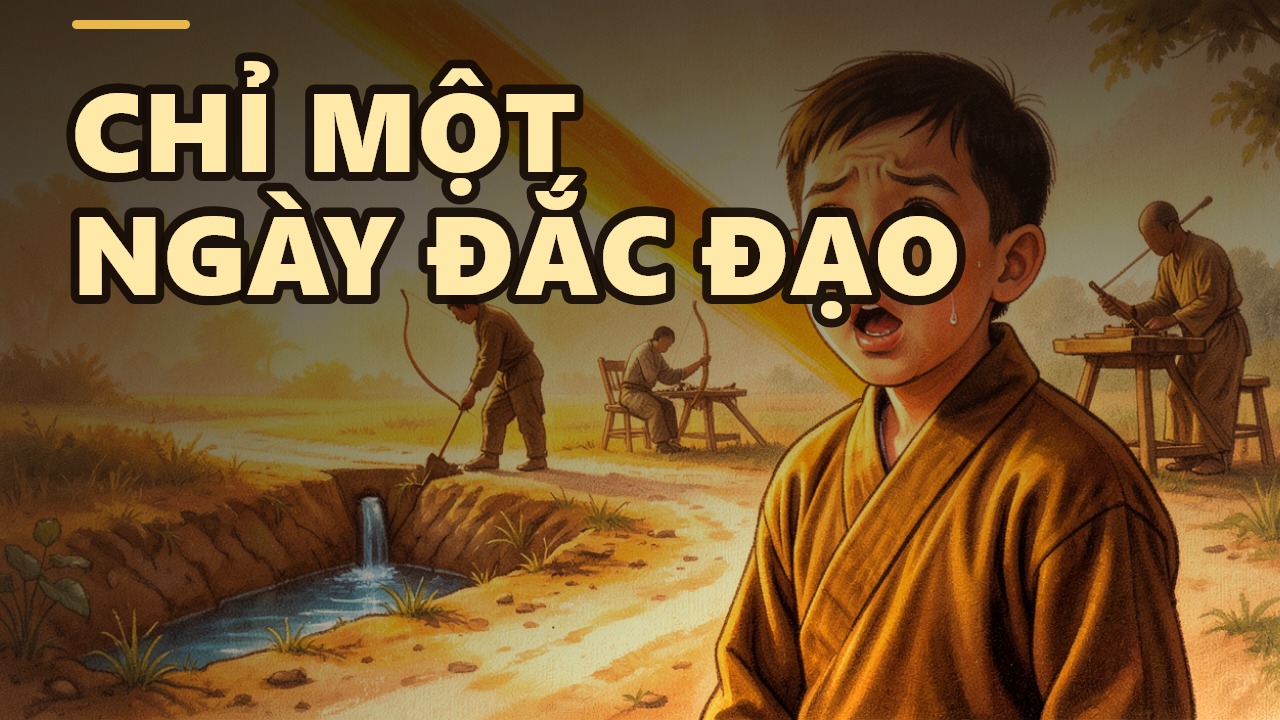
That morning, the young novice monk followed his teacher, Sariputta, into the city on alms rounds. Along the quiet road, he came upon three scenes: a man digging a ditch to channel water, a man straightening arrows for a bow, and a carpenter carving wood. It was no coincidence that these images stirred in him a fierce determination... This is the story that Master Thích Chân Quang told in his lecture on the Dhammapada, number thirty-one, titled "Channeling Water, Carving Wood."
When Images Awaken the Mind
In the Dhammapada, the Buddha taught:
"The wise channel water. Arrow makers straighten the shaft. Carvers shape wood. The wise tame their own mind."
The Buddha spoke this verse in praise of the novice monk. From the simple tasks of everyday life, the novice had drawn a connection to gathering the mind, and from that arose a fierce resolve: he must master his own mind just as people master water, arrows, and wood.
We, too, often encounter such "conditions" in daily life. A drifting cloud, a flowing stream, or even a tree can become a living dharma teaching if our heart is sensitive enough. But why can we not transform ourselves? Because our mind has not yet truly turned toward the path.
Our Associations Reflect Our Karmic Consciousness
Master Thích Chân Quang emphasizes that every association we make carries the imprint of our karmic consciousness:
"Whatever is in our mind, we will associate with that. Whatever karma we carry, we will associate with that."
If a person sees a tiger and thinks of strength and majesty, or thinks of tiger bone wine, or thinks of tiger meat... each way of thinking reveals a hidden layer of the psyche. The Master told of a teacher who gave his student the line "The rain has no chains, yet it holds the guest" to match. One student replied: "Beauty is not a storm, yet it drowns the person." The teacher immediately predicted: this boy would pass the imperial examination as top scholar, but he would die because of a woman. And so it came to pass. Because deep in his consciousness, he had "associated with sensual beauty" rather than with anything noble.
So pay attention to your own associations. They are a mirror reflecting your inner world. When we contemplate them, we can recognize what is truly governing us.
Enlightenment Cannot Be Rushed
The novice monk's conditions ripened fully in a single day. But the Buddha extended time itself so the boy could sit for a full six hours. This was a display of supernatural power, yet the Buddha only used it when truly necessary. Meanwhile, many people practice with lukewarm enthusiasm and do not attain enlightenment, because that lukewarmness is not the final condition.
The Master taught: "Never force yourself to attain enlightenment within this lifetime or within this year. Enlightenment is a fruit that ripens in its own time. When it is ripe, it will fall. Our task is simply to keep planting, keep tending, weeding, watering, and fertilizing."
Every day, when we keep the precepts, help others, and diligently practice meditative concentration, we are planting seeds. Do not be impatient. Simply follow the Buddha's teachings faithfully, and when the season comes, the fruit will arrive on its own. What we must do is remain diligent in every day and every hour.
When We Practice with Sincerity, the Buddha Will Support Us
In the story, the moment the novice monk resolved to practice, the Buddha knew it and used his supernatural power to help. Master Thích Chân Quang affirms:
"None of us who practice with true sincerity is ever alone. Only false practice can leave us alone."
When we practice wholeheartedly, the Buddhas and bodhisattvas always watch over and protect us. Sometimes when we forget our meditation hour, someone naturally reminds us. When an unwholesome thought arises, something appears to wake us up. We may not see the Buddha, but his love always surrounds us. Like a father's love for his child, that love has no form, yet it is always present.
Praise and Blame: The Measure of Spiritual Strength
The lecture also opens another lesson on remaining calm in the face of praise and blame. There was an elder named Badiya who, though enlightened, appeared completely ordinary. People who did not know him would tease and scold him, yet he always remained cheerful. The Buddha taught:
"Like a solid boulder unmoved by any wind, so the wise remain unperturbed amid praise and blame."
Spiritual strength is measured when we meet praise and blame. If we live in a way that draws neither praise nor blame, we will never know how far we have come. Therefore, we should treat praise and blame as opportunities to examine ourselves and to practice. When we hear praise, we check whether we feel delighted. When we hear blame, we check whether we feel angry. If we are not yet at ease, we must train ourselves to remain calm even before attaining enlightenment, because when our mind is disturbed, we will trouble others.
The Master put it wittily: if someone praises the beauty of the shirt we wear and we keep wearing it without ever changing, or praises our graceful walk and we keep pacing back and forth, we will annoy the neighbors. Blame works the same way: if we ask everyone we meet, "Am I being harsh?" then everyone will avoid us. So training ourselves to remain calm before praise and blame is the duty of a practitioner living in this world.
We may not yet have attained enlightenment, but let us begin with the smallest things. Observe your own mind and guide it toward wholesome states. Let your mind be shaped and carved a little each day. When the fruit is ripe, the season will come. For when we walk the path with true sincerity, the Buddhas will never abandon us. Believe this, and practice diligently, love others, and live for everyone. Do not despair, and always remember: we are never alone.
AI-assisted translation from the Vietnamese original.
Read in Vietnamese →