
The Joy of the Noble, the Joy of the Ordinary: Which Kind of Happiness Are You Choosing?
Distinguishing between the joy of ordinary people and that of the noble ones, so we can recognize what true happiness really is. A profound dharma talk by Venerable Thích Chân Quang.
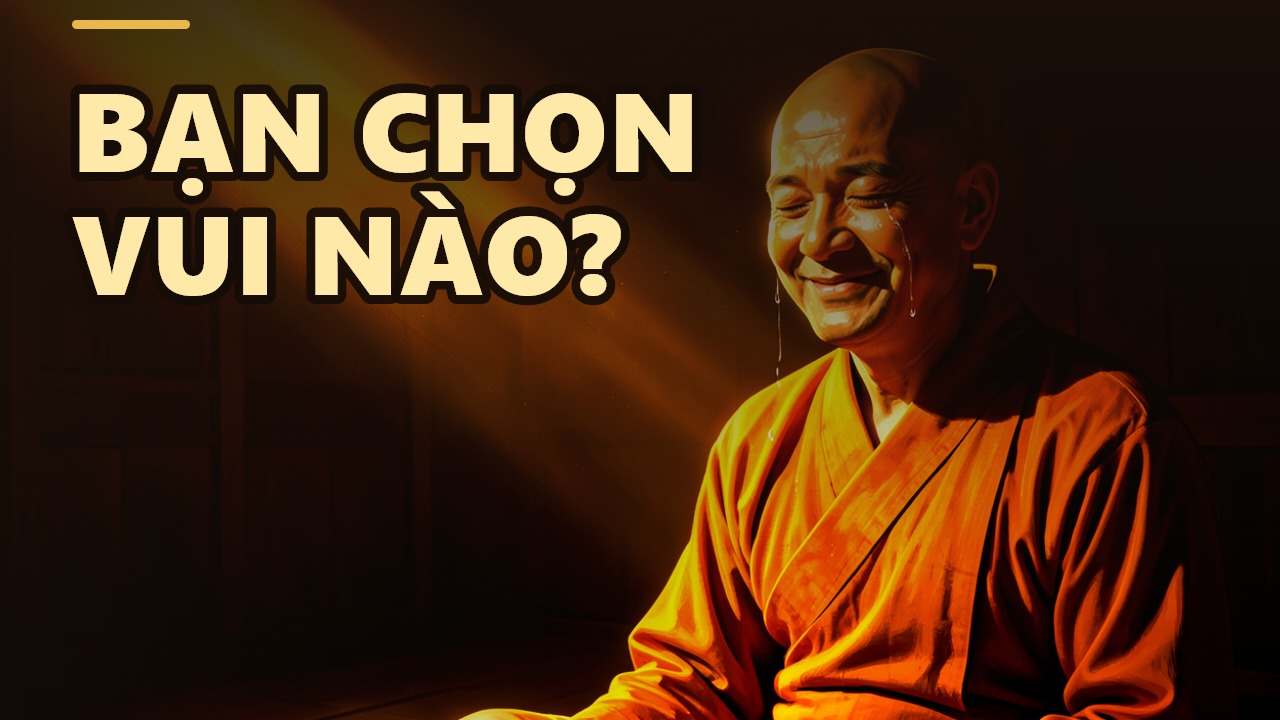
Have you ever wondered why some joys leave our mind restless and agitated, while other joys bring true peace and contentment? Today, let us distinguish between these two kinds of joy, so that we may choose for ourselves a lasting happiness.
Two Kinds of Joy: Excitement and True Contentment
When someone boasts, "I just gave them a good scolding and a few slaps across the face. What a thrill!" — that is the joy of ordinary people. Why? Because it makes the mind restless and arrogant, and it creates more karma. But consider someone who says, "Earlier I was scolded, but I tried my best to endure it and kept apologizing. Eventually the old man's anger subsided, and when I came home, I felt happy." That is the joy of the noble — the joy of one who knows how to practice.
The latter joy is the joy of the noble. It is the joy of one who knows how to practice. In our tradition, that kind of joy is called true contentment.
Both are joys, but one leads us down into the depths of suffering (dukkha), while the other lifts us up in peace and merit. In this world, these two joys exist side by side. If we choose wrongly and step into the joy of ordinary people, our mind becomes restless and we keep creating more karma. If we choose rightly, we reap true contentment and dissolve the sense of self.
When Building a House: "This Belongs to the Buddha"
Some people are so overjoyed at buying their first home that they cannot sleep, touching every wall and saying, "This is mine!" But when building the Bảo Quang meditation hall, Venerable Thích Chân Quang thought differently. He did not say "mine," but rather:
This house belongs to the Buddha. This house belongs to the Buddha.
Why so? Without the Buddha's teachings (Dharma), without the Buddha's disciples, without the religious community, how could this temple exist? Without the devotees who generously donated, how could this facility have been built? When one thinks in this way, joy becomes serene and free from attachment. That is the joy of the noble — absolute contentment.
The Temple as Home — A Place Where Everyone Is Loved
During the construction, one principle was placed above all: whoever comes to the temple must be fed, must be able to rest, and must be cared for attentively. As the Venerable taught:
Whoever comes to the temple must be loved and must be fed.
Because of this, when people come to the temple, they feel it is like a warm home, like their homeland. There are restrooms, places to eat, and warm hospitality — these are the things that make people feel safe and want to stay and practice. When we act in this way, we are practicing the compassion that the Buddha taught.
Do Not Cling to Your Merit: The Wisdom of the Bodhisattva
When we accomplish something great, we easily fall into clinging to our merit: "It was thanks to my offering, thanks to my money, that this meditation hall exists." Clinging to merit is the root of ignorance, buried deep in the subconscious. Faced with an act of merit, people tend to reward themselves. But the wisdom of the bodhisattva is to brush that merit away, to forget it, recognizing that everything arises from conditions (dependent origination), from the Buddha, and from the efforts of many.
Only very lofty wisdom can destroy the clinging to merit.
Like a large tree, one can dig up its roots and replant it elsewhere. But the root of clinging to merit is very hard to uproot — no one can see how deep it goes. That is why, in the Mahayana scriptures, the Buddha always taught about emptiness, so that we would not cling to our merit.
Poverty as the Happiness of the Noble Ones
We often think that wealth brings happiness. But the noble ones actually prefer poverty. Why? Because ordinary people want much, and having little makes them suffer. The noble ones have eliminated wanting, so they always feel they have enough.
We ordinary people fear poverty and crave riches, but a noble one actually delights in poverty.
Venerable Thích Chan Quang once said, "I am the poorest person in the world, because I still want so much." That is a view full of humility. And indeed, poverty can be a form of happiness, because it teaches us contentment, simple living, and freedom from dependence on material things.
Boundless Love Is the Joy of the Noble
When our love is limited to only a few people, we are still ordinary. But when we extend our love to thousands, to countless sentient beings, that is the joy of the noble. In the midst of a crowded festival, we can love everyone present, with an energy that is deeply moving and profound. And when we leave, we carry that flame of love with us to illuminate our daily lives.
Whoever comes to the temple must be loved and must be fed.
Let us practice starting with the smallest things in daily life: when scolded, gently apologize; when we have money, share more generously with others; when building a house, think of the common good. That is how we choose the joy of the noble, so that our mind grows in contentment and our merit deepens day by day.
Today, between heaven and earth, in the homeland of Củ Chi, a meditation hall has risen like a place of love. It is the seed of compassion beginning to sprout. And if you are searching for true happiness, try stepping onto the path of true contentment — where there is no more clinging to self, only the joy of sharing, and boundless love.
AI-assisted translation from the Vietnamese original.
Read in Vietnamese →