
Let Us Come Together: Vu Lan Opens the Door of Love and Gratitude
Vu Lan is not merely a day of filial devotion. Through the door of filial piety, we step into a world of love and gratitude — where liberation means living carefully within the bonds of love and duty.
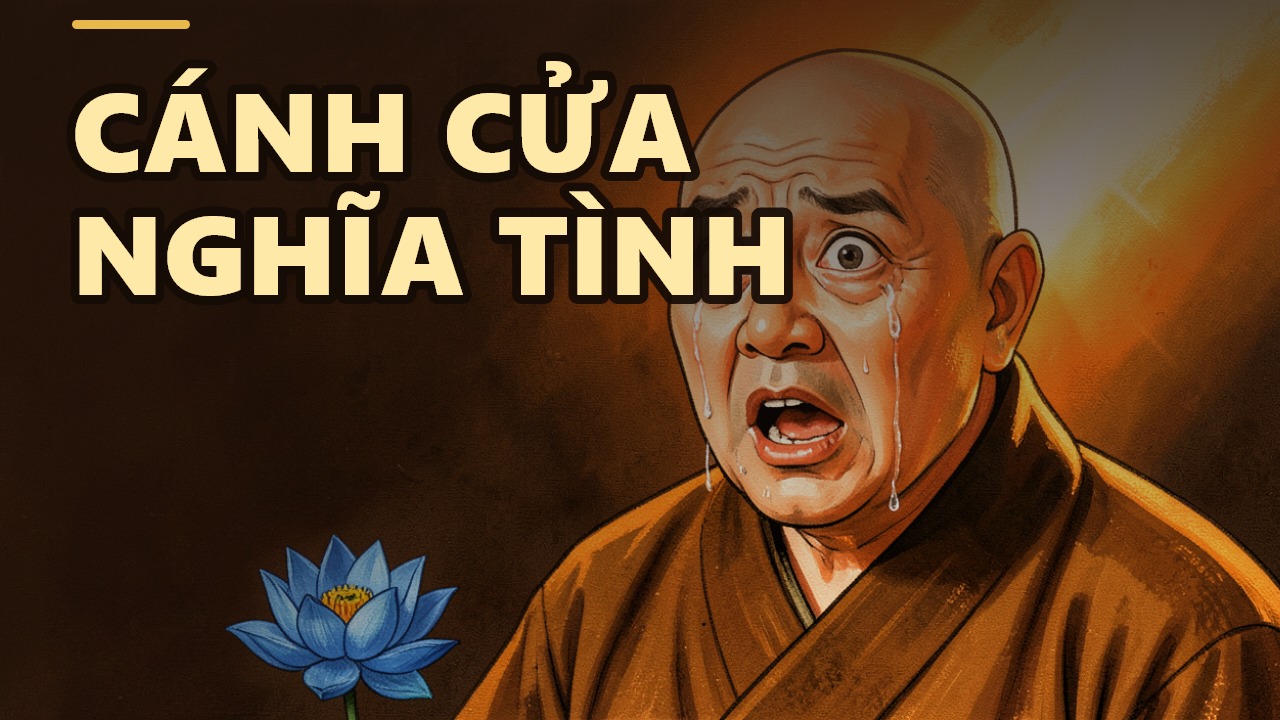
When the seventh month arrives, roses once again bloom across social media and on the chests of devoted children. Each Vu Lan season, we remind ourselves to remember our parents' kindness — the kindness of those who gave us life and raised us. But have you ever asked yourself: is Vu Lan only a day of filial love?
In the dharma talk "Let Us Come Together," Thầy Thích Chân Quang revealed a truly profound meaning of the Vu Lan festival: it is not merely a day of repaying our parents, but a door opening into an entire world of living with love and gratitude, where each person comes toward one another and, through that, touches true liberation.
Vu Lan — The Door of Filial Love, But Not the Whole
Thầy Chân Quang began his talk with a surprising observation: Buddhism is a path of enlightenment and liberation, and all its teachings point toward that goal. Yet during the Vu Lan festival, we hear little mention of lofty teachings; instead, we speak of the most fundamental human virtue: filial love.
"In this Vu Lan festival, we hear little mention of liberation or enlightenment... instead, we hear of a fundamental human virtue, which is filial love."
You might think that filial love is the entirety of morality. But Thầy explains that filial love is only the foundation, the door that opens outward. If we stand forever at the doorway, we see only filial love, without ever entering the vast world of love and gratitude that lies beyond. That is a far greater realm, where each of us must live so as to fulfill our bonds of love and duty toward others, toward all sentient beings.
The Path to Enlightenment — Winding and Deeply Interdependent
On the journey of practice, we often grow weary from wandering without finding the way out. Thầy Chân Quang explains that the path to the shore of enlightenment is not a straight road; it winds so much that it is easy to lose our way. One misstep can carry us a thousand miles further astray.
"The path from where we stand to the shore of enlightenment is winding. That is why we so often lose our way."
For this reason, we need wise teachers and spiritual friends to guide us. In this life, no one can practice alone, walking without needing others. What matters most is knowing how to come together — to lean on one another, to remind one another of that distant destination toward which we are heading.
Reverence — The Mountain That Makes a Soul Vast
Thầy Chân Quang offers a beautiful image: the human soul is like a landscape. If it contains only green meadows, a flowing stream, and resting deer, it would be utterly bland. For the landscape to become majestic, there must be towering mountains. And within the soul, that mountain is reverence.
"The human soul is like a landscape... it would be shallow and ordinary without the feeling of reverence appearing within it."
Many people know only how to love, hate, like, and grow tired of others, but have never known how to revere anyone. Such a soul remains very small. The first thing a saint must build is absolute reverence for the Buddha, and then for parents, and for those worthy of respect. That reverence is the foundation that makes the soul great, giving it the strength to overcome every obstacle on the path of practice.
Filial Love — The Door Into the World of Love and Gratitude
Yet to revere the Buddha while neglecting reverence for one's parents leaves the soul incomplete. Thầy compares it to a painting with a towering mountain but no gentle stream. Filial love is that stream. And more than that, filial love is the door opening into an entire world of love and duty that we must enter:
"Filial love is only the door. Only after passing through this door can we step into the vast world of human morality — the way of being human, a life filled with love and gratitude."
For Thầy, living with love and gratitude is not only filial devotion, but also knowing how to be thankful, to care, and to treat everyone around us with affection and loyalty. A person of love and duty does not live only for themselves, and does not allow excessive freedom to wound others. And according to Thầy, only one who lives with love and gratitude is truly walking the path of the Buddha.
Living with Love and Gratitude — The Measure Between Saint and Ordinary Person
Many people misunderstand "liberation" as indifference, as thoughtlessness, as having no joy or sorrow, no attachments. They imagine that a practitioner who is cold and indifferent to others possesses the highest wisdom. But Thầy points to a different measure: the more ordinary a person is, the more indifferent and practical they live; the more saintly a person becomes, the more they live filled with love and gratitude.
"The more ordinary a person is, the more indifferent and practical their life becomes."
Thầy tells of Sariputta, foremost in wisdom, who throughout his life remained ever grateful, living with deep affection and deep loyalty. He recalls the story of two teachers and students sharing a persimmon offered by a bird, each breaking off half, brimming with love and devotion. Living with love and gratitude may be demanding, but it is the very quality of the saints. Those who live indifferently will, in time, exhaust their blessings from merit and their conditions (dependent origination) with sentient beings; in future lives, even meeting the Dharma will be difficult — no one will listen to them, no one will feel drawn to them.
Yet many people misunderstand the Heart Sutra's teaching that "form is not different from emptiness," and conclude that everything is "nothing," is "empty." Thầy gently reminds us: the Heart Sutra teaches "emptiness" so that we may "have" everything, so that whatever we do, we have — not so that whatever we do, we have nothing.
Let Us Come Together — Liberation Is Living Carefully Within Love and Duty
Thầy affirms: "The more liberated a person is, the more careful they become in matters of love and duty." We often imagine that a liberated person is one who pays attention to nothing. In truth, the liberated ones love more, feel more gratitude, and are more tender and attentive in how they treat others. We need to look back at our past, to see the times we were indifferent to others and feel remorse — that is the sign of a touch of saintliness beginning to take form.
"To become a saint is to live filled with love and gratitude."
This Vu Lan season, may we remember to pass through the door of filial love and come together in love and gratitude. Every word of care, every gesture of concern, every time we remember someone's kindness — each is a stone in the wall of liberation we are building. Let us come to one another, for living with love and gratitude is the very shore we are searching for.
AI-assisted translation from the Vietnamese original.
Read in Vietnamese →