
Come Together: Vu Lan – The Gateway of Love and Gratitude
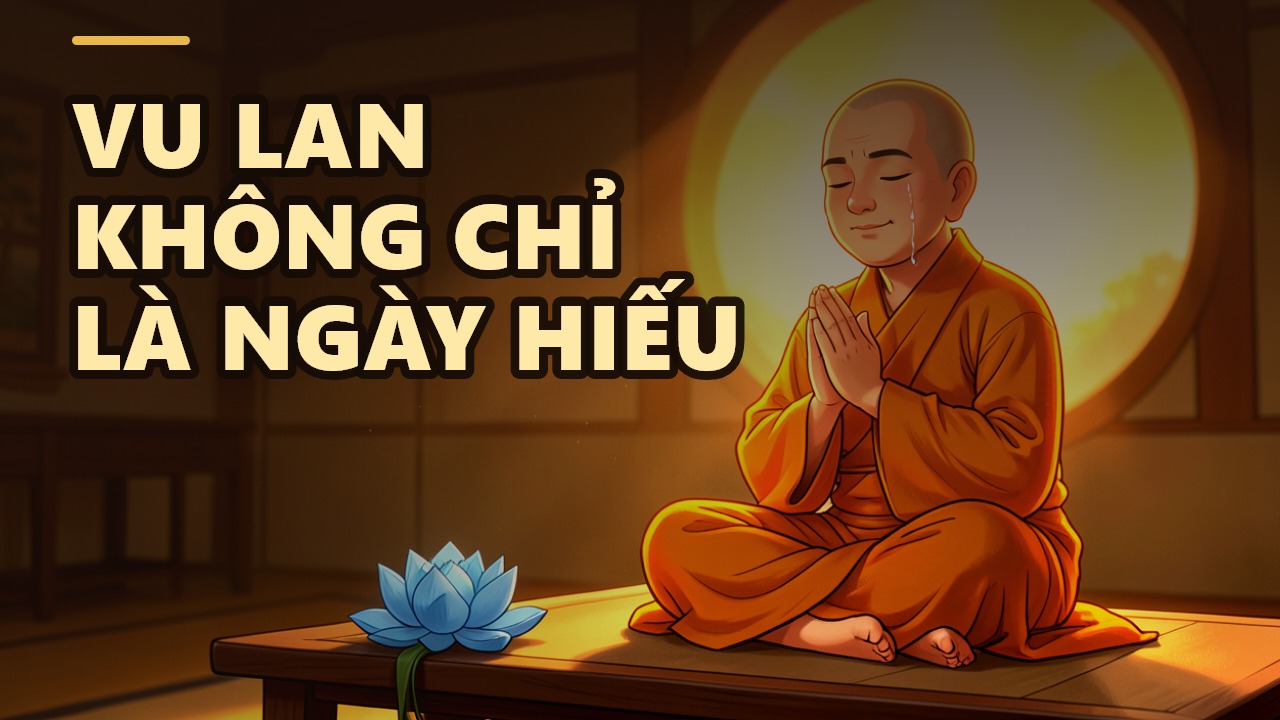
Not merely a day of filial devotion to parents, Vu Lan invites us to step through the gate of filial piety into a vast world of love and gratitude – a world where each person is measured by their devotion and compassion.
Come together. It sounds like an invitation, and at the same time like a deep yearning. When the Vu Lan season arrives, many people immediately think of roses pinned to their chests, and incense sticks lit in remembrance. But is that all there is? Venerable Thich Chan Quang opens a different door: Vu Lan is not only a day of filial devotion, but the foundation for a life of love and gratitude – something that carries us from the shore of filial reverence to the great ocean of liberation.
The Path to Enlightenment – Winding and Easy to Lose
The Buddha's teachings (Dharma) is the way of liberation. But between where we stand and the shore of enlightenment lies an entire journey full of rough terrain. No one can see the destination; there is only faith. The Venerable affirms:
"Only through some stroke of luck, through some auspicious conditions (dependent origination) from many lifetimes, do we come to have faith in enlightenment. The faith that the Buddha attained enlightenment. Now, if we follow the path that he taught, surely we too will arrive."
That path is so winding that a single misstep can lead us astray. That is why we need good spiritual friends, and wise teachers to guide us.
Vu Lan: A Stretch of the Journey of Love and Gratitude
Within that winding journey, there is one remarkable stretch – the stretch of love and gratitude. And Vu Lan is the resting point where we pause and recognize where we are passing through. Vu Lan teaches us filial reverence toward our parents, something the Buddha's teachings (Dharma) makes shine even brighter. The Venerable says:
"On Vu Lan day... the filial piety of the Buddha's teachings (Dharma), the filial piety of Asian culture, is the anchor that holds morality for humanity once again."
In an age when people worship absolute freedom and equality, filial love serves as a point of support. It reminds us to place ourselves humbly beneath our parents, so that we may keep alive our reverence – a precious feeling that makes the beauty of the heart.
Reverence – The Mountain That Lifts the Soul
The Venerable compares the heart to a landscape. If there are only flowers and grass, only a flowing stream, but no majestic mountain ranges, the scenery becomes bland. The heart is the same. The feeling of reverence is the "mountain peak" that lifts a person up. And the one most worthy of reverence is the Buddha himself. The Venerable suggests that reverence for the Buddha is a measure of one's blessings from merit, the force that carries us soaring into the sky of the Buddha's teachings (Dharma). If we do not yet have absolute reverence, we are still on the path of building it, step by step.
Filial Devotion to Parents – The Gentle Stream in the Landscape of the Heart
But a landscape with only high mountains and no water is not yet complete. The Venerable reminds us: "If we only come to the Buddha's teachings (Dharma), only revere the Buddha, and forget our filial devotion to our parents, then our heart is still not perfect." For parents are the ones who gave us life, who loved and nurtured us. There may be exceptions, but a parent's love is boundless.
"A beautiful painting has a high mountain peak, but also a gentle stream flowing around it. Likewise, our heart may hold absolute reverence for the Buddha, but it must also hold filial devotion – devotion to our parents."
Living with Love and Gratitude – The Measure of Saint and Ordinary Person
Vu Lan only opens the gate of filial piety. But the patriarchs left that gate open so we could step into a boundless world – the world of love and gratitude. Gratitude not only toward our parents, but toward everyone. Living with love and gratitude is fundamental morality. The Venerable offers a measure:
"Whoever lives overflowing with love and gratitude, that person is a saint. Whoever lives carelessly and pragmatically, that person is ordinary."
The higher the saint, the more deeply they live in love and gratitude. We see in the scriptures that Sariputta lived carefully with each person, always remembering kindness. Meanwhile, the careless and pragmatic person remains an ordinary being. So let each of us measure ourselves. Looking back at the past, if we see that we were once careless and feel regret, that itself is a step forward.
Do Not Misunderstand "Emptiness, Emptiness, Emptiness" – Live Carefully in Love and Gratitude
The Venerable warns of a dangerous misunderstanding: the idea that practicing the Buddha's way means being indifferent, caring for no one. In truth, liberation means living freely while overflowing with love and gratitude. In the Heart Sutra of Perfect Wisdom, "emptiness" does not mean doing nothing at all.
"The Heart Sutra of Perfect Wisdom says emptiness, emptiness, emptiness, emptiness throughout. Why? So that whatever we do, we do it fully, fully, fully. Only such a person truly understands the Heart Sutra of Perfect Wisdom."
If we misunderstand, we will fall into indifference and lose our conditions (dependent origination) with sentient beings. The result: when we are reborn, it becomes difficult to meet good teachers and true friends, difficult to persuade anyone. Therefore, let us live carefully within love and gratitude.
As the Vu Lan season returns, let us pause for a breath. Look into our own heart: is it a landscape complete with mountains and streams? Let us learn to revere the Buddha, to honor our parents, and to live with love and gratitude toward everyone. This is precisely the path the patriarchs opened – the path of "Come Together" – so that from the gate of filial piety, we may step into the vast world of human love, and of liberation.
AI-assisted translation from the Vietnamese original.
Read in Vietnamese →