
Neither Shore Exists: Transcending All Concepts
A dharma talk on Dhammapada verse 80: There is no this shore or other shore, neither shore exists — a teaching that transcends language, letting go of attachment so the mind shines naturally.
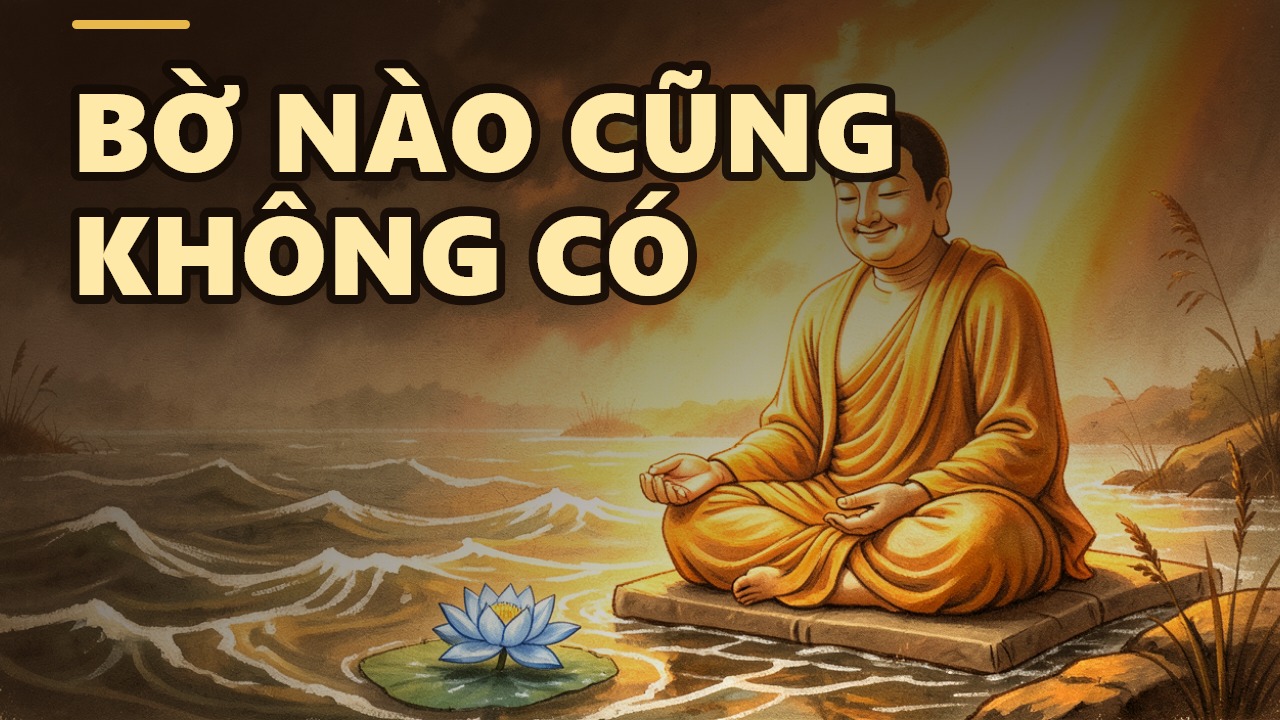
Have you ever wondered: after achieving every goal in life, is there a "far shore" to reach? In the Dhammapada, Mara once asked the Buddha what the "far shore" was. And the Buddha's answer became a profound teaching on liberation: "There is no this shore or other shore; neither shore exists." What lies behind these words? Let us listen to the teaching of Venerable Thich Chan Quang.
The Far Shore — From the Ganges River to the Spiritual Life
In ancient Indian society, crossing the Ganges was an extremely harsh challenge. The vast, powerful currents forced people to use multi-layered bamboo rafts, paddling with tremendous effort. Thus, whoever managed to cross the river was seen as having accomplished a great feat. From this, the phrase "reaching the far shore" became a symbol of completing something difficult.
One who has crossed, free of "it" and "I," has reached the far shore — reaching the far shore and crying out in triumph.
Later, in Buddhist scriptures, "the far shore" came to signify fulfillment, the completion of the path of Dharma. Thay Chan Quang explains:
The word "paramita" carries the meaning of a sacred, sublime Mahayana teaching of the bodhisattva. But originally, it came from those who paddled and poled their rafts across the Ganges.
But do not let words obscure reality. When Mara asked what the "far shore" was, the Buddha immediately rejected the question, because absolute truth does not reside in any concept whatsoever.
The Beautiful Mara — The Fragile Boundary Between Saint and Demon
Many people imagine Mara as a terrifying figure. In reality, however, Mara refers to beings with great blessings from merit, extraordinarily beautiful, yet harboring schemes in their hearts, craving power and rivalry. Thay shares:
Mara is extremely beautiful. Why would a demon be beautiful? Where does beauty come from? From merit — so why does Mara have merit?
Mara may be someone who does a great deal of charity work, yet is shaken by fame and gain. In life, there are countless successful, wealthy, powerful people out there — they too have merit, but if they cannot let go of the ambition to control others, they become Mara. Thay illustrates with a familiar image:
People fight over small positions, with nothing to rise to — a deputy leader scrambling to become the leader.
The boundary between demon and saint is very fragile. Doing the same good deeds, one who knows how to cultivate becomes a saint, while one consumed by rivalry and scheming becomes a demon. And within each of us live both the seeds of the saint and the seeds of the demon. That is why self-examination and transformation are essential.
Neither Shore Exists — A Lesson About Language
Mara asked the Buddha about the "far shore" to set a trap. If the Buddha affirmed that a far shore existed, Mara would argue that the far shore was still a shore, still full of mire just like this one. But the Buddha denied it all:
The Buddha said: O Mara, there is no this shore and no other shore. Only when you are free from suffering (dukkha), when all fetters have ended, do I call you a Brahmin.
This teaching cuts deep into our attachments. Language is merely a means of pointing; it can never fully express the truth. If we cling to words, we become stuck. Thay Chan Quang explains:
Language can never fully express the profound truth. Language only points the way; it can never speak the truth completely. And if we cling to language, we become stuck.
Therefore, liberation does not come from searching for a new "shore," but from letting go of this shore and that shore — letting go of concepts and preconceptions. That is when the mind is free from suffering, free from bondage.
Silence and Mindfulness: Going Beyond Words
Thay tells the story of four monks practicing silence: four people sitting in meditation keeping quiet, but when the lamp went out, one began to chatter, and in the end everyone spoke. The story mirrors our own mind in practice. We use one phrase to suppress another, but never truly bring it all to an end. Thay teaches:
At first, we truly do rely on language to understand the truth. But as understanding deepens, the real truth goes beyond language.
In practice, we use mindfulness, we use the recitation of the Buddha's name, to wash away the afflictions (kleshas). As the mind gradually awakens, we begin to see a light arising within. When the mind itself shines, no words are needed — that is precisely awakened mindfulness. Let us begin here: knowing ourselves clearly, letting go of this shore and that shore, so the mind may be still and at ease.
This dharma talk shows us not to run after some distant "far shore." This shore or that shore are both concepts. What matters is to be free from suffering, free from bondage, right here. Practice letting go; do not let Mara — our ambitions and our anger — pull us along. Every moment of mindfulness is a step on the path of liberation.
AI-assisted translation from the Vietnamese original.
Read in Vietnamese →