
Instinct or Morality? What Determines Your Behavior?
Venerable Thich Chan Quang decodes the origins of all behavior: instinct, habit, and morality. Through this understanding, we see how spiritual practice helps transform the mind and guide us toward goodness.
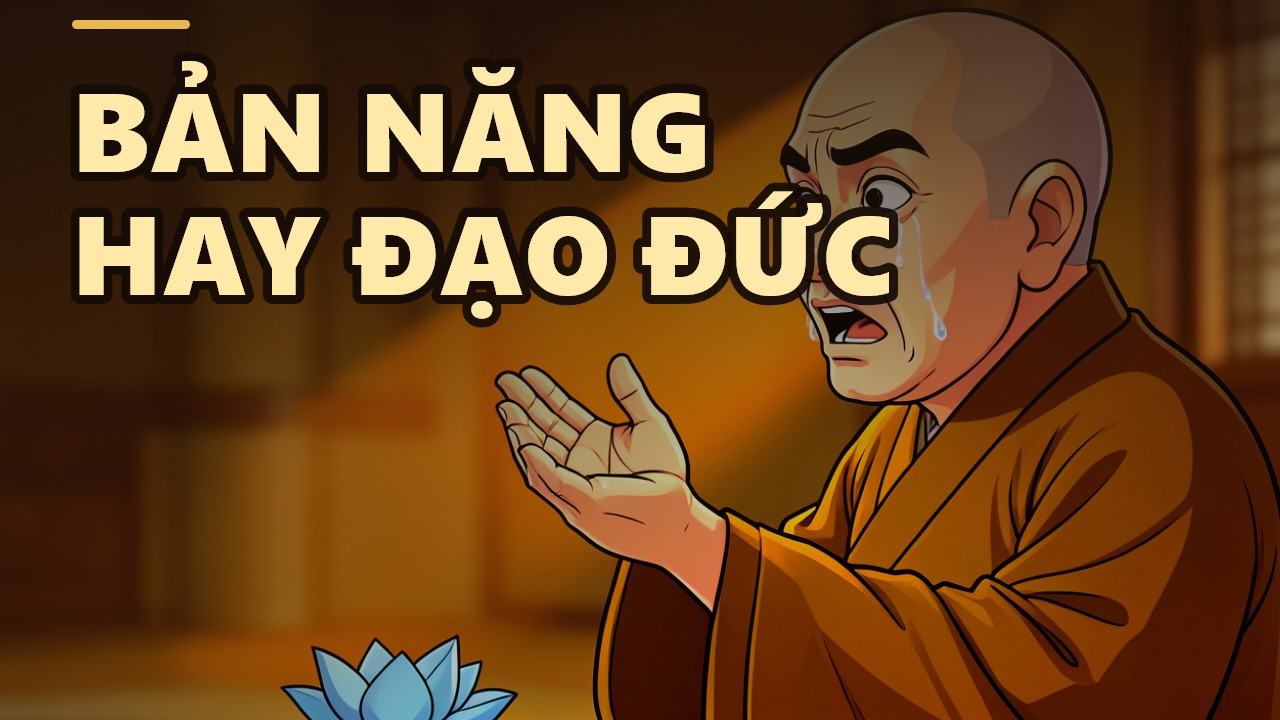
Imagine you are walking down a street when you suddenly see a dog that has been hit by a car. Its leg is broken, and it lies pitifully on the grassy verge. What would you do? Would you walk away, feeling pity but continuing on your path? Would you take it home to care for it? Or would you think about preparing a meal from its meat? Facing the same scene, each person chooses a different course of action. Why is this so? The dharma talk titled "The Nature of Behavior" by Venerable Thich Chan Quang offers us an unexpected answer.
Three Sources That Guide All Behavior
According to Venerable Chan Quang, whether we act or refrain from acting, both constitute behavior, and every behavior creates karma. Interestingly, these behaviors are driven by three sources: instinct, habit, and morality. Let us return to the injured dog. Those who walk away do so out of a habit of indifference to the suffering of sentient beings. Those who consider eating the meat are driven by the instinctual greed for food combined with the habit of consuming dog meat. Those who rescue the dog are motivated by morality and compassion that have been cultivated through practice.
Every action we impose upon life creates a type of karma. Sometimes it is wholesome karma, sometimes unwholesome karma. And each type of wholesome or unwholesome karma carries its own future consequences.
Instinct: The Root of All Suffering
Instincts are tendencies pre-programmed within us: the desire to live and fear of death, the love of pleasure, selfishness, and sensual desire. No one teaches us these things, yet everyone possesses them naturally. Consider a child hiding a cake, or a dog carrying a bone to find a secluded corner; these are all instincts. Venerable Chan Quang emphasizes:
Instinct is a tendency of consciousness pre-programmed in sentient beings. It does not need to be learned or trained, and we all possess it inherently.
Most instincts are negative. If we continue to live according to instinct, sentient beings remain trapped in samsara, constantly creating unwholesome karma. Those dominated by sexual desire easily fall into lower realms of existence. This is why cultures grounded in morality always encourage people to restrain their instincts, though they cannot eliminate them entirely without achieving meditative concentration.
Habit: The Well-Worn Path of the Mind
Habits are behaviors repeated many times until they become natural reflexes. A person accustomed to ignoring others will also walk past the injured dog. A person used to eating dog meat will immediately think of a delicacy upon seeing a dog. Venerable Chan Quang states:
If we have been accustomed to something for so long, we will inevitably repeat that behavior.
Although habits are not instincts, they can still become significant obstacles, leading us away from morality. If we do not recognize and transform them, bad habits will drag us downward.
Morality: The Power of Transformation
Fortunately, in the human realm, there are wise sages and loving mothers. They teach us to rise above instincts and bad habits. A mother in Northern Vietnam taught her son: "When you eat a cake, do not wait for your friend to ask for some. Break it in half and give your friend the larger piece." Her son remembered this lesson his entire life and lived generously. Venerable Chan Quang praises this style of education:
In families and nations where people receive thorough moral education, we see them living beautifully because they actively counteract the selfish tendencies of instinct.
It is morality that enables soldiers to overcome the fear of death, charging into battlefields fueled by love for their country. Morality is an invisible strength that helps humans transcend themselves.
Meditative Concentration: The Path to Opening Wisdom
The Buddha taught: To believe in me without understanding me is to slander me. In other words, if we only believe without understanding or practicing, we have not yet followed the right path. Venerable Chan Quang shares that one of his Pure Land teachers, after many years of chanting the Buddha’s name, realized:
Only the method of meditative concentration helps us open wisdom and achieve the goal of enlightenment and liberation.
That teacher then resolved to establish a meditation center for Buddhism in the Western region. With wisdom, we can clearly see our instincts, habits, and morality, allowing us to choose correct behaviors that benefit ourselves and others.
Reflect deeply on even the smallest actions in daily life—a wounded dog, a beautiful person passing by, or a harsh word spoken to someone—and observe what guides your mind. Begin your practice by first recognizing your instincts, changing habits through wholesome dharmas, and nurturing morality every day. Meditative concentration will help open wisdom so you can understand the nature of all behavior yourself, just as an enlightened teacher affirmed: To become a Buddha, one must practice meditative concentration.
AI-assisted translation from the Vietnamese original.
Read in Vietnamese →