
Are You a Saint or an Ordinary Person? How Much of the "Self" Still Remains in You?
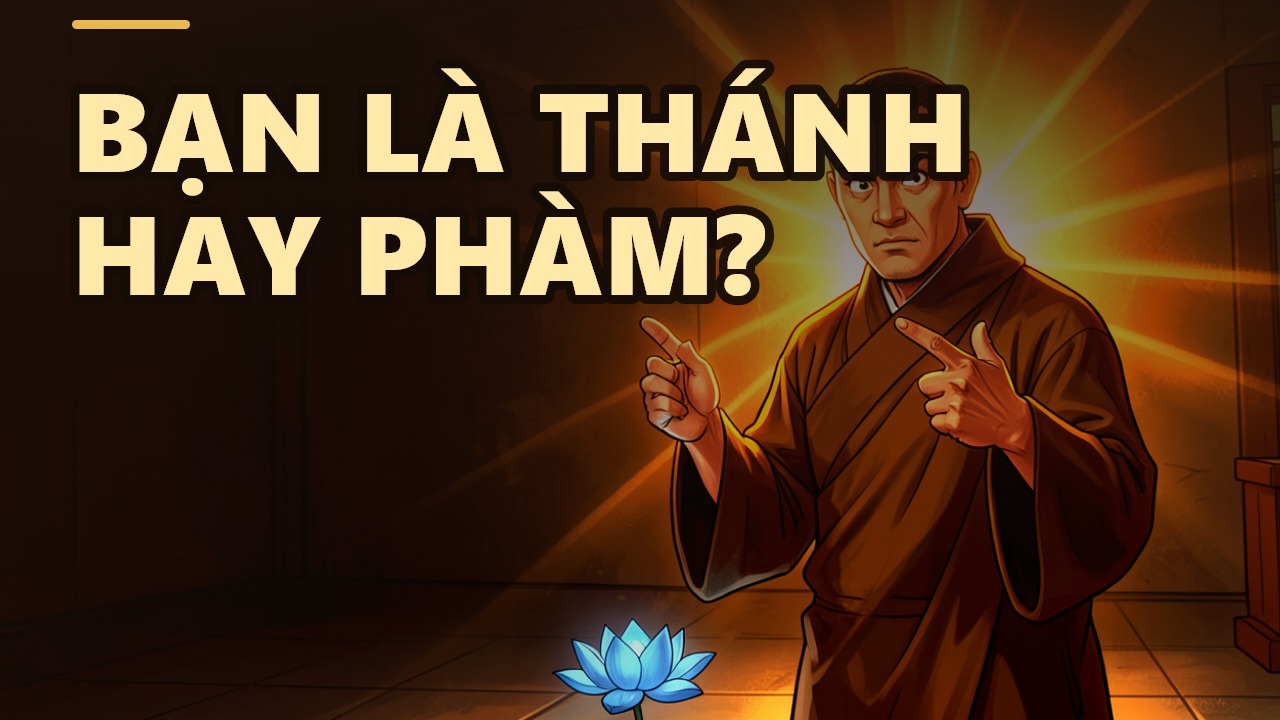
What distinguishes a saint from an ordinary person, according to the teachings of Thầy Thích Chân Quang? It is not merely kindness, morality, or ability, but something far deeper: non-self (anatta) and attachment to self. This article invites you to look honestly at yourself.
Have you ever called someone a "saint" simply because they were too kind, too gentle, or possessed extraordinary abilities? Yet if asked "what makes a saint, and what makes an ordinary person?", how many of us truly understand the inner nature of the matter? Today, let us listen together to the teachings of Thầy Thích Chân Quang on this topic — a subject that seems familiar, yet holds a depth that startles many.
Saint and Ordinary Person in Everyday Understanding
When people ask "what is a saint?", we usually think of someone kind, virtuous, or gifted with unusual abilities. Thầy Chân Quang points out three common standards: first, lasting kindness; second, the virtue of patience and tolerance; third, special powers. But ask yourself: how long can our kindness truly last? Thầy says:
"Our kindness only goes so far. Even if we still have money left over, even if we still have plenty, if we no longer feel like giving, if we feel irritated, then we are still ordinary."
In this way, even if we help someone for months or years, the moment our kindness runs dry and we begin to feel weary, we remain ordinary people. Sainthood is the transcendence of the limits of ordinary kindness. Likewise, a person of high morality is not necessarily a saint if they are still troubled by afflictions (kleshas), still becoming angry when treated poorly. And a person with miraculous powers is not necessarily a saint either, for such powers may be only an outward display. So where does the true standard lie?
The Heart of the Buddha's Teachings: Non-Self and Attachment to Self
According to the Buddha, every definition of saint and ordinary person comes down to one essential point: the self. Thầy teaches:
"A saint in Buddhism is one who moves toward non-self (anatta). And what is an ordinary person? One who is heavily burdened by attachment to self."
Thus, ten times we think of ourselves, ten times we cling tightly to our "I," and ten times we remain ordinary. Conversely, one whose sense of self grows light, who no longer worries excessively about "me" and "mine," is, in every second and every minute, walking the path of the saint. The Buddha taught that a person whose heart/mind rests in non-self (anatta) is no longer governed by greed, hatred and delusion — and that is what it means to be a saint.
Why Become a Saint? Wisdom and an Aspiration Beyond the Ordinary
A question arises: why struggle so painfully to become a saint? Thầy Chân Quang tells of the philosopher Wang Yangming, who, when asked why he studied, answered: "I study to become a saint." This strikes many as strange. But if we have even a little wisdom, we will see that this life is not merely birth, aging, sickness, and death. Those without wisdom are swept along by the current of life, living as everyone else does, and at death they will not know where they are going. Those with wisdom always contemplate death with concern:
"A person of wisdom, while still alive, has already begun to think about the realm of death."
It is like knowing we will soon be transferred to Saigon: we would research the climate, housing, and work in advance. The realm of death is a place we are certain to go, yet how many of us bother to learn about it? A person of wisdom knows to be concerned about their own ignorance, and knows to rise above the human condition in order to reach toward sainthood.
Saints Without Attachment to Self: Trần Hưng Đạo, Thánh Gióng, and Uncle Hồ
Thầy Chân Quang offers extraordinary historical examples of letting go of the self. Trần Hưng Đạo, after driving out the Mongol invaders, held all power in his hands and could easily have taken the throne. But he refused. Why? Because he had no craving for the crown, no thought of personal gain:
"He absolutely refused to be king. Even though the opportunity for power was fully in his grasp, he placed the good of the nation above all else."
So too, Thánh Gióng, after defeating the enemy, claimed no credit, asked for nothing, and soared straight back to heaven. That is absolute non-self (anatta). Uncle Hồ, too, is a saint in the hearts of the Vietnamese people, for his whole life was one of devotion, indifferent to fame and fortune. It is precisely this "not clinging to merit," this "not thinking of the self," that placed them among the saints.
The Four Fruits of Sainthood: From Nearest to Farthest
In Buddhism there are four fruits of sainthood: Sotapanna, Sakadagami, Anagami, and Arahant. Thầy Chân Quang emphasizes that one who attains the first fruit — Sotapanna — has already entered the stream of sainthood, and such people are very close to us:
"A Sotapanna eats a bowl of rice just as we do, yet is always full of insight, always careful, and always at ease. Standing beside us, they are always our teacher."
They still feel love, still feel fear, but they constantly struggle against these, never being swept away by them. They are close friends and teachers, whose every action and every word is steeped in insight. The Sotapanna is the nearest of saints, but as one advances to Sakadagami, Anagami, and Arahant, the attainment becomes ever more exalted.
Conclusion: Begin Practicing Today
Whether we are ordinary or saintly does not depend on whether we do great things or small, or whether we possess power, but on how much of the "self" still remains within us. Thầy Chân Quang encourages us: if we have wisdom, let us begin by looking at ourselves, letting go of some of our ego, living with more compassion for others. Do not let the current of life sweep us along in ignorance. Learn to struggle against fear and craving, and always keep the realm of death in view as an inevitable journey. When you can do this, you have already begun to become a saint. Be gentle each day, one step at a time, letting your sense of self grow thinner and your heart/mind open ever wider.
AI-assisted translation from the Vietnamese original.
Read in Vietnamese →