
Force or Morality: What Makes a Hero?
When is the use of strength heroic, and when does it become violence? This dharma talk by Venerable Thich Chan Quang helps us distinguish clearly between the two and reveals the vital role of morality in controlling force.
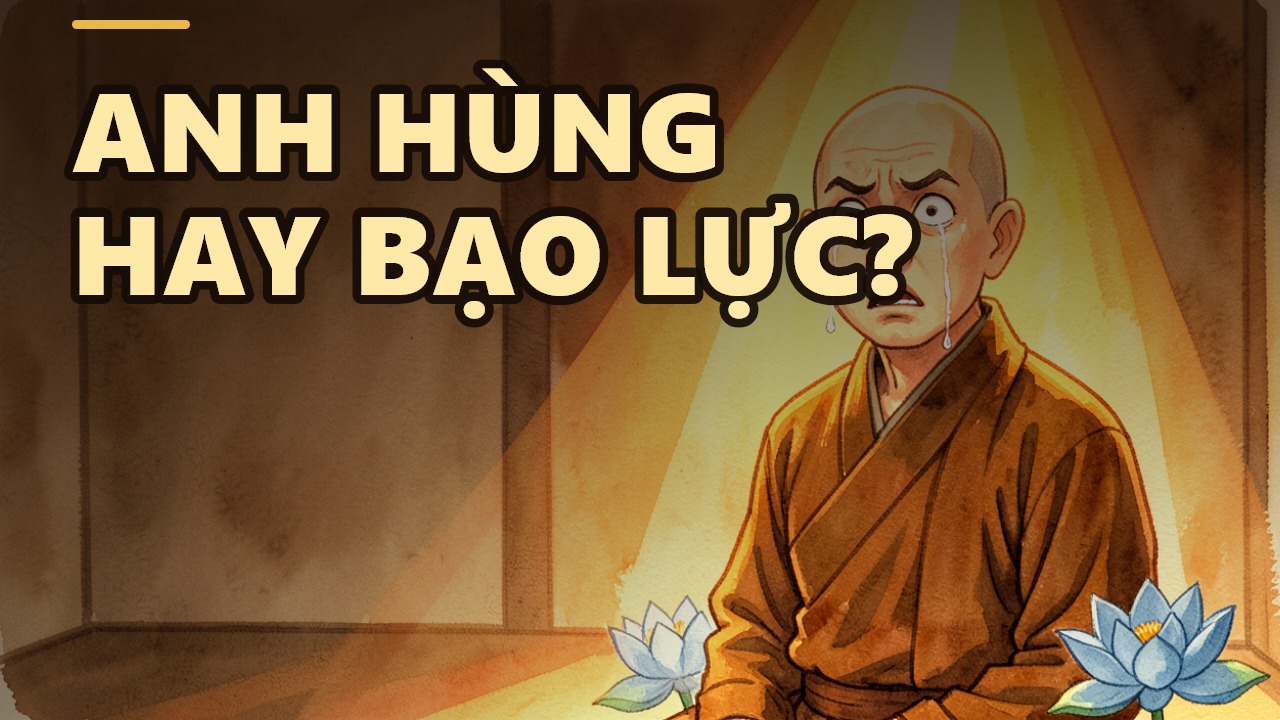
Have you ever wondered what separates a warrior who wins every battle from a person chasing others with a knife on the street? Both use force. So why is one called a hero while the other is deemed violent? In his dharma talk titled "Force," Venerable Thich Chan Quang illuminates this issue deeply. He helps us understand true strength and how to avoid becoming victims of anger and the hidden animal nature within each of us.
Strength is more than just muscles
The teacher begins with a physical definition: strength is the ability to change the state of another object. However, humans possess many types of strength. Beyond muscular power, there is intellectual strength, which allows us to calculate and manipulate the world, much like a hacker clearing bank accounts. There is artistic strength, which can soothe hearts or incite emotions, even driving someone to death. And there is the strength of beauty, which makes heroes bow down. All these are forces capable of changing people’s lives.
Force in history and the present
In primordial times, survival required muscular strength for hunting and defending against wild beasts. Yet nature did not grant humans muscles as powerful as those of other animals. Monkeys climb better; tigers bite harder. What elevated humans was intelligence, leading to the development of martial arts. Gradually, humans realized that force does not always yield good results. From that moment, humanity separated itself from primitive life and the wild jungle.
From the time humans understood that force does not always bring goodness, and that love and kindness are more necessary for building a peaceful and happy community, we stepped away from our savage origins.
The teacher cites Vietnamese history: Ngo Quyen used strategy by planting stakes in the Bach Dang River to defeat the Southern Han army, earning the title of hero. Conversely, a person stabbing others out of wounded pride is labeled a demon reborn or a terrorist. Where lies the boundary?
Where is the line between hero and villain?
Force itself is not at fault. The error lies in how we use it. If force is used for personal gain, to satisfy hatred and greed, or outside the law, it becomes violence and brutality. If force is used to protect the community in urgent situations where the law cannot intervene in time, it is heroism.
Force itself has no fault; the mistake lies in the purpose for which we employ it.
Do not let force turn into violence
It is dangerous when a person possesses weapons, guns, or martial skills. What prevents them from slipping into personal violence? It is morality. The teacher states:
What controls this? Morality.
But do not confuse weakness with patience. A person without strength may be timid, fearful, and submissive before the powerful. That is not patience; it is a deficiency of the soul. In contrast, a person with great martial power who still chooses gentle words due to compassion embodies true patience.
A fearless mind adorned with strength
Therefore, training the body and learning the Phat Quang Quyen martial system at the temple is not for confrontation or killing. It is to cultivate courage and readiness to fight for the community. The teacher emphasizes:
We need a little strength so that we do not become weak.
The ultimate goal is to attain a mind free from fear. We should fear only one thing: acting against the Buddha’s teachings.
We fear only one thing in this world: doing something contrary to the Buddha’s teachings. Apart from that, we fear nothing else.
When we see others suffer and feel pain in our own heart, that is the holy quality within us. When we feel moved seeing litter on the ground, we possess blessings from merit. True courage goes hand in hand with compassion, and morality is the strongest weapon to control force.
Equip yourself with a measure of strength—not to become a tyrant, but so your mind remains strong, steadfast, and unyielding before any power. This is also how we protect ourselves and those around us, living worthy of human dignity—humans who use strength under the guidance of morality.
AI-assisted translation from the Vietnamese original.
Read in Vietnamese →