
Why Must We Practice Meditation? – A Matter of Life and Death
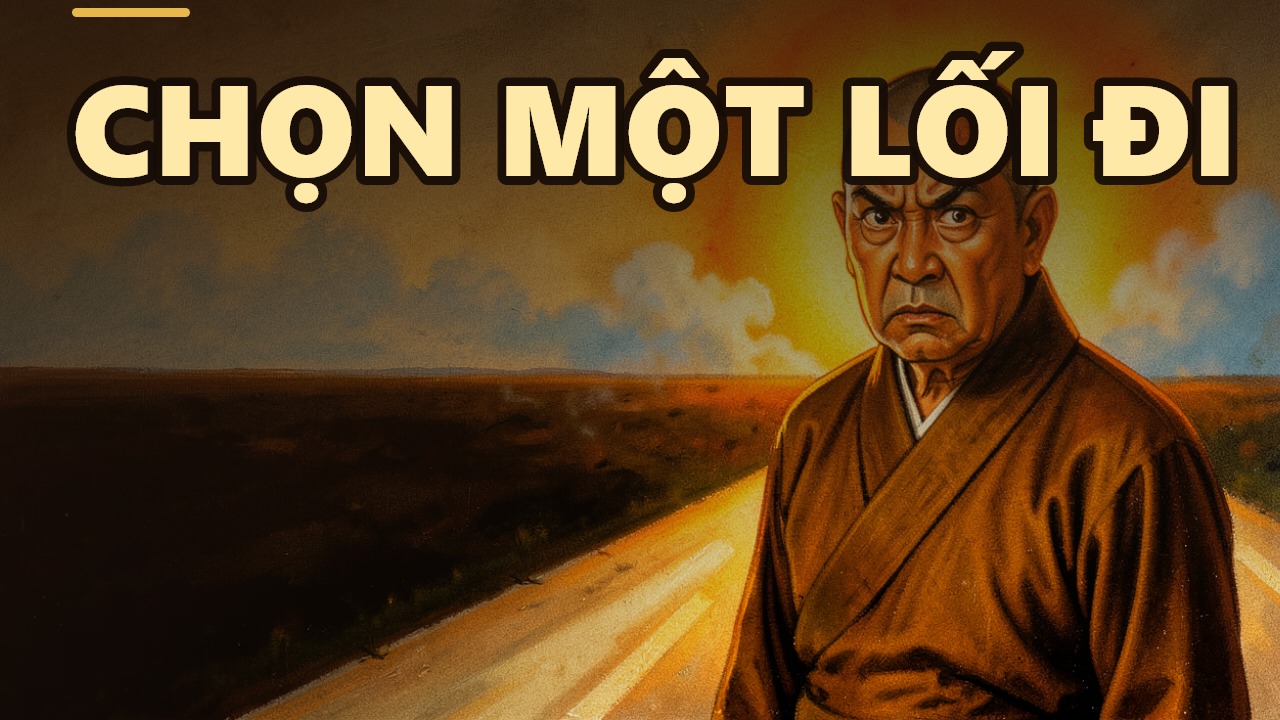
A dharma talk by the Venerable Thích Chân Quang brings us to the edge of fierce choices: good or evil, love or turning away. In the end, practicing meditation is the only path to eliminate the self – the root of all suffering.
Life holds moments when we must stand before two forks in the road. One path leads to glory, the other leads home. The general Trần Bình Trọng once chose: "I would rather be a ghost of the Southern land than a king of the North." That saying shows us: some choices may seem simple, yet they determine our entire character and future.
Some things we are forced to choose one of, and cannot have both
In life, there are times when compromise is allowed, and times when it is not. A sick person must both take medicine and observe dietary restrictions, but must not starve to the point of exhaustion. A daughter-in-law must be skillful in pleasing both her mother-in-law and her husband. But when standing before the choice between good and evil, between right and wrong, between becoming a disciple of the Buddha or refusing – we are compelled to choose one. Thầy Thích Chân Quang emphasizes:
"There are things in life where we are allowed to choose only one, not two. And only after we have made our choice do we begin to discuss the middle way, the compromise, the balance. This is the secret of living."
We cannot hold a job while also robbing others. We cannot follow the Buddha while also turning our back on the Buddha. Each of us must resolutely choose our own path.
Only on the chosen path do we discuss the middle way
After we have chosen the path of goodness, the path of the Buddha, only then do we speak of the middle way. The middle way is not fence-sitting, not being partly good and partly evil. The middle way is balance within the path of goodness itself. Do not be so extreme as to give away everything until nothing remains to live on; nor be so lazy and negligent as to stay away from the temple for three years. Thầy teaches:
"The middle way means helping others within our capacity, so that we can regenerate and restore our own strength and continue helping others for the long term."
Thus we still care for our family, still fulfill our worldly responsibilities, while at the same time setting aside time for practice, for paying homage to the Buddha, for repentance. That is living in moderation, in balance, walking steadily toward the infinite.
Choose one path resolutely: to love, or to turn away?
Look out at the world and see how many people, how many sentient beings there are. But have we ever asked ourselves: Do I choose to live in order to love sentient beings, or to turn my back on them? Many people have never asked that question. Thầy Chân Quang poses it with fierce clarity:
"Choose the path of living to love sentient beings, or turning your back on them? To choose love is to struggle. Turning away is easy. If you turn away, you need not care for anyone, and in time no one will care for you. Later on, your life will slowly become lonely."
To choose love is to choose the difficult path. But it is the path of those with a conscience, of those who wish to escape samsara (cycle of rebirth). We must choose resolutely, casting our vote with our own heart.
The root of all afflictions (kleshas): attachment to self
Why are people selfish, greedy, competitive, envious? It all springs from a single root: attachment to self – the belief that there is a real "me." This attachment is invisible, subtle, deeply embedded in the mind/heart. It causes us suffering (dukkha) and rebirth in samsara (cycle of rebirth). Thầy points out clearly:
"It is precisely this invisible, abstract, hard-to-see attachment to self, hidden deep within our mind/heart, that has created selfishness, greed, competitiveness, hatred, envy, jealousy, and all manner of afflictions (kleshas)."
If we do not recognize and eliminate attachment to self, we will forever be dragged down into animal rebirths. Therefore we must choose the path of enlightenment, the path of eliminating the self.
Why must we practice meditation?
Practicing meditation is precisely the path of practice that gradually dissolves attachment to self. Meditative concentration helps us observe our own mind/heart, seeing clearly all greed, hatred and delusion, all selfish thoughts. Thanks to this, we no longer chase after the blind commands of the ego. Thầy reminds us: practicing meditation is not about attaining realization within a few hours of sitting. It is a persevering journey, combined with repentance, doing good, and selflessness. Those who choose to practice meditation are those who have chosen a life of selflessness, chosen tranquility and inner peace.
Today, right now, we can begin with a question: Have I resolutely chosen the path of meditation practice? If not, place it on the scales: on one side, selfishness with its fleeting pleasures; on the other, selflessness with its lasting peace. And then, choose. For it is the supreme command of conscience – the command that leads us toward the light.
AI-assisted translation from the Vietnamese original.
Read in Vietnamese →