
Why Do Those Who Practice Meditation Seek Non-Self?
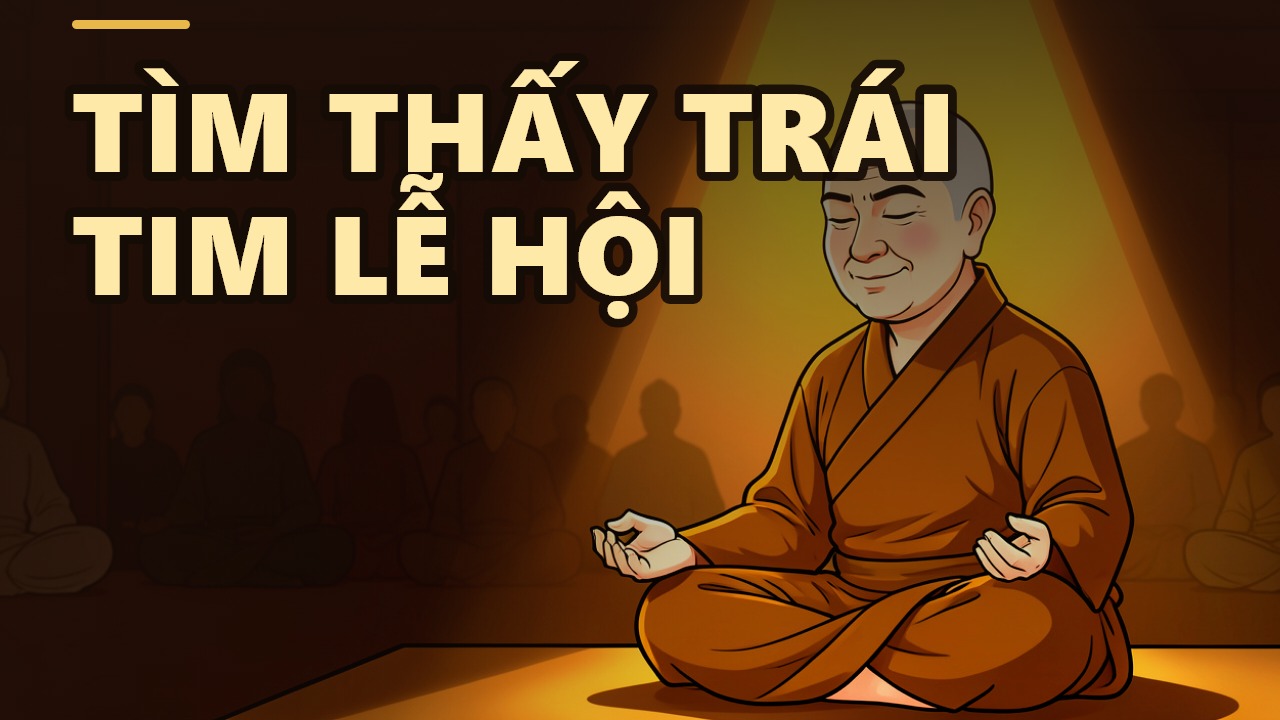
People hold magnificent festivals for Avalokitesvara: elaborate invitation ceremonies, chanting, bustling and sacred stalls. But few ask: where does the heart of such a festival lie? This is a question that Venerable Hue Vinh, the abbot of Quan The Am Pagoda, has pondered deeply. His answer is that the heart of the festival is the practice of meditative concentration. Therefore, for each festival season, Thay Thich Chan Quang is invited to guide the sitting meditation, forming the "core" for the external activities.
**The Heart of a Festival**
Thay Chan Quang shares that over the many years of the Avalokitesvara festival, which attracts large crowds, Venerable Hue Vinh sensed that the joyous and solemn atmosphere still lacked a certain depth. It needed a core—a heart—so the festival would not just be about external programs but also a place for people to return to their inner selves. And that heart is the practice of meditative concentration.
*"The core of the Avalokitesvara festival is this afternoon, here in this hall, with people sitting quietly together, not speaking, discussing the meditative concentration of the Buddha."*
This is a profound insight. We often pour our energy into organization and external forms, forgetting that the ultimate goal of the Buddha's teachings is liberation—and liberation must be realized through practice in every single moment.
**Meditative Concentration – The Path the West Seeks**
The Thay recounts that as Da Nang develops, more international visitors will come. They will seek the great culture of the nation—the Buddhist path. And when they come, they will look for a practice method. They do not accept a path based solely on simple faith. They need a path full of wisdom and science, one that satisfies their intelligence. That path is meditative concentration.
*"The world, with its very high level of knowledge, is not seeking a simple path of faith. They demand that we provide them with a path of practice full of wisdom, satisfying their Western intelligence. And that is meditative concentration."*
Even filmmakers acknowledge this. In the movie "Star Wars," the Jedi knights are those who know meditative concentration, control their breath, and through it save the universe. The Thay remarks wryly, "So for decades, this person has been plotting to praise meditative concentration as the savior of the universe." It can be said the world is naturally returning to meditative concentration.
**Four Distinctive Aspects of Buddhist Meditation**
But there is an issue: there are many meditation schools in the world. So what is special about the Buddha's meditation? Thay Chan Quang points out four things:
The meditation of the Buddha was taught by the Buddha—the one who attained the highest enlightenment.
It has clear formulas, like mathematics, without ambiguity.
It has a specific route, step by step, without confusion.
It leads us to the ultimate goal of non-self.
*"The Buddha's meditation is mathematics, is science with clear formulas."*
The Thay emphasizes that many people practice without knowing where they are on the path. They claim "I am enlightened," "I have attained," but have no roadmap. Buddhist meditation is different: as we practice, we know exactly at which stage of attainment we are.
**The Goal of Non-Self – Buddhism's Secret**
But the most special aspect—and also the most difficult—is the goal of non-self. Before and after the Buddha, no one achieved this. The ancient Indian masters could attain deep concentration and supernatural powers, but never reached non-self. Only the Buddha, under the Bodhi tree, attained ultimate non-self and taught it for forty-five years.
*"To practice until there is no longer a self. All other sentient beings in this world, due to ignorance and the greed, hatred, and delusion, all wish to practice to gain something for themselves."*
This is a "strange" religion: those who follow the Buddha do not find anything for their ego; instead, their ego dissolves. Therefore, anyone who hears the goal of non-self and feels joyful and happy has had good roots with the Buddha across many lifetimes. Anyone who feels uneasy or confused is still an ordinary sentient being. The Thay asks, "Who likes to practice to get more for themselves?"—no one raises a hand. "Who likes to practice until there is no longer a self?"—very many raise their hands. He is glad the Buddha's teachings will endure.
**Three Pillars Supporting Meditative Concentration**
To reach non-self, we must practice tirelessly. The Thay recalls the Noble Eightfold Path, whose last three parts are right effort, mindfulness, and right concentration. To support this, the meditation practitioner needs to cultivate three foundations:
Merit—a lifetime of creating blessings from merit.
Ethics—a lifetime of cultivating inner virtue.
Energy training—a lifetime of practicing energy cultivation (qigong).
*"One who practices meditative concentration must create a great deal of merit. One who practices meditative concentration must cultivate their inner ethics a great deal. And one who practices meditative concentration must practice energy training a great deal."*
These three pillars give us the capacity to pass through wondrous realms and "harbors of delusion" on the meditation path, so we do not stop or get lost in enjoyment, but always turn towards non-self.
So, the true goal of meditation lies not in what we attain, but in what we let go of. To practice is to no longer be oneself—that is the noblest journey. If you hear these words and feel at peace within, it is certain you have a good affinity with the Buddha's teachings. Let us practice together, so that each day, the self grows smaller, and compassion and wisdom grow within us.
AI-assisted translation from the Vietnamese original.
Read in Vietnamese →