
Why Does Buddhism Have Fewer Followers Than Other Religions? – A Lesson on Rituals
Thích Chân Quang points out that current rituals are too elaborate and lack genuine practice, leaving Buddhists unable to understand or love the Dharma. Rituals need to change so they become easy to understand, easy to chant, offer concrete methods of practice, and are infused with modern music.
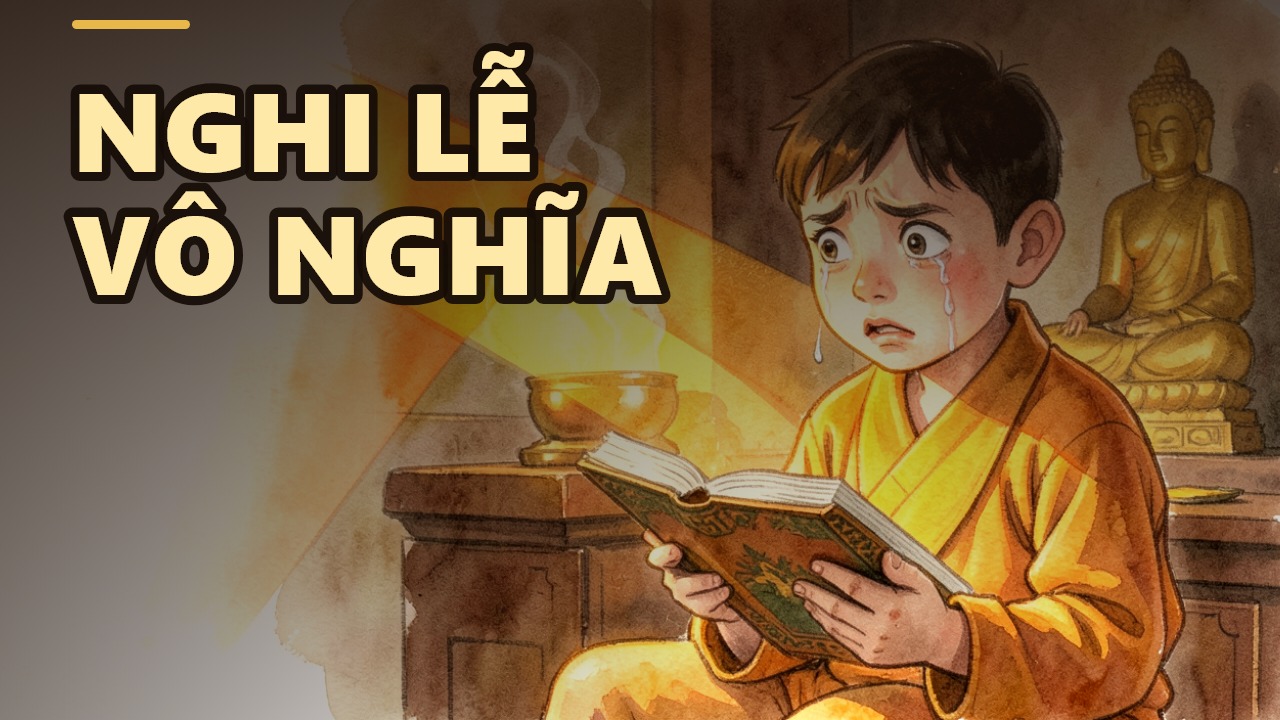
You step into a temple in the middle of a ceremony. The master is chanting a sutra, fast and rising and falling, accompanied by the wooden fish. You bow your head, but you do not understand a single word. As you leave, you feel as though you have just attended a heavy, burdensome ceremony, and a thought crosses your mind: "Why is our temple not like that church down the street?"
Buddhism Is Falling Sixty Years Behind
Thầy Thích Chân Quang speaks frankly: "If we look at the world, look at other religions, and then look back at our own Buddhism, we will see that we are walking sixty years behind the others."
There are many causes, but one of the deeper reasons is that we still maintain a proud, aloof attitude, like Bodhidharma waiting for Hui Ke to cut off his own arm. Buddhism is like a high mountain, and Buddhists must climb up to reach it. Meanwhile, other religions actively "come down" to each family, each person, using every means to attract followers.
Rituals – Central Yet Meaningless
Whoever comes to the Dharma kneels and bows, chants a few lines, makes a few aspirations. Ritual is the central gateway to the teachings. But many chants today are meant for those of the highest capacity, and do not suit the general public. A typical example is the Heart Sutra: "Everything is empty. Who understands enough to praise it? Who here truly understands what is being praised? Only one who correctly understands the Heart Sutra can praise it. Yet almost everyone, past and present, has misunderstood it."
People chant a sutra without understanding it, without any intention to practice, holding only blind faith. And so their love for the Dharma cannot grow, because: without understanding the teachings, there is no practice; without practice, there is no love for the Dharma.
Six Purposes of True Ritual
Ritual is not an empty formality. According to Thầy Thích Chân Quang, a genuine ritual must achieve six purposes. Among them, two are the most essential: "First, we offer our prayers to the Buddha. Second, when we chant in this way, the teachings themselves penetrate deep into our own hearts."
Beyond that, ritual helps the community understand and practice together, helps outsiders grasp the teachings, and brings joy to departed spirits and celestial beings.
Renewing Ritual: Easy to Understand, Easy to Chant, With a Method of Practice
Thầy Chân Quang emphasizes: "Ritual must offer a practical method of practice, not just chanting that ends with no idea what to actually practice."
That is why at Phật Quang temple, the ceremonies have been rewritten in a modern direction, with dignified yet easy-to-understand language and chants that are easy to follow. Modern music has been brought into the rituals as a "pathway" to touch the hearts of the young. "We have brought all of modern music into the ritual."
A new chant expresses this spirit:
"The more passionately one loves the Buddha's teachings (Dharma), the more deeply and sacredly one loves the homeland."
Helping the Young Love the Dharma – That Is the Greatest Gain
For Thầy Chân Quang, a successful ceremony is not one that collects many offerings, but one that increases people's love for the Dharma. "What is the purpose of this ceremony? If after the ceremony everyone's love for the Dharma has grown, then we have succeeded."
When ritual becomes alive and filled with teachings for practice, people will understand, be moved, and come to love the Dharma. Imagine a ceremony where young people sing the sutras aloud, where everyone feels a sense of peace and joy – that is precisely how we bring Buddhism into daily life.
Every ceremony must be an opportunity to touch each person's heart. If ritual helps people see the path of practice and know how to eliminate greed, hatred and delusion, then love for the Dharma will blossom. Let us, as children of the Buddha, transform our rituals in this spirit, so that the Dharma not only endures but flourishes powerfully in the new era.
AI-assisted translation from the Vietnamese original.
Read in Vietnamese →