
Why Do You Love and Hate? The Buddha Explained It Long Ago
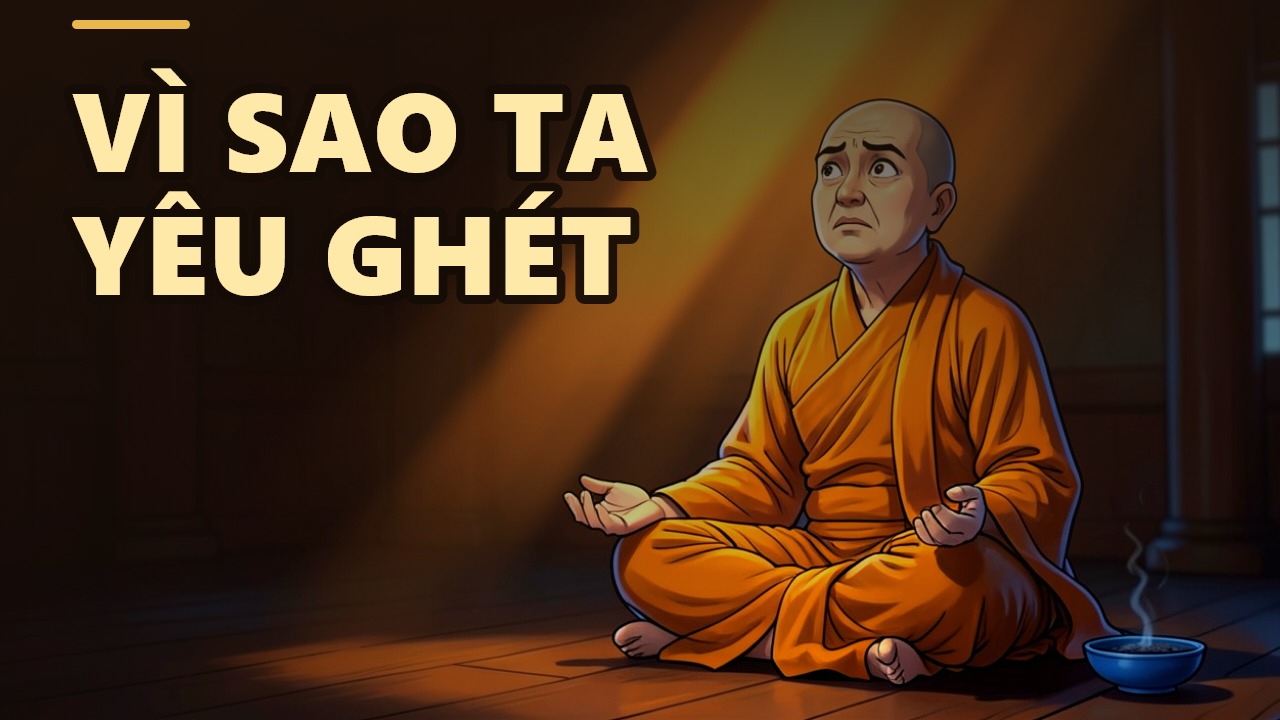
Have you ever wondered: What is love? Why do we cherish one person and dislike another? The poet Xuân Diệu himself felt helpless before this question. He wrote: “What does love mean? One afternoon it seizes our soul with gentle sunlight, with clouds and gentle breeze…” and then fell silent, offering no further definition. Emotions are an invisible, powerful force, like gravity—everyone knows they exist, yet no one can truly grasp them.
**Emotions: Indescribable, Yet Known by All**
In the fourth part of his dharma talk on “The Structure of the Five Aggregates,” Venerable Thích Chân Quang asked: “What is emotion? If anyone can define it, they are more brilliant than the poet Xuân Diệu.” He did not attempt a definition but instead pointed out that emotion is an action of the mind. When we love someone, we feel joy in their presence and miss them when apart; we worry, care for them, and want to offer them a cup of water. These manifestations show us that emotion is present. But its true nature remains a mystery.
“Emotion is an action of the mind. Loving emotion, hateful emotion—they are actions of the mind. Therefore, they belong to the aggregate of mental formations.”
The aggregate of mental formations is the operating system of the mind. From water, we have streams, rain, waterfalls, and bubbles. Similarly, from this aggregate arise countless activities: reasoning, retrieving memories, creativity, as well as love and hatred. Emotions are just one of the many streams flowing within consciousness.
**Sensation and Emotion: Two Distinct Layers of the Mind**
Many people confuse sensation with emotion. The Venerable makes a clear distinction: sensations are suffering, joy, pleasantness, unpleasantness—these are “nouns.” Emotions are love, hate, anger, resentment—these are “verbs.” Feeling discouraged can be a sensation—“I feel discouraged.” But “I am so discouraged with him” is an emotion. The boundary is thin and easily blurred.
The Buddha was extraordinarily precise in separating these two layers. Consider: when someone praises us, a sensation of joy arises. From that sensation of joy, an emotion is born: the desire for more praise, and even affection for the one who praised us. Yet we often mistake the two for one.
“Feeling (vedanā) gives rise to craving (taṇhā). This is within the chain of twelve links of dependent origination. Craving gives rise to clinging (upādāna), clinging gives rise to becoming (bhava)—feeling gives rise to craving.”
**Contact, Feeling, Craving, Clinging, Becoming: The Chain of Deluded Thoughts**
When sitting in meditation, leg pain appears. What is this pain? According to the twelve links, it is “contact” (phassa)—the meeting of sense object and sense organ. From contact, “feeling” (vedanā)—a sensation of discomfort—arises. From feeling, “craving” (taṇhā)—aversion to sitting in meditation—arises. From craving, “clinging” (upādāna)—the action of pulling the leg out—arises. From clinging, “becoming” (bhava)—a picture of the next life is painted with strokes of laziness and negligence.
“The leg pain is contact. Contact gives rise to feeling, feeling gives rise to craving, craving gives rise to clinging, clinging gives rise to becoming.”
This chain of dependent origination unfolds continuously. But when the mind is pure, we can feel the pain without discomfort. Feeling does not arise, so craving does not appear, and clinging is not created. Thus, meditative concentration is a means to halt the flow of karma, painting a serene picture for future lives. The Venerable has said:
“The Master can only guarantee one thing: a peaceful death. If you walk the path the Master teaches.”
**When Sitting in Meditation, Pain Is Our Teacher**
Everyone who meditates experiences pain and stiffness. But like a soldier on their first day of service, or a doctor embracing a corpse, we push through to grow. If we can sit through leg pain without complaint, our karma is gradually repaid. In old age, we will pass away lightly. But if we cultivate yet criticize, we become trapped in a vicious cycle.
The Venerable teaches: “Praising is the mark of the wise. Criticizing is self-destruction.” Words of praise cost nothing but win the affection of others and create wholesome karma. A mouth prone to criticism is like a hammer that inflicts suffering, creates heavy karma, and leads to a tragic end.
**Begin to Observe Yourself**
What have you learned today? Emotions are no longer a mystery, but a psychological process that can be observed. When you sit in meditation, try paying attention: leg pain—do you feel discomfort? If discomfort arises, do not rush to abandon the practice. Reflect on the chain of dependent origination, see the pain clearly so it does not drag you into the abyss of craving and clinging.
Every minute spent in meditation is a minute of repaying karma, painting a brilliant picture for the future. Begin today, with a humble heart, free of arrogance. The path to enlightenment is not somewhere distant; it lies within your very breath and a heart that knows how to observe.
AI-assisted translation from the Vietnamese original.
Read in Vietnamese →