
The Practice of the Mind: Four Levels Everyone Must Traverse
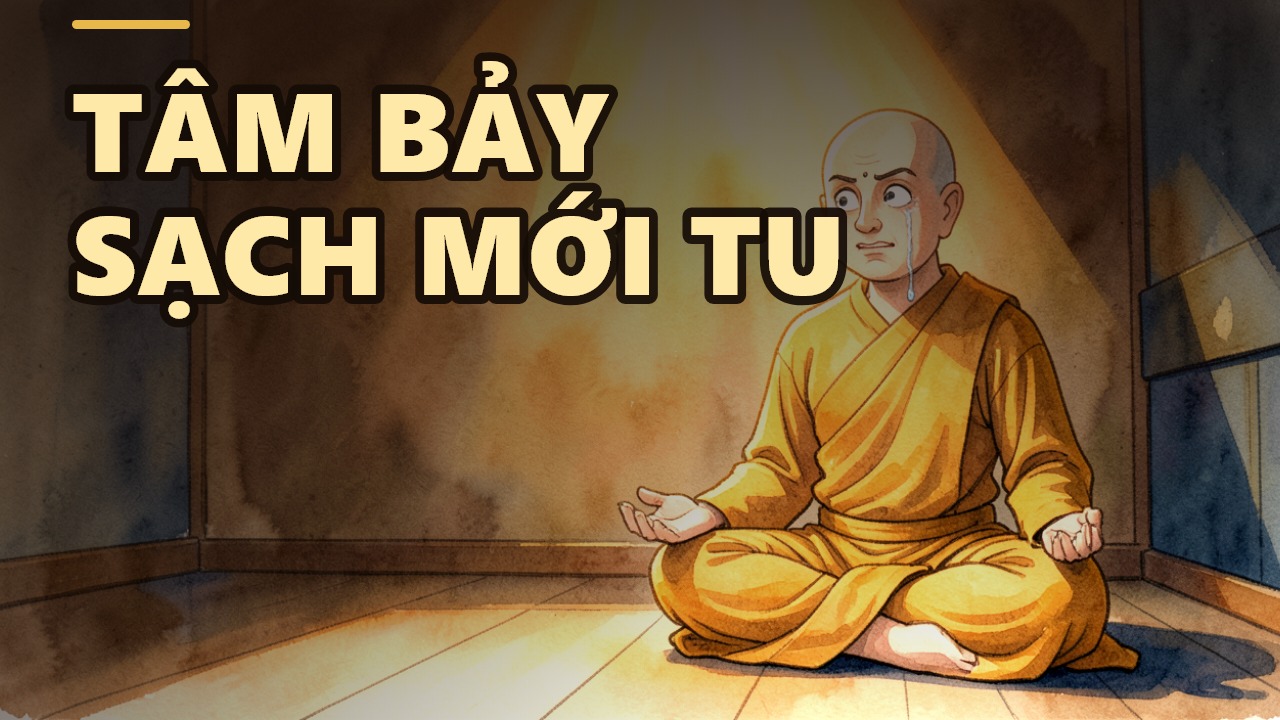
In this dharma talk, Venerable Thich Chan Quang reveals four levels of mental practice. He guides us from the internal battle between right and wrong to mindfulness, meditative concentration, and non-self (anatta). This teaching helps practitioners reflect deeply on their inner journey.
Imagine sitting quietly alone, gazing into the empty space before you. Thoughts rush in like a tide: a touch of jealousy, a hint of pride, a flicker of resentment. Here, the practice of the mind begins in a place that seems small but is filled with storms. Venerable Thich Chan Quang outlines these four stages to help us clearly see where we stand on the path back to our true nature.
## Level One: Right and Wrong – The Invisible Internal Battle
At the first level, the mind becomes a battlefield for thoughts of right and wrong. Having lived through countless lifetimes in delusion, we often think incorrectly. Those who do not know how to practice do not care about right or wrong; they only want their desires fulfilled. However, those who seek the Buddha's teachings (Dharma) begin to understand merit and sin, right and wrong. The difficulty lies in the fact that wrong thoughts are sneaky and invisible to others. Venerable Chan Quang warns:
"The incorrect thoughts within your mind are known by no one and seen by no one. Therefore, you freely indulge in them. But when you think wrongly often, your soul becomes tarnished."
Look closely at yourself. How many times a day do you secretly praise yourself? How many times do you criticize others in your heart? Perhaps you gave five liters of rice to a poor person and mentioned it repeatedly for three months. When you meet someone more beautiful than you, a flash of irritation arises. When friends are praised, you tell yourself, "It is nothing, just luck." These thoughts slowly diminish your blessings from merit. Without control, human value declines rapidly, much like an animal.
### Three Special Blessings That Illuminate the Mind
The teacher explains that without blessings from merit, this battle between right and wrong can last for four thousand kalpas. Yet, three specific types of merit can significantly shorten this struggle.
First, show reverence to holy beings. Meeting a noble one, paying respect, and making offerings increases merit greatly and awakens wisdom.
Second, cultivate compassion. Regularly reminding yourself to love all sentient beings generates such powerful merit that even evil spirits must stay away.
Third, invite friends to practice together. Sharing the Dharma with others rapidly increases inner merit.
If you possess these three kinds of merit, your mind will become purely good within ten years. Upon death, you will be reborn in heavenly realms.
## Level Two: Mindfulness and Unmindfulness – The Lamp Within
When the mind becomes relatively pure, the practitioner enters the second stage: the struggle between mindfulness and unmindfulness. This is the time to practice meditation. There are three steps: resting awareness in the whole body, contemplating impermanence (anicca), and observing the breath moving through the body. The teacher describes this state:
"This is a state where the inner mind becomes spacious and clear, like a lamp glowing steadily inside. However, conceptual thoughts still arise; they have not yet ceased completely."
Yet, this lamp is easily extinguished amidst the busyness of life. When cooking, the mind scatters like a crowded market. When eating, you pick up dishes without realizing you have lost mindfulness. Practitioners must strive to keep this lamp burning. The teacher calls this "preservation"—maintaining the state of mindfulness. This is the practice of genuine cultivators, our true teachers.
## Level Three: Meditative Concentration and Agitation – Peace Amidst the World
Moving to the third level, the conflict shifts between meditative concentration and agitation. Remember the teacher’s words: "The third level is the tug-of-war between stability and movement." When the mind is settled in meditative concentration, you are no longer swept away by the currents of the world. However, it is in crowded places, during daily tasks, and under pressure that you discover if you can maintain this stability. Some people eat simply, choosing only one or two dishes, avoiding excess. This is a sign of a tranquil mind.
## Level Four: Non-Self and Ego-Attachment – The Peak of Liberation
The final level involves the struggle between non-self (anatta) and ego-attachment. The teacher states: "The fourth level is the highest peak, the battle between non-self and clinging to the self." Here, the practitioner clearly sees that the "I" is an illusion. All suffering (dukkha) stems from ego-attachment. When this veil is removed, the mind naturally expands boundlessly, free from borders. However, this is a very high stage requiring great diligence and karmic conditions.
The journey of the mind is not merely about understanding, but about practice. You can start at the level of right and wrong. Today, try living a day with only wholesome thoughts. When greed, hatred, and delusion arise, recognize them and replace them with a thought of compassion. Each time you do this, you win a battle and move closer to the light. May you always keep the lamp of mindfulness burning in every step you take.
AI-assisted translation from the Vietnamese original.
Read in Vietnamese →