
Gods and Sages: Do You Know Where the Boundary Between Power and Morality Lies?
Thay Thich Chan Quang teaches about the concepts of Gods and Sages: A God embodies power, while a Sage embodies morality. Both serve as forces that lift human beings beyond themselves.
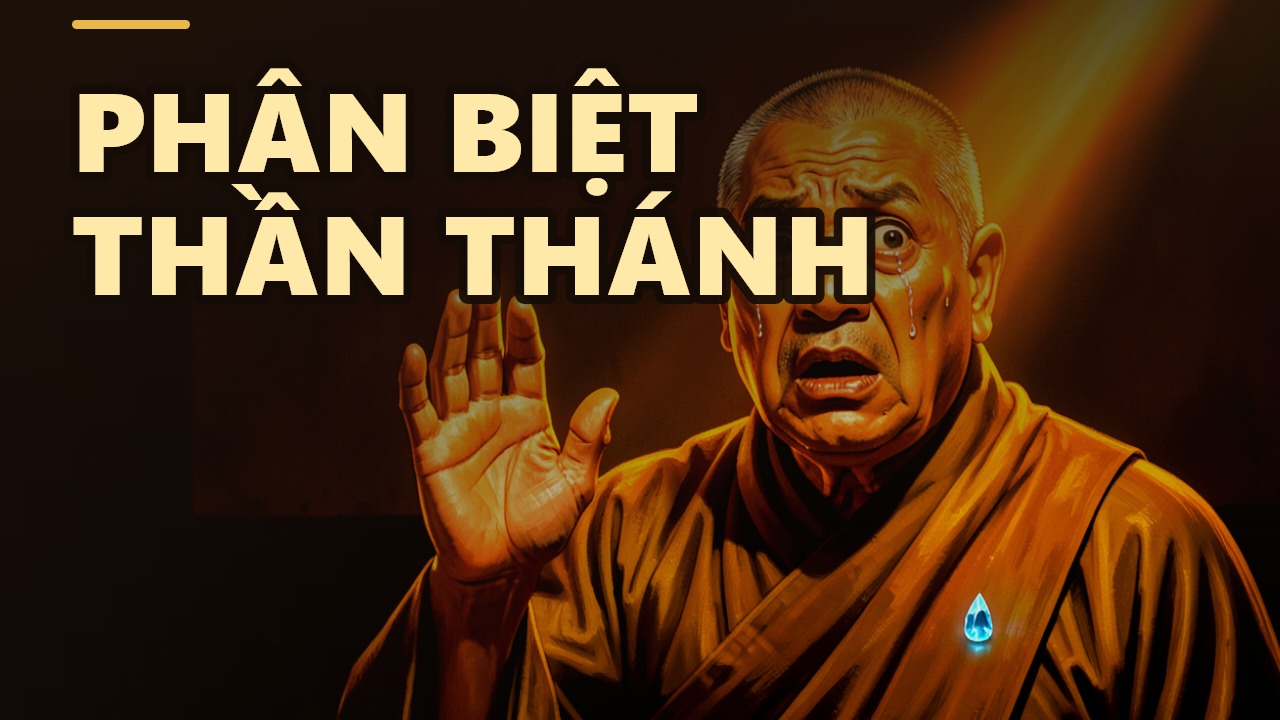
Have you ever wondered why human beings, despite being the most intelligent creatures on this earth, still believe in beings higher than themselves? And if you stood before a God and a Sage, would you know how to tell them apart?
Who are Gods and Sages?
In the dharma talk "Gods and Sages," Thay Thich Chan Quang opens with a striking observation: Humans are the most intelligent of all species on earth, yet it is precisely because of this intelligence that we are able to envision beings greater than ourselves. These are the Gods and Sages. They surpass humans in five aspects: size, wisdom, lifespan, appearance, and power.
Speaking of size, Thay tells the story of the monks at Dai Tung Lam who once saw dharma protectors of strangely towering stature, so that when they read the sutras describing celestial beings with bodies as large as Mount Sumeru, they were no longer surprised. As for wisdom, the Gods and Sages know the past and the future, and even our previous lifetimes. Regarding lifespan, some heavenly realms live for millions of years. As for appearance, people of extraordinary beauty often carry traces of higher realms. And as for power, there are phenomena that science cannot yet explain: a man pushing a cart nearly struck by a truck suddenly found himself at the roadside, saved by a stranger who reached out, grabbed him, and vanished.
"Gods and Sages are a class of beings in this universe of heaven and earth who are higher than humans in many respects."
Why do humans have the concept of Gods and Sages?
This is precisely a sign of intelligence. Thay Thich Chan Quang defines it this way: "An intelligent human being is one who can envision something greater than themselves. That is intelligence." When people are not satisfied with their own condition, they dream of reaching higher levels. Religion arose to answer that dream. It is precisely by believing in Gods and Sages that human beings find a goal for their practice and turn toward goodness.
How does a God differ from a Sage?
In spiritual studies, especially in Buddhism, we distinguish between Gods and Sages as two separate categories. This differs from many other cultures and religions that group them together as "divine beings."
"A God is the master of power; when a being's power far exceeds that of humans, we call it a god. A Sage is the master of morality. When someone's morality reaches a level of wonder and nobility, we call them a sage."
Thus, a God may be very powerful but is not necessarily perfectly moral. Conversely, a Sage may not be all-powerful, but their morality is exemplary. For example, in Vietnamese history we have Saint Giong, the first of our sages, and Duc Tran, Tran Hung Dao, who refused the throne in order to unite the nation. More recently, Uncle Ho is also regarded as a sage for his pure life and profound morality.
Where do Gods and Sages come from?
There are two kinds: Gods and Sages with human origins, and those without human origins. Those with human origins are usually famous or great figures who came to be venerated, such as Saint Giong or the guardian deities honored by royal decree. Those without human origins were created by human imagination, like the Monkey King of legend. Thay offers a warning: "We must be careful with what we hear. If everyone believes something, we believe it too. But often, at its root, it was never real in the first place."
Gods, Sages, and spiritual practice
Belief in Gods and Sages gives people the motivation to practice. We fear the rewards and punishments of higher beings, and so we strive to do good and avoid evil. However, there are those who exploit this faith, like the drug lords in films who worship God yet still take lives. Thay emphasizes: "People who have faith and belief in the divine tend to be inclined toward goodness, but there are also people with too many blessings from merit, too much arrogance, who exploit the divine."
Therefore, faith must not stop at fear; it must be transformed into practice through meditative concentration and moral living. Thay teaches that sitting in meditation is the heart of practice, helping us return to the pure nature within.
Elevate your own condition
Thay Thich Chan Quang's dharma talk reminds us: the concept of Gods and Sages is not meant for blind worship, but to serve as a goal for our striving. If a God represents power and a Sage represents morality, then each of us can become more like a Sage by cultivating our own morality. As Thay says: "Even offering this entire life to the Buddha in making offerings would never be enough." So do not wait. Begin today, right now. Sit quietly for a minute and look deeply into yourself.
AI-assisted translation from the Vietnamese original.
Read in Vietnamese →