
Better to Live Alone Than Befriend a Fool? The Buddha's Teaching on Seeing One's Own Faults
The story of two disciples of Venerable Kasyapa opens a profound teaching on the "fool" in the Buddha's teachings (Dharma): not someone lacking intelligence, but someone who cannot see their own faults. Thay Thich Chan Quang analyzes five types of people and the meaning of choosing friends.
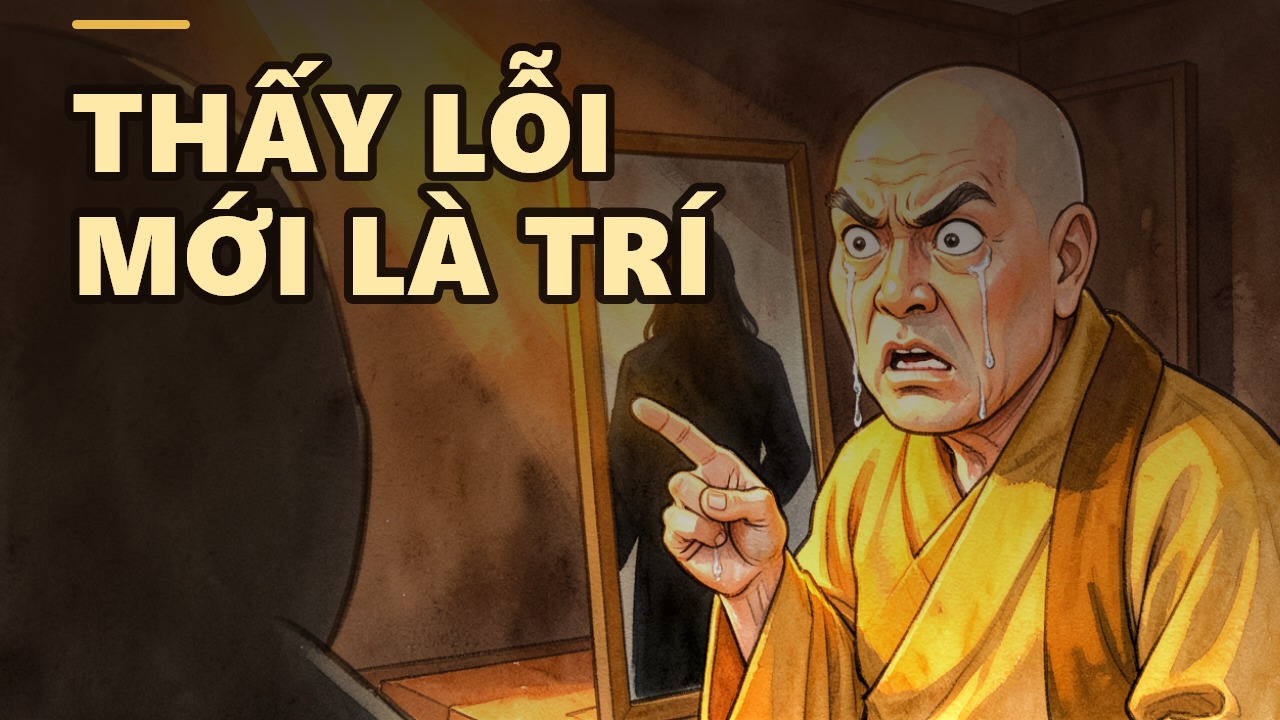
Have you ever wondered why a Great Arhat like Venerable Kasyapa would accept a worthless disciple? And why did the Buddha teach: "If you cannot find a companion better or equal to yourself, it is better to live alone than to befriend a fool?"
The Story of the Two Disciples of Venerable Kasyapa
In the Dhammapada, this verse arose from a true story: two disciples of Venerable Kasyapa, one good and one bad. The good one was obedient and diligent in practice, praised by the teacher and entrusted with important tasks. The bad one was competitive and envious, and the more the teacher scolded him, the angrier he became. One day, this man went asking for food in the teacher's name, causing Venerable Kasyapa to scold him yet again. Filled with resentment, he waited until the teacher was away, smashed everything in the hut, and returned to lay life. But lay life brought him no happiness at all: he married, his wife changed her nature, he suffered, created karma, died young, and fell into hell.
Upon hearing this story, the Buddha did not give a long lecture, but spoke only one verse: "If you cannot find a companion better or equal to yourself, it is better to live alone than to befriend a fool." So who is the "fool" in the Buddha's teachings (Dharma)?
"Being a fool means not knowing. And what is it that one does not know, that makes oneself an immoral person? Not knowing one's own faults instantly makes one an immoral person."
Who Is the "Fool" in the Buddha's Teachings (Dharma)?
Many people understand "foolish" as lacking intelligence or having low education. But in Buddhism, the word "fool" refers to a person without morality. And the root of morality is precisely the ability to see one's own faults. A person may hold a doctorate or excel in international mathematics, but if they cannot see their own faults, they are still called a fool. Conversely, one who sees their faults before they arise, or who extinguishes them as soon as they appear, is truly a wise person.
This is very important in daily life. You may be highly educated, with degrees and credentials, but when faced with competition, money, or praise, if you cannot see the trace of greed or the trace of anger in your mind/heart, then you are still just a fool. The person who guards against faults before they even arise is truly noble.
Five Types of People, Wise and Foolish
Thay Thich Chan Quang points out five types of people for us to examine ourselves against:
The first type: one who sees their own faults before they arise. For example, upon hearing that a piece of land given through making offerings has risen in value to several billion, the moment greed arises in the mind/heart, they recognize it and keep the mind/heart pure. Such a person easily attains the path.
The second type: one who knows immediately when a fault arises. The moment the fault appears, they recite the Buddha's name in repentance and eliminate it at once.
The third type: one who does not see their own faults, but when others point them out, recognizes them, repents, and changes.
The fourth type: one who has faults, and when others point them out, does not see them, and even insists they are right. This is a person of poor morality.
The fifth type: one who has faults, does not see them when others offer advice, and instead harbors hatred toward those who advise them. This is an extremely immoral person, walking toward hell.
"Anyone who raises their hand but cannot see their own faults — that person, I ask for their name and address, so that I may never dare set foot in their house."
The words are humorous but penetrating: a person who cannot see their own faults and even hates those who remind them of them — living with such a person only brings trouble to everyone around.
Choose Your Friends Wisely
In Buddhism, a companion is someone with whom we study, practice, work, and relax. Each kind of friendship carries a different closeness. Friends from childhood are usually pure, because there is no competition for power or gain. Drinking buddies and playmates are fragile — they are fun only when there is money and entertainment, but when we meet hardship, their true face shows at once.
That is why the Buddha teaches us to draw near to people of morality, to those better than us or equal to us. If we cannot find them, it is better to live alone than to befriend a fool. Being alone but practicing and keeping the mind/heart pure is better than befriending someone who drags us down.
Holding Firm to Faith in a Troubled World
Nowadays, many people lose faith because they see scandals among some monastics. Thay Chan Quang reminds us: human beings may err, but the Buddha's teachings (Dharma) are never wrong. Do not let one person's wrongdoing make you careless — you must keep yourself on the right path.
"Do not continue making mistakes because of the mistakes of others. As for whoever goes wrong against the Buddha's teachings (Dharma), let them be — as for your own part, you must keep to the Buddha's teachings (Dharma) and practice."
And let us also remember: the precepts are a form of restraint, but it is a restraint that helps us grow in virtue. Those who know how to practice see the precepts as happiness, while those who do not see them as a burden. Let us learn to see our own faults, hold firm to our faith, and choose our friends wisely — that is the path we walk in the light of the Buddha's teachings (Dharma).
We invite you to put this into practice: begin by looking at yourself each day, seeing your faults and correcting them. That is the way to truly become a wise and moral person in the eyes of the Buddha.
AI-assisted translation from the Vietnamese original.
Read in Vietnamese →