
The Buddha Praises the Diligent: The Secret to a Peaceful Death
Through the story of Tissa, Thầy Thích Chân Quang teaches us about sincere diligence, the two goals of life, and how to have a peaceful death.
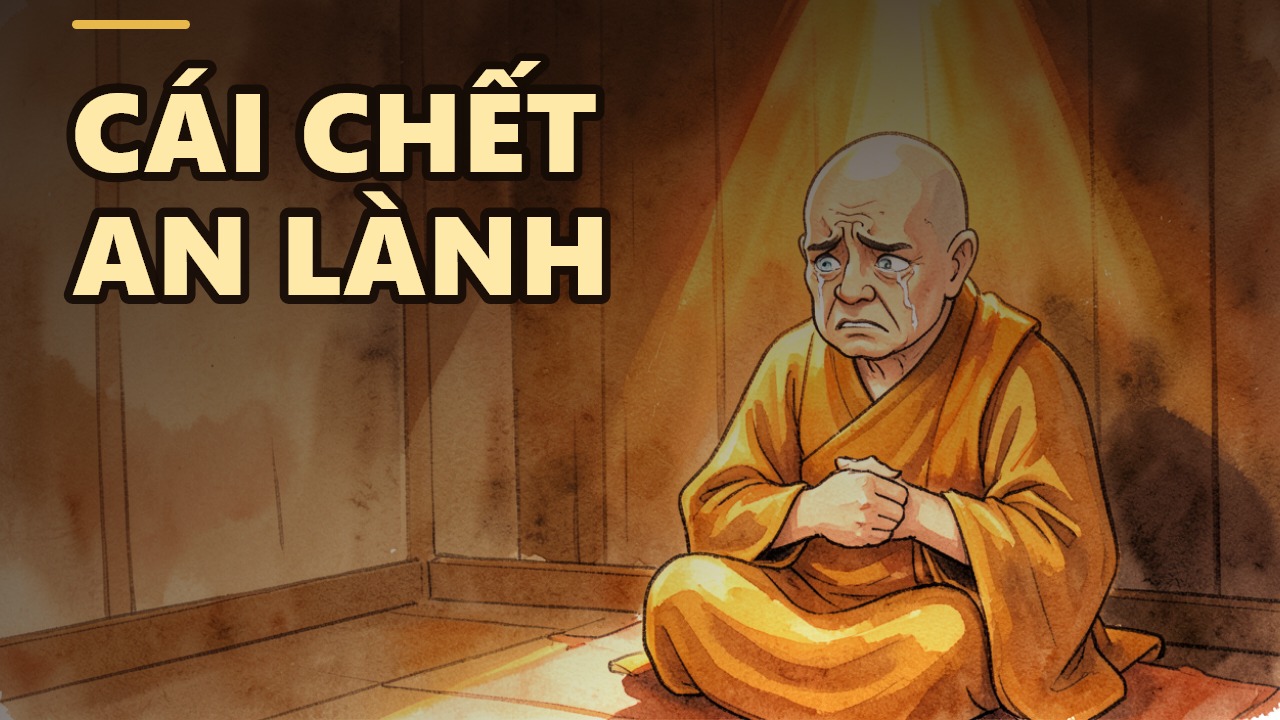
There was a monk named Tissa. When he heard that the Buddha was about to enter nirvana, he no longer concerned himself with his fellow monks. He withdrew to a quiet corner, spoke to no one, and quietly devoted himself to practice. Many who saw him thought he was strange. But the Buddha said:
Tissa knows he will soon be far from the Tathagata, never to see the Tathagata again, and knowing he has not yet attained the path, he is pouring all his strength into practice. Such a person is one who truly cherishes and reveres the Tathagata.
The verse from the Dhammapada, verse fifty-seven, is not only a story about diligence, but also opens for us a profound vision of life: in the end, what are we being diligent for?
True Diligence Is Not for Showing Off
Thầy Thích Chân Quang teaches that true diligence is gentle, continuous, and free of arrogance. In contrast, if one is diligent so that others will admire them, that mind is one of showing off and ambition. The Thầy warns:
Pretending to be diligent so that people see you as diligent, so that people admire you—that mind is a mind of showing off, arrogance, and ambition.
Looking at modern society, we easily see people who work hard only to be recognized, or practitioners who strive to be admired. But a true practitioner, like Tissa, exerts effort out of love and reverence for their teacher, out of fear of not attaining enlightenment in time. That is the pure motivation.
The Two Most Worthy Goals of Life
We often dream of money, fame, and status. But when facing death, everything becomes meaningless. The Thầy reveals that only two goals remain important:
First, to live in a way that is extremely beneficial to others, not living for oneself. Second, to die with ease.
Living usefully is a happiness; dying peacefully is an accomplishment. Do not wait until your final moments to realize this—begin building it today.
Five Causes Leading to a Peaceful Death
Thầy Thích Chân Quang points out five factors that help one pass away with lightness:
Contemplating the impermanence (anicca) of the body: Sitting in meditation, relaxing, knowing clearly that this body will decay.
Having once resolved to sacrifice one's life for a great cause: A single resolute thought creates wholesome karma.
Not clinging to life or fearing death: Eliminating the instinctive grasping at existence.
Always living selflessly, letting go: Not considering anything as one's own, living for others.
Attaining the power of meditative concentration: Dying at will, at ease like the great meditation masters.
These five causes are inseparable from one another. Whoever practices them regularly will feel a growing peace with each passing day.
Dwelling Alone and Dwelling Together: The Two Hardest Skills
The Buddha often praised those with the strength to live alone, because the need for companionship is a fundamental one. But a practitioner must overcome both challenges:
First, to dwell alone in peace without sadness. Second, to dwell together with others without conflict.
In reality, many people feel lonely and miserable when alone, yet argue when living with others. A practitioner needs to know how to rest in meditative concentration when alone, and to nurture compassion when living with others. These are two gates of spiritual maturity.
Keeping Precepts and Ritual Attachment: Do Not Become a Cruel Person
There is a thin line between keeping precepts and ritual attachment. A true keeper of precepts loves those who have not yet managed to keep them, while one who falls into ritual attachment looks down on them. The Thầy teaches:
When someone who does not eat in the evening sees a person who does, and their heart feels disdain, thinking themselves better than that person, that is immediately wrong. That is not a saint—that is cruelty.
Therefore, when you see someone who has not yet done good, feel compassion and wish to help them. Do not use your own practice as a stepping stone to look down on others.
Learn from Tissa: be diligent a little each day, without showing off, without weariness. Live well so you may pass away with lightness. Do not wait for illness—begin right now, with every breath.
AI-assisted translation from the Vietnamese original.
Read in Vietnamese →