
Not Yet Enough: The Mantra That Dispels Complacency
We often become complacent after small achievements, but the Buddha's teaching "not yet enough" helps us overcome arrogance and keep practicing without pause. Let this mantra illuminate each step of the way.
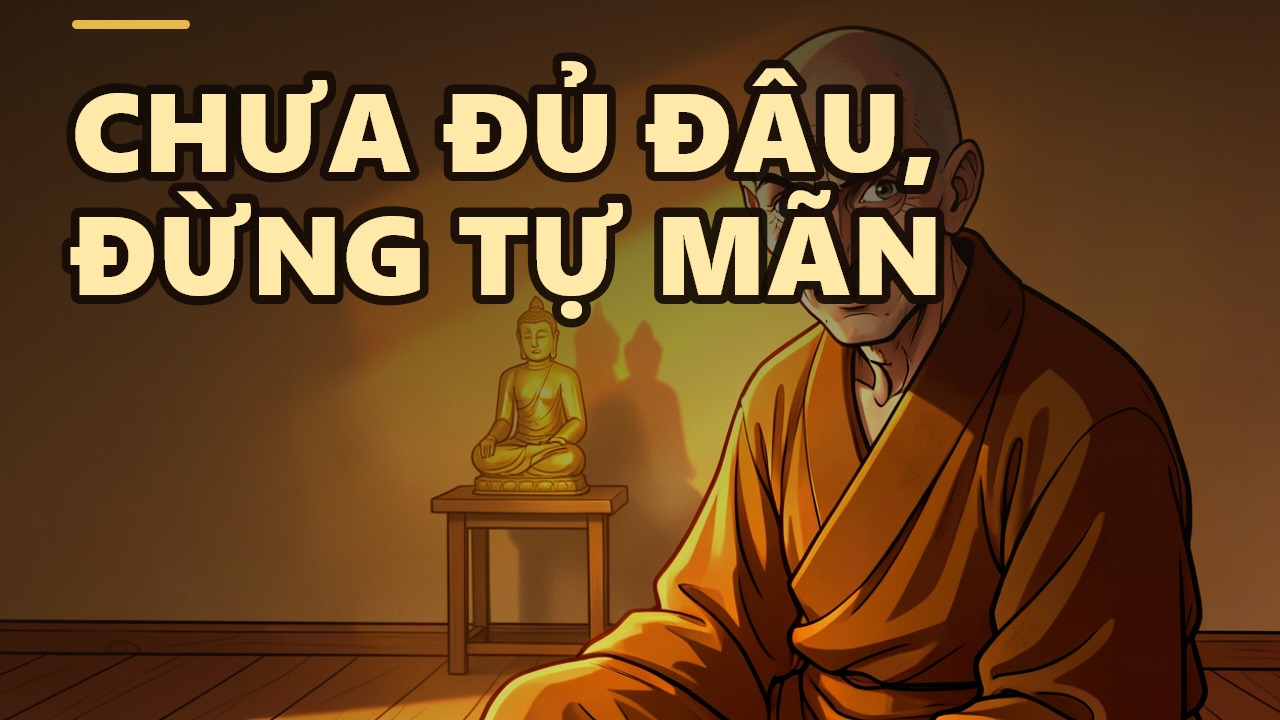
On the first day of the new year, on Buddha Quang Mountain, Buddhists from everywhere traveled long distances to visit the temple. They often joked with one another that there were only two disappointments: the temple was plain and simple, and the teacher was thin and frail. But Thay Thich Chan Quang smiled and replied:
"On the other hand, we have the most beautiful thing of all: we have a beautiful Buddha, and that is enough."
And yet, to light incense, bow to the Buddha, and go home thinking we have fulfilled our duty is truly not enough. Let us begin this spring teaching with the mantra that Thay offers as a gift: "Not yet enough."
Complacency: the silent thief of blessings from merit
Thay explains: "Complacency is when we have a success. At first we gain some understanding, we do a few good things, and then we tend to become complacent and think it is enough. But as soon as the complacent mind appears, we immediately lose our blessings from merit. We stall, we stand still, and then we decline and fall backward."
Thay says that even the noble ones who have attained realization still harbor a hidden trace of complacency, one that takes many lifetimes to eliminate. So how much more should we, who only go to the temple once a month and do only a little good, refrain from thinking we have done enough.
Is "being a good person" enough?
Many friends in daily life tell us: "I don't need to follow any religion. It's enough to just be a good person." Thay Chan Quang turns the question around:
"What does it actually mean to be a good person? Well, I live my life without harming anyone, I obey the laws of the state, and once in a while I see someone suffering and I help. So that's fine, living like that is fine. But not yet enough."
Why? Because we still carry hidden greed, hatred and delusion. At some moment, we may stumble and commit wrongdoing without even knowing it.
Going to the temple during Tet: bowing to the Buddha, hearing the Dharma, and making vows
Thay recalls the tradition of the New Year: expressing love and going to the temple to bow before the Buddha. But bowing alone is not enough. We must hear the Dharma and, above all, make vows at the start of the year. Thay suggests that instead of superstitious star worship, we hold a peace ceremony and make vows with three levels of prayer: for our family, for our country, and for the world. And every Buddhist should offer four vows:
To repair body and mind, overcoming our mistakes, our narrowness, our greed, and our dishonesty.
To create much merit and help many people.
To bring the Buddha's teachings (Dharma) to everyone around us.
To bring at least ten people to the temple for taking refuge.
If we make such vows every year, our practice will have a long-lasting direction.
Do not turn knowledge into a weapon of pride
Thay points out that many Buddhists fall into complacency after only preliminary attainments: after one hundred bows to the Buddha, they already see themselves as "the Buddha's beloved child"; after sitting in meditative concentration and noticing their wandering thoughts grow quiet, they imagine they have realized the true mind and Buddha nature; after merely hearing "form is emptiness," they claim to have understood Prajna wisdom. In truth, none of this is nearly enough.
More dangerous still is the teaching of "is." When someone misuses the phrase "the Buddha is me, I am the Buddha," they have stepped into dark territory. The Buddha taught that even attaining the first meditative concentration requires "seclusion from sensual desire and unwholesome states" — a mind that is completely and purely wholesome. Yet many people, having realized nothing, rush to declare themselves enlightened, which leads to madness, as Thay warns:
"I had a relative, an older man, who was very bright and capable, and suddenly he developed symptoms of mental illness. The cause was his talent. Because he thought he was gifted, he became arrogant. Because he was arrogant, he looked down on people, looked down on heaven and earth, looked down on the gods, and lost his mind."
"We don't need the lofty. We only need the correct."
In this age of the declining Dharma, the safe path is to return to the fundamental foundations. Thay Chan Quang guides us:
"We don't need the lofty. We only need the correct."
A true practitioner always sees themselves as a speck of dust at the Buddha's feet. The more we practice, the smaller we see ourselves. As Thay says: "The lower you see yourself, the safer you are."
A life-protecting mantra
This dharma talk especially emphasizes that the phrase "not yet enough" becomes a mantra. When we are praised, we remind ourselves: not yet enough. When we face hardship, the phrase can ring out like a way of escape. Thay tells this story: "Sometimes when someone wants to beat us, or our car is about to be robbed, we simply forget ourselves and keep repeating: not yet enough. Suddenly the robbers take everything and leave. Who knows why, but it worked — it truly worked. It truly worked."
Because we have used that mantra to remind ourselves to practice, it becomes a spiritual energy that protects us.
But be careful. Thay also tells of a Buddhist who had an accident on the road to the temple. While a sincere mind does not change, we must also prepare for physical safety. Do not let "going to the temple" become a risky "journey."
In the end, no one reaches the destination overnight. Let us remember Thay's teaching:
"To become the Buddha's beloved child takes thousands of lifetimes. It is not easy."
Not yet enough.
AI-assisted translation from the Vietnamese original.
Read in Vietnamese →