
Aspirations and Realization: From Childhood Dreams to the Vow of Attaining Buddhahood
A dharma talk by Most Venerable Thich Chan Quang on the connection between aspiration and action, tracing the journey from childhood dreams to the path of cultivation, with a reminder to transform wishes into concrete deeds.
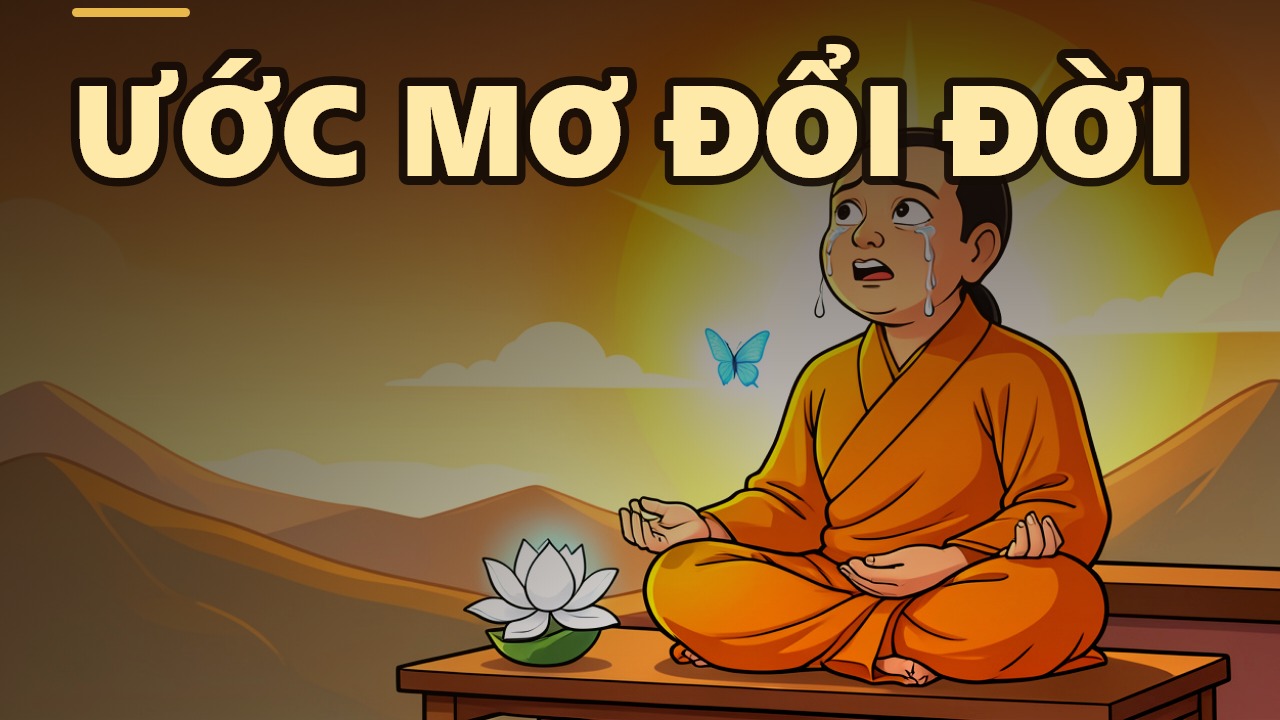
Have you ever sat on a rooftop, gazing at distant mountains, wishing you could invent an airplane to fly from one hill to another? Most Venerable Thich Chan Quang once had such a dream. As time passed, that dream faded, replaced by grander aspirations: becoming a scholar, contributing to the nation, and bringing happiness to all people. Eventually, he realized that these dreams were merely illusions. Only one path remained practical and achievable—the path of spiritual cultivation. This leads us to a profound question: Which is more important, aspiration or realization?
Dreams Change With Each Stage of Life
We all experience different phases of dreaming. In childhood, we imagine magical, unrealistic things. As we grow older, our goals become more specific. Master Chan Quang shared that encountering reality caused his dreams to shrink and become more grounded. Unexpectedly, the path of monastic life became his destined affinity. He recalled the teaching of his root teacher: "You can never completely eliminate human greed." This statement startled him into changing his perspective. He realized that offering morality to humanity is truly offering them happiness. To achieve this, there was only one way: cultivating oneself and transforming one’s own mind.
He reflected, "When all other paths are closed, only the path of cultivation remains. Yet, surprisingly, this is exactly my destiny, matching my true nature and capabilities."
Noble Aspirations in Buddhism
Upon entering the Dharma, Master Chan Quang discovered wonders within the Buddha's teachings. The daily sutras contain vows made by enlightened beings, far surpassing ordinary thought. One such vow is: "May all sentient beings in the dharma realm, both conscious and unconscious, together attain Buddhahood." This means praying for all living creatures—humans, dogs, pigs, fish—and even non-sentient entities like plants, stones, and earth to achieve enlightenment. At first glance, this seems impossible, yet this vow nourishes our spirit and opens a world without borders. As he said, "We can only feel reverence; we revere it, though we cannot fully comprehend it."
"When reading sutras like the Lotus Sutra or the Avatamsaka Sutra, we are overwhelmed by the vastness of the universe. We see Buddhas emitting light across ten directions, and countless realms with diverse forms. These ideas expand our minds, freeing us from the limitations of the small self. We realize that the Buddha's teachings are not just the philosophy of one nation, but the truth of the entire cosmos."
When Aspirations Are Grand, Action Becomes Crucial
However, Master Chan Quang also pointed out a weakness in Buddhism: the imbalance between speaking and doing. Scholars have noted, "Buddhism speaks the most, yet sometimes does nothing." While the doctrine is profound and great, some stop at reading, chanting, and studying without applying it to life. He recounted a sad historical lesson: when French missionaries spread Christianity, they quickly gained many followers who later opposed their own country. Why? Because monks at that time refused to propagate the Dharma, staying quietly in temples. Those who knew came; those who did not, stayed away. By failing to act and bring the Buddha's teachings to the people, they lost spiritual ground to others.
Living Meaningfully Through Our Deeds
Master Chan Quang used himself as an example. He admitted, "I am someone who talks endlessly, frighteningly so. But I do make some effort." His disciples are guided to practice continuously: Buddhistizing families and communities, meditating, bowing to the Buddha, and performing good deeds. Some complained, "Following the master is too hard!" But he encouraged them, saying, "Try harder; tomorrow will be even tougher. Keep going!" Ultimately, they realized their lives had meaning. This meaning comes not from what they understood or said, but from what they accomplished for the world.
"Life has meaning because of what we have done, not because of what we have understood. It is meaningful not because of what we have said, but because of what we have achieved for this life."
Transforming Aspirations Into Action
There is a vast gap between aspiration and realization. We may harbor grand wishes, but without execution, they remain empty words. In Buddhism, the priority is turning vows into concrete actions. Every day, every hour, let us set small tasks to fulfill our desires. It might be a gentle word, helping another person, a moment of meditative concentration, or a tolerant gaze. When we act, our hearts find peace, and life gains deeper significance.
Let our vows be more than sounds chanted aloud; let them be tangible deeds beneficial to all beings. As the Master taught, "Continue following me, and continue enduring hardship. It is alright." That hardship is action, is realization. Through this, we gradually reach the Buddha-realm within our own hearts.
AI-assisted translation from the Vietnamese original.
Read in Vietnamese →