
The Beggar Who Is a Scholar: Understanding the True Meaning of Buddhist Practice
It is not merely carrying a bowl and begging that makes one a bhikkhu. Venerable Thich Chan Quang explains Dhammapada verse sixty-five: A true practitioner must live according to the right dharma, maintain constant awareness, and possess noble spiritual conduct.
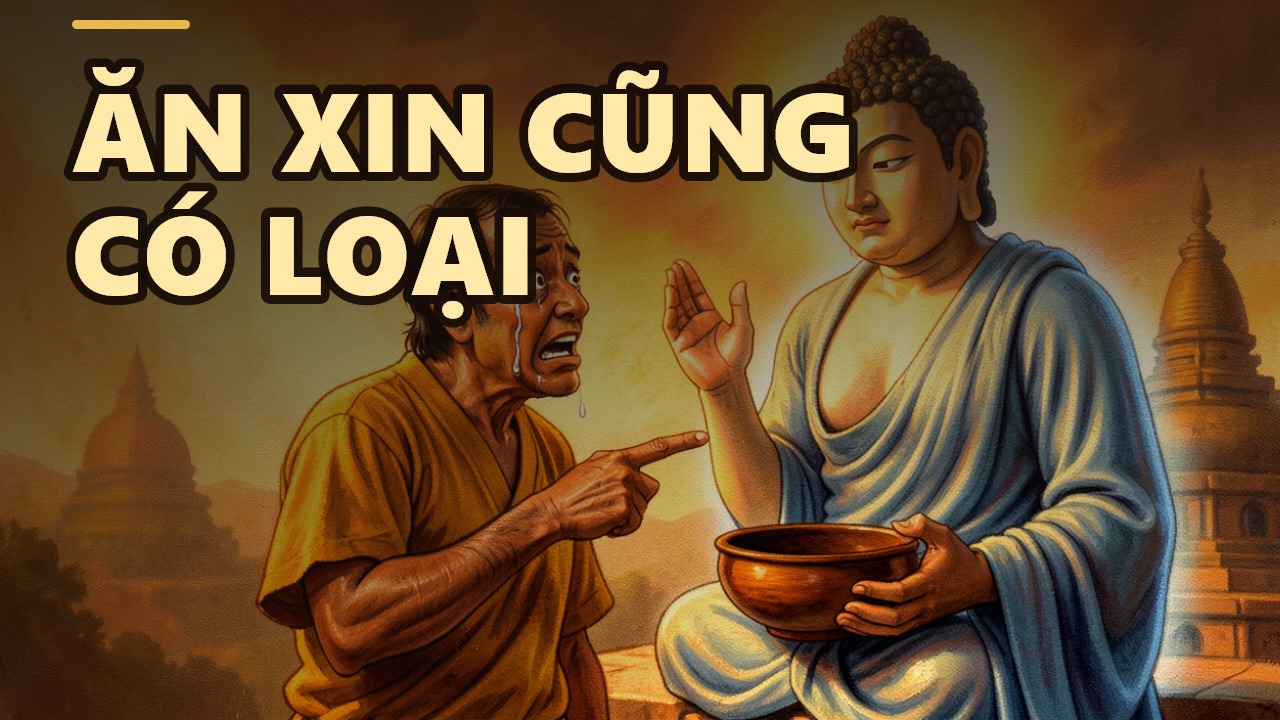
Long ago, a Brahmin left his family to become a renunciant. He carried a bowl and begged for food just like the disciples of the Buddha. One day, he met the Buddha and claimed that because he also practiced alms-round, he deserved to be called a bhikkhu, or a mendicant scholar. The Buddha gently corrected him, stating that not everyone who begs for food is a bhikkhu. Only those who fully uphold the right dharma, live a holy life, and remain mindful every second are worthy of being called true bhikkhus.
Begging has its own categories: What is a mendicant scholar?
The Buddha taught:
"It is not simply by begging that one becomes a bhikkhu. To be a bhikkhu, one must fully embrace the right dharma. Those who transcend good and evil, living a pure holy life, remaining mindful in every moment, are truly worthy of the name."
A practitioner differs not only in external appearance but also in inner mind/heart and moral conduct. In modern times, we often make mistakes when we see someone wearing robes with a shaved head and immediately assume they are a holy person. However, virtue is the most important measure.
The difference between a "mendicant scholar" and a "beggar"
The title "mendicant scholar" combines the word for "begging" and the word for "scholar," implying intellect and dignity. The term "scholar" adds value, much like doctor, professor, singer, or musician, all of whom possess education and character. Therefore, a mendicant scholar is not an ordinary beggar. Venerable Thich Chan Quang emphasized:
"Anyone who bears the title of 'scholar' must possess knowledge, usually indicated by degrees and proper conduct."
A true mendicant scholar walks with ease and grace during alms-round. If a household does not offer food, they move on without bowing low or pleading. They do not say "please give me food"; instead, they live by the right dharma, guided by compassion and mindfulness in every step. When receiving offerings, they leave surplus food for those who arrive late, practicing moderation and contentment.
Is silence wise or foolish?
Some people believe that silence is inherently holy. But the Buddha taught that the silence of one who knows nothing is merely the silence of a fool. A true recluse must possess wisdom, distinguishing between wrong and right, abandoning unwholesome actions while cultivating wholesome ones. The teacher quoted:
"It is not simply by keeping silent that one is called a recluse. Only when a person possesses wisdom, knowing what is right and wrong, understanding this life and the next, can they truly be called a genuine recluse."
In daily life, we often see people who appear quiet but lack real knowledge and understanding. Silence only holds value when accompanied by compassion and wisdom.
Material and spiritual value in making offerings
Usually, the one who helps another stands in a superior position, while the receiver is in an inferior one. But with a true bhikkhu, it is the opposite. When a layperson makes offerings of material goods, the bhikkhu gives back the dharma and faith. This return is worth hundreds of thousands of times more than the material gift. Even in silence, a virtuous bhikkhu inspires confidence in the Buddha's teachings (Dharma), guiding us toward goodness and away from evil. The teacher said:
"Therefore, even if it seems they give nothing, in truth, a true bhikkhu has given us so much that they remain in the superior position. This does not contradict cause and effect (karmic law)."
Thus, making offerings to a true practitioner is not ordinary charity; it is a spiritual connection through which we receive boundless dharma.
Practical lessons for today
This is a profound lesson: We must be wise in our judgments and avoid judging by appearances alone. Furthermore, we should examine ourselves to see if our words and actions contain any contempt for others. The teacher shared a story about an Arhat who knew that in a past life, his nephew liked to lie in a hammock with his feet pointed east, showing disrespect to people. As a result, in this life, he was born into a humble family. This teaches us how blessings from merit accumulate through small details.
May each of us, if we are monastics, nurture our virtue to deserve the title of true mendicant scholars. If we are laypeople, may we follow the good conduct of practitioners, correcting ourselves, turning toward goodness, and living a peaceful, awakened life.
AI-assisted translation from the Vietnamese original.
Read in Vietnamese →