
Hard to Practice Near Home: Lessons from the Handsome Monk Who Was Seduced
A dharma talk by the Venerable Thích Chân Quang tells the story of a young, handsome, wealthy monk whose family used beauty as a scheme to pull him back home. From this story, we see clearly how family instinct is a deep obstacle on the path of practice, and how dangerous are the traps that appear utterly natural.
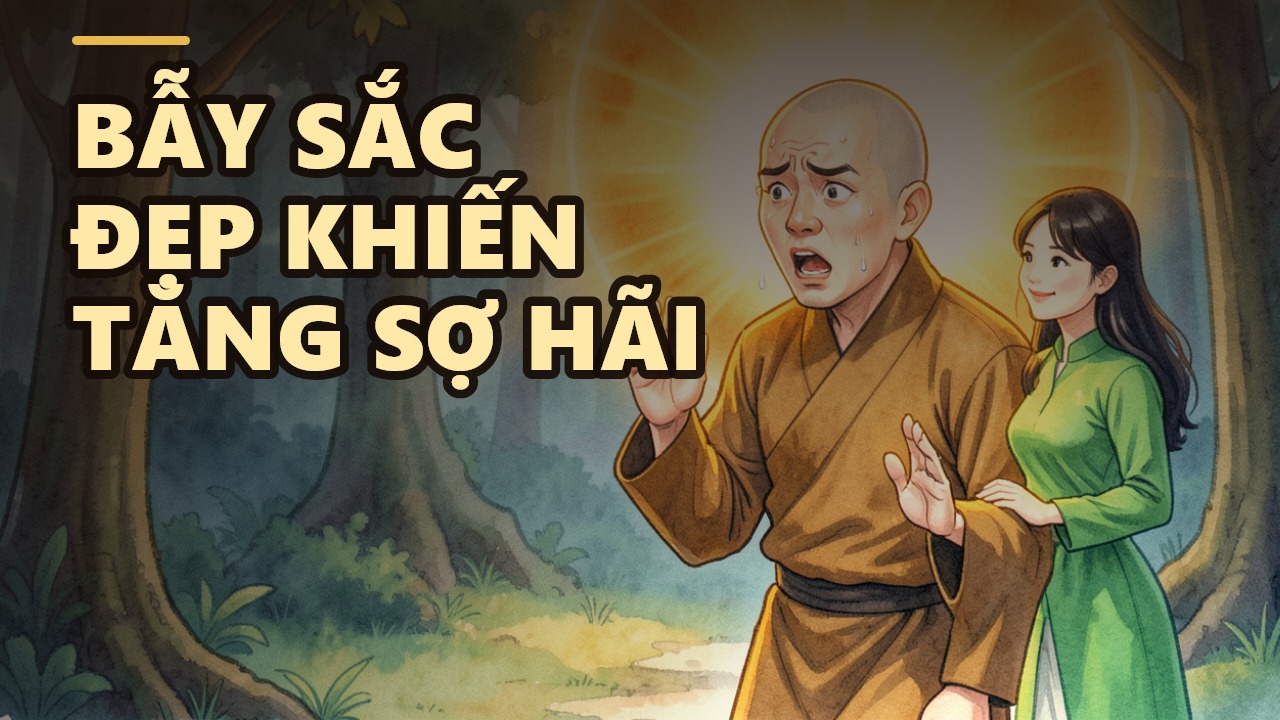
There was once a young man who was both handsome and wealthy, pampered by his parents since childhood. One day, he heard the Buddha preach the Dharma, understood the teachings, and resolved to become a monk. His parents refused, so he went on a hunger strike to win their permission. But even after he ordained, his family kept coming day after day, bringing gifts and attending to him as if he had never left home. Finding it hard to practice, he asked to move somewhere very far away. Thinking he was finally at peace, he never imagined his parents would pay a beautiful woman to stage a scene so natural that she appeared to be a devout Buddhist follower, drawing him step by step into their trap. At the very moment he was shaken, the Buddha appeared and spoke this verse: "In this world, one who has cut off sensual desire, left home, and lives the holy life; when craving for existence is fully destroyed, him I call a Brahmin."
The story of the monk Sundara Samudda is not only a moving tale but also a profound lesson for all who walk the path of spiritual seeking.
Why is it "hard to practice near home"?
In his talk, the Venerable Thích Chân Quang emphasized that no matter how beautiful or convenient one's homeland may be, those who truly ordain usually leave their hometown far behind to practice. Why is this so? Because family attachment keeps binding us, entangling us, stirring up in the mind images, memories, and responsibilities. He said:
"It is hard to practice near home. This is a very interesting point. Most of our monks and nuns, when they ordained, left home and went far away."
One who ordains is one who must "leave home," meaning they must completely let go of responsibility for their own family. Only when that root is cut off entirely can we love all sentient beings equally, as the Buddha taught. If there remains even a trace of partiality in the heart, a trace of "this is mine, this belongs to my family," then that person cannot realize the state of an Arhat. This is a deep reason why the Buddha established that anyone who truly seeks the fruit of the path must ordain.
Family instinct: A beautiful emotion or an obstacle?
For laypeople, love for family is morality, duty, something sacred and worthy of praise. But for one who has ordained, it becomes a great obstacle. The Venerable Thích Chân Quang analyzed this with great sharpness:
"Family attachment is an instinct of the kind that is very hard to sever. It is a mysterious, sacred thread in the depths of the human heart. For a layperson, it is called morality, duty, responsibility, a beautiful quality of the soul. But for one who has ordained, it is precisely an obstruction."
Because this instinct is so strong, there are people willing to trade away their entire country, their whole people, millions of lives, just to save their beloved child. They do not see this as wrong, because in their eyes, their child is everything. The world praises such devotion, but a practitioner must see clearly that it is a shackle.
The Venerable also offered a very concrete way to practice: A monk or nun should treat their family with proper respect, but without lingering attachment in the heart. With money offered by devotees through making offerings, one may sometimes need to help one's family, but must weigh it carefully, lest that burden damage one's blessings from merit. Even in the matter of transmission, a teacher must not choose a disciple to become abbot simply because that disciple is a relative. One must choose someone worthy in talent and virtue, in order to preserve the equality of the Dharma.
The "reasonable" trap of Mara
The life of the monk Sundara Samudda teaches us not only about letting go of family attachment, but also warns of something deeper: traps forever disguise themselves in forms that seem utterly natural and reasonable.
"A trap, by its very nature, appears extremely natural. For example, when a fish sees a worm wriggling very naturally, it lunges at it — and what happens? When we walk past a market and see it there, we never suspect that behind it, inside it, is a fishhook."
When people in the world are seduced or deceived, it is usually because they trust too much, because they are too simple. A person of virtue, with few schemes and little cunning, is easily treated with subtle manipulation. That courtesan prepared a luxurious house located exactly along the path where the monk walked on his alms round, with a cool courtyard and shady trees, and she took on the appearance of a gentle, devout laywoman. What sincere practitioner could ever suspect it?
For this reason, the Venerable Thích Chân Quang taught: when we see something that seems too convenient, too "reasonable," we must stay alert and examine it again. Very possibly, behind that appearance lies a scheme to make us lose our blessings from merit and our practice on the path. "In this life, there are things that seem reasonable to us — beware, for they may be very unreasonable. But the wise person is one who sees the unreasonableness hidden behind a very reasonable exterior."
A lesson for ourselves
Even if we cannot yet ordain because our conditions are not ripe, right now, in our hearts, we can still form the aspiration toward ordination. It is the love of the Dharma, the wish for liberation, the recognition, however small, of how worldly attachments bind us.
Let us practice loving with an equal heart, without partiality, without harming other sentient beings for the sake of our own family. In our work and in all our relationships, let us learn to see the unreasonableness hidden behind what appears beautiful and natural. And most important of all, let us always keep in our hearts a supreme aspiration: "One must ordain in the end — if not in this life, then in another. That is the final shore."
Let us pray for ourselves and all sentient beings to soon receive the wholesome Dharma, to soon cut the invisible cords that bind the soul, and to attain true liberation. Homage to our original teacher, Shakyamuni Buddha.
AI-assisted translation from the Vietnamese original.
Read in Vietnamese →