
Courage: The Fearless Strength to Protect the Dharma
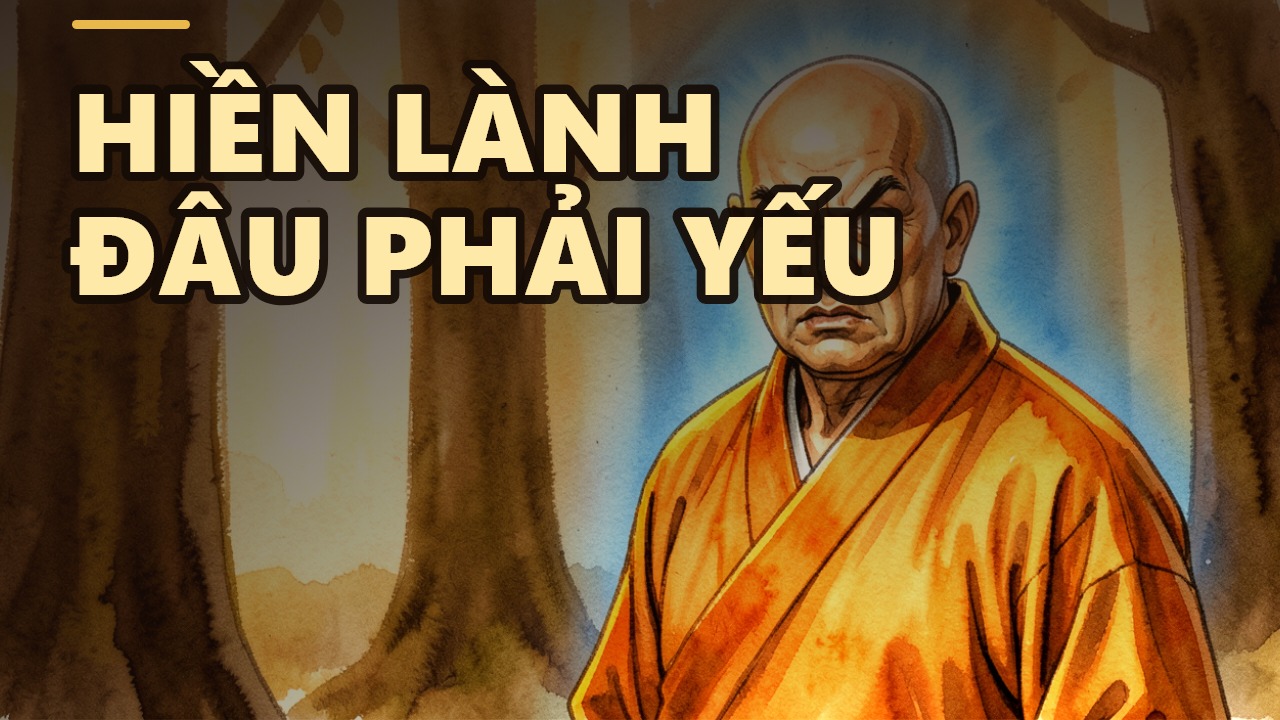
Have you ever wondered why Buddhists are often perceived as overly gentle, even weak? In daily life, kindness is sometimes mistaken for fragility, a lack of courage to confront injustice. Today, Venerable Thich Chan Quang invites us to reflect on a vital quality every practitioner needs: courage.
### Kindness Does Not Contradict Courage
Venerable Chan Quang begins by noting that gentleness has its merits, just as bravery does. However, if we misuse either trait, both become harmful. This reminds us that every quality has two sides. Misapplied kindness becomes weakness, while misapplied bravery becomes aggression. The issue lies not in the quality itself, but in how we choose to use it.
Courage, or spiritual strength, is defined as the power of fearlessness. It is the ability to face dangers and external threats with clarity and resolve.
### Courage Is Not Aggression
Many people mistakenly believe that courage means being fierce or aggressive. In reality, there is a profound difference. Aggression is loud and violent, whereas true courage is an inner state of fearlessness. It allows one to remain calm and find skillful ways to respond to challenges.
Consider a thief entering your home. A fearful person might close their eyes and pretend to sleep. A courageous person, however, quietly seeks help from authorities or finds a safe way to stop the theft. This is calmness, not violence.
In life, we often face difficult situations: defending justice, helping victims, or standing up against unfairness. In these moments, courage helps us move forward without trembling.
### Courage in Buddhism: From Deep Forests to Shaolin Temple
The Buddha left his palace to practice alone, facing wild forests and dangerous lands. He remained unmoved under the Bodhi tree when Mara tried to disturb him. Patriarch Bodhidharma drank poison five times yet stayed serene. These figures possessed extraordinary strength, praised as Great Heroism and Great Power.
At this level, it is no longer merely called courage; it is known as Great Heroism and Great Power. Among the titles we recite for the Buddha, "Great Heroism and Great Power" stands beautifully alongside "Great Compassion."
We see this balance at the Shaolin Temple, where martial arts became an expression of Buddhist practice. Monks trained their bodies not for fighting, but to build internal energy that supports meditative concentration and provides self-defense when necessary. This practice balances the passive tendencies of those who misunderstand the teachings.
### Lessons from History: Do Not Forget You Are the Dharma
When Islamic armies invaded India, many monks sat still and accepted death, believing this demonstrated patience and non-self (anatta). As a result, the Buddha's teachings (Dharma) were completely erased from that region. Venerable Chan Quang asks: What principle are we showing by standing still while others kill us? Is it patience? Non-self (anatta)? Gentleness?
He then affirms: Each practitioner is a part of the Buddha's teachings (Dharma). Losing one practitioner means losing a part of the Dharma. If all practitioners are lost, the entire Dharma disappears. Therefore, protecting one’s life is not selfishness; it is preserving a portion of the sacred path.
### Three Levels: Selfishness, Altruism, and Non-Duality
Some live only for themselves, which is selfishness. Others live entirely for others, forgetting themselves. This is altruism, but it still distinguishes between "self" and "other." Those with deep understanding see that self and other are one. Venerable Chan Quang teaches: "Self and other are simply one. Do not distinguish between them. For example, if you are hungry, feed yourself; if others are hungry, feed them. Because both you and they are experiencing hunger."
Thus, using this body to care for the Buddha's teachings (Dharma) is also caring for all sentient beings. When we no longer see ourselves as a separate "I," we feel merged with the Dharma. From this perspective, courage becomes the strength of non-self (anatta), acting with compassion (karuna) in all things.
Courage is not blind rushing; it is calm, clear wisdom to do what is right. Let us not allow gentleness to turn into weakness. Use this body to protect the Buddha's teachings (Dharma) and live a life beneficial to oneself and others. This is the noble meaning of "Great Heroism, Great Power, and Great Compassion."
AI-assisted translation from the Vietnamese original.
Read in Vietnamese →