
What Is the Most Reliable Refuge When Everything Changes?
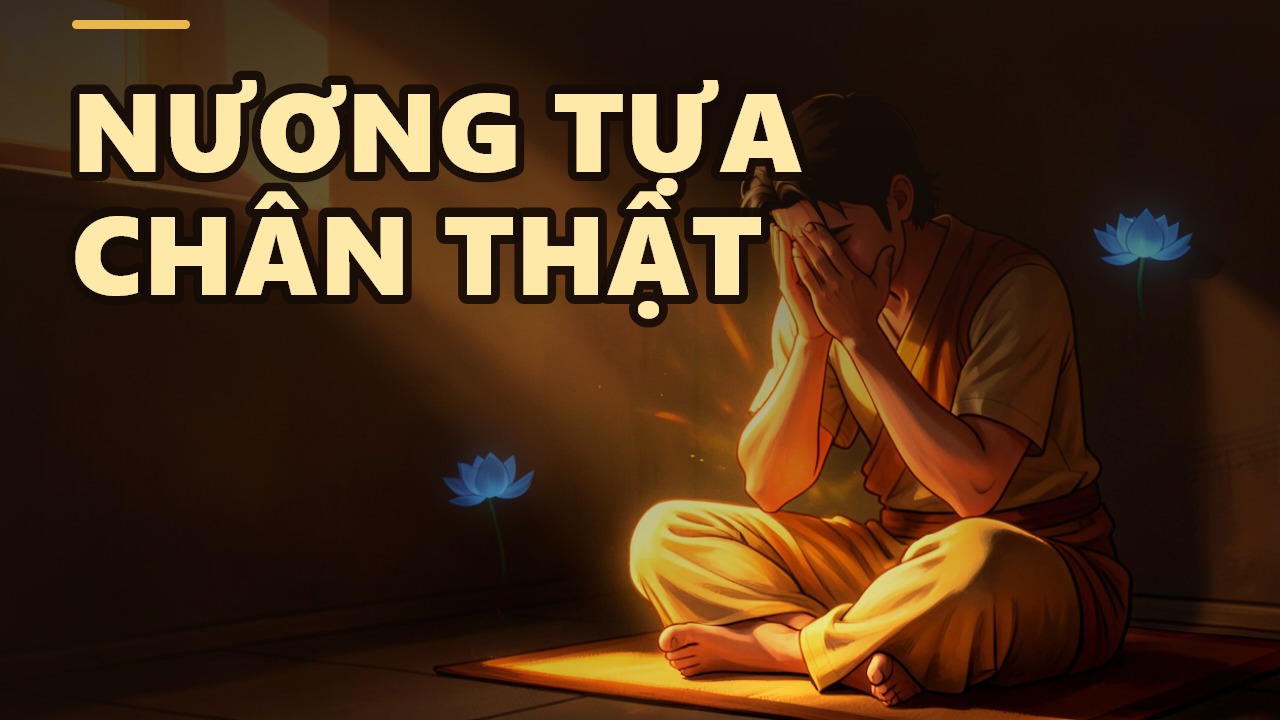
Venerable Thich Chan Quang helps us realize that the true Dharma is the only refuge amidst life’s uncertainties, and pure moral conduct is the path to genuine happiness.
There was once a young man in Rajagaha, born into a wealthy family, who had just married. One day, he discovered his wife’s infidelity. Overcome with shame, he dared not leave his house for a long time. Eventually, he visited the Buddha. The Buddha comforted him, saying, "It is not only in this lifetime that I speak of such matters. In a past life, this situation also occurred. Back then, I reminded you that seeking fidelity in human emotions is extremely difficult."
Unstable Emotions – The True Dharma as Refuge
In this life, nothing changes as quickly as the human heart. Someone may love you today but grow cold tomorrow. People make promises, only to turn their backs later. Therefore, the Buddha taught that worldly affection is not a stable foundation upon which to rest one’s life. In his dharma talk, Venerable Thich Chan Quang emphasized:
"In this life, the truth is that emotional relationships are unstable. Instability is not a solid ground where we can safely place our lives. Understanding this, we never become angry when we face betrayal in love."
So, what is the true refuge? There is only one thing: the true Dharma. The Dharma is the supreme support. When we understand this, we no longer suffer from the ups and downs of the world, but calmly observe everything as if it were merely a passing breeze.
Chastity and Responsibility – Two Values That Preserve the Family
A verse in the Dhammapada states, "Adultery defiles women." Some might hear this and think the Buddha favored men over women. However, the Venerable explained clearly: "Nature created two opposite genders, male and female. These distinct beings have different personalities and natural roles. It is precisely these differences that come together to form a family."
The value of a woman lies in her chastity. The value of a man lies in his sense of responsibility. If a woman loses her chastity, the family collapses. If a man lacks responsibility, the family falls apart. The teacher shared:
"If a chaste woman stands firm to hold the family together, the household will recover, and the children will continue to move forward steadily. But if the woman is unfaithful, the family breaks immediately. Thus, for stability, the primary role belongs to the woman, and her chastity is what allows the family to overcome all challenges."
In life, sometimes men may wander or behave frivolously for a while, but if the wife maintains the home, the husband eventually returns like leaves falling back to their roots. Yet if the wife is unfaithful, the family is lost forever. Therefore, everyone must uphold their natural role: men learn to bear burdens, and women learn chastity.
Generosity – The Brake on the Downward Path of Karma
The next verse says, "Greed defiles generosity." A person with a greedy mind cannot practice giving. The Venerable said, "Living in this world without knowing how to give, rest assured that you are descending from the human realm to the animal realm, and soon enough, to the realms of hungry ghosts and hell." To stop this downward slide of karma, we must use the brake of generosity.
"You may still have many flaws, incomplete morality, weak ideals, or shallow understanding of the Buddha's teachings (Dharma). But please start by giving first. This is the most fundamental merit. If you do not know how to make offerings, how to give, or how to share, it is as if your house has no foundation. All other merits easily collapse."
Generosity is not just about money; it is about giving time, assistance, and joy. Some say, "I am too poor to give." The teacher replied, "Poverty itself is often the result of greed in past lives. Now, you must break through it with decisive action." Interestingly, those who give so naturally that they enjoy sharing, whose hands are never clenched tight, possess a "saintly quality"—the nature of a Stream-Enterer. As soon as money enters their pocket, they think of giving it away. They do not hoard wealth for themselves.
Malice – The Trace of Hell
The third verse states, "Malice defiles karmic actions." Here, karmic actions refer to moral conduct. Malice is the desire for others to suffer. Feeling happy when others are in pain is malice. The teacher pointed out very common signs:
"When you see someone’s house burn down, you rejoice, thinking, 'Oh, now they have no money, so they cannot build a bigger house than mine.' When you see someone fail an exam, suffer, or when a family breaks up, you feel glad. These are signs of a malicious mind. Even if you did not cause the suffering, rejoicing in another’s pain means your heart is already malicious."
The result of malice is hell—"there is no escape route." Those with malicious minds will fall into hell after death. The teacher warned, "Among those listening to the Dharma today, many lack the power to harm others directly, yet they readily rejoice when seeing others suffer. As long as this mindset remains, the trace of hell awaits. Therefore, purify your soul until you feel deep compassion when witnessing others’ suffering. Only then are you truly a disciple of the Buddha, possessing that saintly quality."
Practicing in This Era – Do Not Let Defilements Remain in the Mind
The final verse reads, "Among these defilements, ignorance is the highest. A monk who removes defilements becomes free from stain." Ignorance is the root of samsara (cycle of rebirth). To remove defilements, monks must eradicate impurities. However, in our time, we are far from the Buddha and rarely meet enlightened beings, so progress is slow. The teacher identified two types of people who develop intense motivation to practice: those who meet an enlightened being, and those who deeply understand the teachings. Without these factors, the mind sinks into confusion.
The teacher also advised us not to blame monastics when we see their shortcomings. They were born in times without enlightened beings present, and their understanding of the doctrine may not be profound, making their practice difficult. Instead of criticizing, we should pray for them. Absolutely do not speak ill of the Sangha, as this weakens Buddhism. "Never speak ill of monastics. If anyone does, we must correct them immediately, because they are aiding the decline of the entire Buddhist tradition."
Restraining the Ego – The Key to Polite Living
Another verse in the Dhammapada says, "Easy is living without manners, stubborn like a crow, attacking with words, boastful, stained, and reckless. Difficult is living politely, always seeking purity, living selflessly, humbly, cleanly, and wisely." The six bad traits—rudeness, stubbornness, verbal attacks, boasting, impurity, and recklessness—are the characteristics of thugs. The qualities of good people are politeness, purity, selflessness, humility, cleanliness, and wisdom.
Why do humans easily fall into bad habits? Because everyone harbors a subtle "self" within the ego. As the ego grows, bad habits arise. When the ego is restrained and eliminated, negative traits disappear. Non-self (anatta) is the core of all goodness. The teacher taught, "The ego is the core of all evil, so non-self (anatta) is also the core of all good things in this world. Often, a person need not practice every aspect of morality perfectly; simply focusing on reducing the ego allows virtue to grow."
In modern life, there is a culture that celebrates individuality and the ego. Young people prefer to be different, standout, even dressing strangely. But this leads to social chaos. The lesson is to live harmoniously, connecting warmly with others, allowing the ego to shrink so society can stabilize. Practice restraint: restrain your mouth from cursing, your hands from stealing, and your mind from hatred. Remember, "Living politely, humbly, selflessly, and wisely is indeed difficult, for it requires eliminating our own ego."
Every Precept Matters – Do Not Underestimate Any Rule
In the sutras, laypeople once debated which precept was most important. The Buddha taught that every precept is vital, because one sin leads to others. The teacher gave an example: a rapist fears being reported, so he kills; to cover it up, he lies; to calm himself, he drinks alcohol; and finally, he steals a watch. From one crime, five sins emerge. Therefore, we must practice restraint from the very beginning.
"Every precept is important; every sin is fearful. Sin spreads like a chain reaction; one fault gives birth to another. So we must cultivate restraint. Initially, when bad habits are strong, we must cut them off, struggle against them, and hold them back. The ability to restrain oneself is a crucial strength for living in this world."
When you see someone you dislike, restrain your tongue. When you find dropped money, restrain your hand. When you see others showing off their cars, restrain your mind. Step by step, we purify the soul, eliminate defilements, and live in peace. Pure moral conduct is not just the foundation of ethics but the path leading to safety and happiness, ultimately reaching a state free from all stains.
Today, as you listen to the Dharma, reflect on your own heart. Do you still have greed, hatred, and delusion? Practice generosity, restraint, and cultivation. Do not let life drift by in instability and suffering. The true Dharma is your refuge; moral conduct is your compass. Start with the smallest things—a kind word, an act of sharing—to purify the mind/heart and bring peace to your life.
AI-assisted translation from the Vietnamese original.
Read in Vietnamese →