
Eliminating Delusions: Do Not Use Delusion to Eliminate Delusion
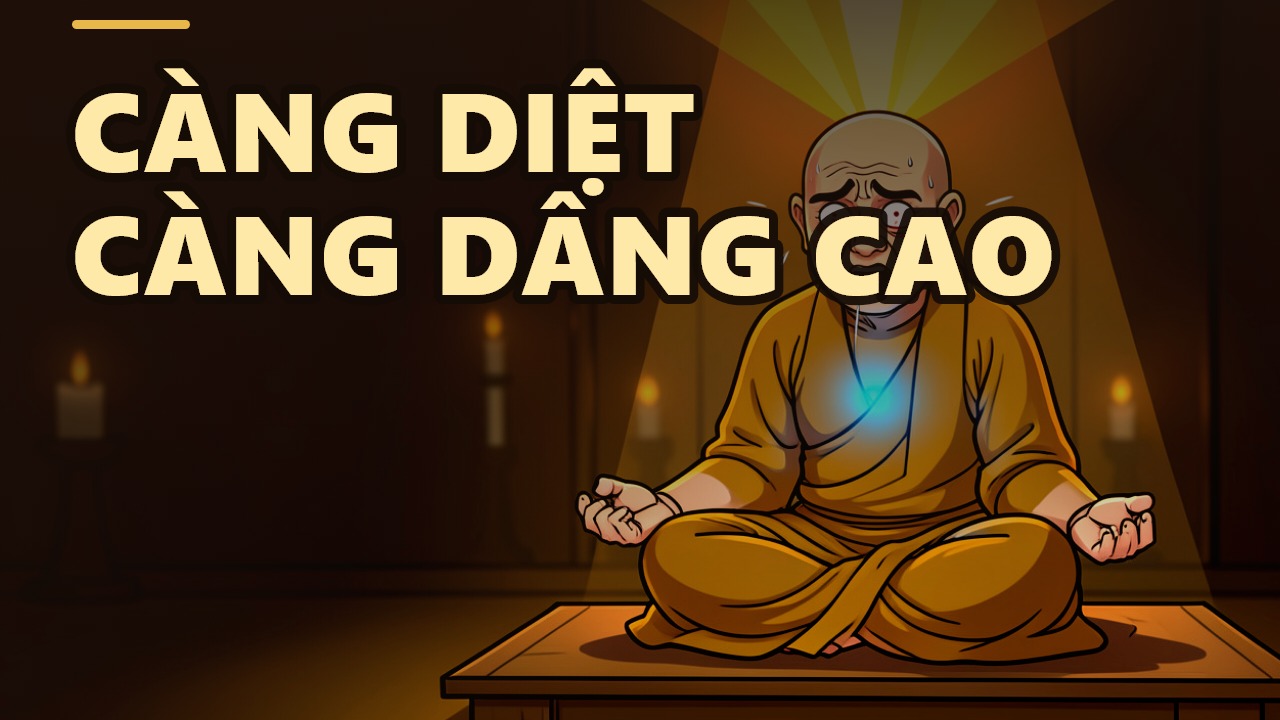
**Summary:** Eliminating delusion is a paradox, for the one who eliminates is also delusion. Learn to dissolve it through reverence for the Buddha and the cultivation of morality, like growing a lotus amidst the mud.
You sit in meditation, close your eyes, breathe deeply, and try to push away stray thoughts. But the harder you try not to think, the more you think. A hundred desires, a thousand threads, like waves endlessly crashing upon the shore. The ancients said: "Meditation requires eliminating delusion." But how? And what happens when the one trying to eliminate the delusion is itself delusion? Let us listen to the teachings of Thầy Thích Chân Quang to find the answer.
**What is the pinnacle of meditation?**
Thầy Chân Quang began with a question: "What is the pinnacle of meditation?" One who practices meditation must know what they are practicing for and where they are going. Otherwise, they will not have enough strength to endure the hardships of meditative concentration. The true purpose is not simply relaxation, but enlightenment and liberation.
What is meditation for? To seek enlightenment, liberation, to end ignorance, to end the self, to realize the path, to attain the path, to realize the state of an Arahant, or to become a Buddha.
However, not everyone who asks should hear this answer. Depending on their capacity, we answer skillfully: the one concerned with health hears "meditation to alleviate illness," the busy person hears "meditation for tranquility." But here, only those who have resolved to sit in meditation, to endure hardship and suffering, are ready to hear this profound purpose.
**The first step of meditation is a moment of emotion**
The practice of meditation does not begin with imitating the cross-legged posture. It begins from a moment in countless lifetimes: when we encounter a holy sage, witness their noble deeds, and our heart is moved with reverence. That is the first seed of the spiritual mind being planted.
In some condition, we meet a supremely enlightened sage, we understand a part of their greatness, and we are moved with deep respect. That is the initial step, the first thought arising in the endless stream of samsara.
From there, the seed is watered and grows through many lifetimes. Today, you are able to sit here and practice meditation; you have already walked a very long path. But do not be complacent. The journey from emotion to realization is still endless. Only those who are diligent and uninterrupted can shorten the time.
**The paradox of the one who eliminates delusion**
When we say "meditation is eliminating delusion," many imagine themselves as a person wielding a sword to chop off the heads of "delusion-thoughts." But Thầy Chân Quang points out a painful truth: the one holding the sword is itself delusion.
The very self that seeks to eliminate delusion is also delusion. Can one use dung to wash away dung and get clean? No. Can one use mud to wash away mud and be free of mud? No.
This is why many people practice their entire lives and still do not find a peaceful mind. The harder they try to eliminate delusion, the very desire for it is also delusion. They use mud to wash mud, and forever, they will never be clean.
**Dissolving delusion by growing lotuses**
If elimination is not possible, then it must be dissolved. See delusion like a muddy swamp. The swamp can nourish pure lotus flowers. Likewise, afflictions cannot be thrown away, but can be transformed into bodhi, the awakened mind.
The first method is a heart of reverence for the Buddha. Each time you pay respects to the Buddha, you are planting a lotus sprout amidst the muddy swamp of delusion. Morality and merit are the next steps: transform thoughts of harming others into thoughts of helping, transform love for some into compassion for all sentient beings. It is the same mind, but its direction has changed.
When that deluded mind transforms into inner morality, the mud becomes life, no longer foul or polluted. It is the same mind, but it has become something beautiful.
More broadly, we see that spiritual practice is not just sitting in meditation. Meditation is the backbone, but the body needs many other parts. A person who practices correctly is beautiful in every moment: chanting sutras, performing rituals, helping the community, expressing a moral heart. That is like polishing a diamond on many facets.
**Persevere in practicing correctly and completely, and you will taste peace**
Thầy Chân Quang emphasizes: meditation practice must be correct and complete. Correct means the method is accurate; complete means it is surrounded by all wholesome virtues. Right in this very lifetime, if we practice correctly and completely, even at seventy years old, we can taste the flavor of inner peace before we close our eyes.
Start from today. Each morning, set aside time to pay respects to the Buddha. Each day, uphold the precepts and live with goodness. Each hour of sitting in meditation, do not rush for the distant goal, but quietly transform the muddy swamp into a lotus. As the teacher taught, the foul, muddy swamp will become green, thriving paddy fields, turn into bamboo shoots, durian, oranges, lemons, guavas… That is the good thing for this life.
O child of the Buddha, do not wait for a giant leap. Begin with a single small step: sit down, breathe evenly, and direct your heart towards the Buddha. From there, peace will come like a cool, silent stream.
AI-assisted translation from the Vietnamese original.
Read in Vietnamese →