
Filial Piety: The Root of All Human Virtue
Venerable Thích Chân Quang expounds on filial piety – the foundation of all morality. The text helps us understand why honoring one's parents is the measure of character, and how to practice it in daily life.
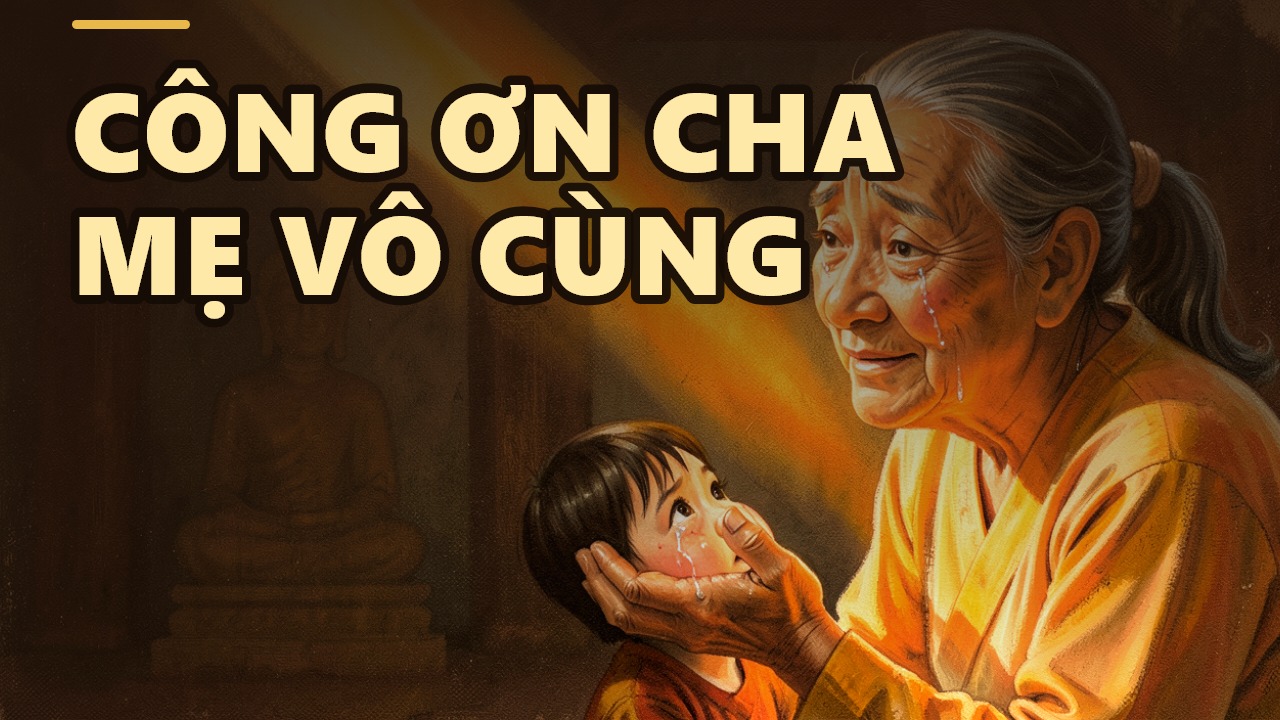
Have you ever wondered what makes a person truly trustworthy? Is it talent? Is it wealth? Or is it a kind heart? During a talk given on the occasion of Vu Lan, Venerable Thích Chân Quang pointed to a simple yet profoundly deep measure: filial piety.
Filial piety – the foundation of all relationships
The Venerable emphasizes that filial piety is not merely a duty of children towards parents, but the fundamental basis for evaluating a person's character. If a person lacks filial piety, then all their other relationships are also highly suspect.
"If you see a person who shows no filial piety towards their parents, you can be certain that they will not be good to their spouse, siblings, friends, teachers, or to their homeland. Because filial piety is the root virtue."
Therefore, when assessing a person, we should look at how they treat their parents. This principle applies regardless of wealth or social status. If a friend treats you well but scolds their parents at home, then that friendship warrants a second look.
Water flows downward – why do we so easily forget our parents' grace?
The Venerable points out an eternal truth: the love of parents for their children is always stronger than the love flowing in the other direction. This is a common human instinct.
"If left to pure instinct and human sentiment, the eternal law is that water flows downward. We tend only to care for, focus on, and love our own children, while our own parents are easily forgotten."
Thus, filial piety represents an awakening, where human beings use reason and conscience to "look upward" in remembrance of the grace of birth and upbringing. Without proper teaching, humans will gradually become like animals – only loving their own offspring and forgetting those who gave them life.
The grace of parents: boundless love and hardship
The debt owed to parents extends beyond concrete acts like providing food and clothing; it is enveloped in a boundless love. The Venerable uses a vivid example of two identical cakes: one given out of politeness, and one given with a whole heart of love. The value of the cake given with love increases ten thousandfold.
"Our parents treat us with this infinite and profound love, incomparable to anything. Therefore, the value of their care for us is, we say, priceless."
Furthermore, parents are our first teachers. The lullabies and simple folk verses mothers sing to us in infancy are our very first lessons in morality. As the saying goes: "Even if we travel through an entire lifetime, we still cannot finish listening to our mother's lullabies."
When parents are imperfect, children must still uphold filial piety
Sometimes parents make mistakes, hold outdated views, or lose their temper. But the Venerable teaches: "Even when our parents are sometimes wrong, we are not permitted to be wrong in return, because our duty as children is to uphold our filial piety completely."
This is a crucial point: filial piety is not a transaction. We honor our parents not because they are perfect, but because it is the human way. Even if parents divide an inheritance unfairly, children must maintain respect and not let greed take control.
Practicing filial piety: from lullabies to duty as a child
The Venerable shares concrete ways to practice this at every stage of life. In childhood, we repay our debt through obedience and good behavior:
"We repay our parents in childhood through being good-natured. Since we cannot yet provide for them, please just be obedient and well-behaved. That is the first form of repayment."
As we grow older and start working, children should dedicate their first earnings to caring for their parents. One should not rush into marriage while neglecting this duty:
"With your first paychecks, please restrain yourself. Do not rush into marriage, but first repay your parents by caring for them."
Using your first month's salary to buy milk and pastries for your parents – that is expressing filial piety, bringing joy to your parents, and accumulating great blessings.
Conclusion: Live out filial piety to be worthy of being human
Filial piety is not merely a ritual or a Vu Lan ceremony. It is an entire life's journey lived with gratitude, a loving heart, and a sense of responsibility. When we learn to honor our parents, we also learn how to love everyone. Let us begin with those closest to us. As the Venerable teaches: "Water flows downward, but we must learn to look upward."
AI-assisted translation from the Vietnamese original.
Read in Vietnamese →