
Fairness Is Not Equality: A Buddhist Perspective
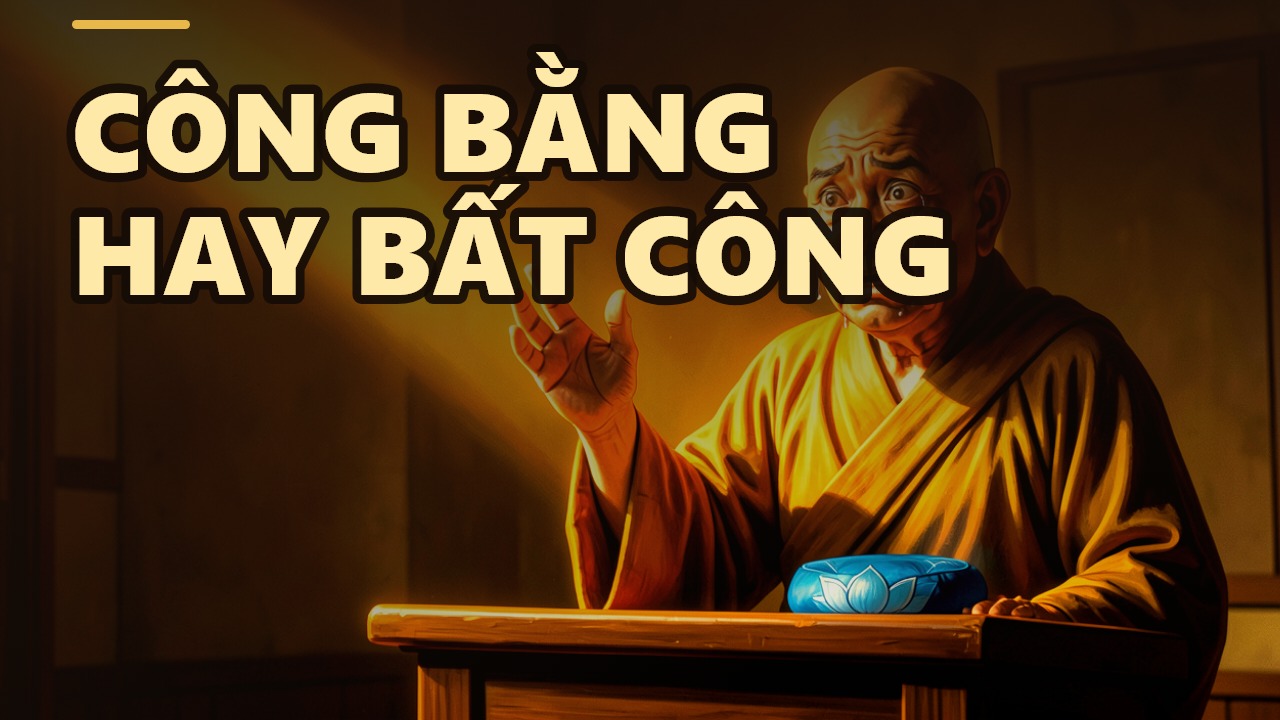
Have you ever wondered why some people are born into wealth while others face poverty? What does a truly fair society look like? In his New Year teaching, Venerable Thich Chan Quang offers an answer that may startle many. He reveals that fairness and equality are two concepts that are completely opposite to each other.
The Misunderstanding of Fairness
We often demand fairness, but few understand its true meaning. Venerable Chan Quang uses the example of a family. Parents love their children equally in principle, yet as the children grow, one may be diligent while another is wayward. If parents treat both exactly the same, the diligent child will feel unjustly treated. As the teacher explains, the word fairness is very different from the word flatness or uniformity. They are far apart, even contradictory.
In a company, skilled workers and less capable ones cannot receive the same salary. Treating people fairly means rewarding those who contribute more effectively. If everyone receives the same regardless of effort, society becomes paralyzed.
Fairness According to Cause and Effect (Karmic Law)
Buddhism teaches that every action has a corresponding result. Those who put forth greater effort naturally deserve better treatment. This is fairness according to cause and effect (karmic law). The person who contributes positively should receive preferential treatment. Conversely, those who bring no benefit, or even cause harm, do not deserve such privileges and may face consequences.
However, if this principle is applied rigidly, society falls into a spiral of division.
The Unexpected Consequences of a "Fair" Society
When the talented, healthy, intelligent, and wealthy are favored, they increasingly hold important positions. Meanwhile, the less fortunate are left behind. Society splits into two classes: the elite and the bottom rung. This leads to dissatisfaction, class struggle, and even rebellion.
This disparity creates deep repercussions. The rich get richer because they have capital and investment opportunities. The poor get poorer because they lack conditions for education and development. New injustice arises from the initial definition of fairness.
Those with advantages gradually occupy all key social roles and take all societal benefits. Who is left out? Those with poor health, little education, limited intelligence, weak morality, unattractive appearances, or impoverished backgrounds find themselves unable to achieve anything.
Even in wealthy nations like America, thousands of homeless people are left on the streets. In contrast, Vietnam, though poorer, strives to build homes for the needy. The teacher asks: Which society is truly fair?
Equality: Another Trap
If we choose equality, where everyone receives the same pay regardless of effort, no one will strive to work hard. Society collapses due to paralysis. The teacher uses a mathematical analogy: two plus two equals four, four plus two equals six, six plus two equals eight. But what happens when eight plus two equals zero? Every path has its price.
Enforcing absolute equality causes society to crumble. We see that strict fairness leads to extreme disparity between the very rich and the very poor.
A Buddhist View: Avoiding Extremes, Turning Toward Enlightenment
The Buddha taught that both fairness and equality are worldly concepts, inherently imperfect. The Buddhist perspective does not stop at distributing wealth, but focuses on transforming the mind/heart. When each person practices spiritual cultivation and engages in letting go of greed, hatred and delusion, society naturally finds peace.
In his talk, the teacher recalls a poem by King Tran Nhan Tong about the realm of enlightenment and the spring season: "Human life is but a breath; worldly emotions are tears. The demon’s palace is noisy; is there any joy greater than the realm of enlightenment?"
This serves as a warning for us to look inward, cherish spiritual values, and seek true peace.
The teacher does not ask us to choose between equality or fairness. Instead, he guides us to live with wisdom and compassion. An ideal society lies not in policies, but in the character of each individual. Begin with this breath, with this thought. Let every action be wholesome, so that cause and effect (karmic law) naturally creates a society we might call the realm of enlightenment and eternal spring.
AI-assisted translation from the Vietnamese original.
Read in Vietnamese →