
The Bodhisattva's First Awakening of Mind: When a Saint Accepts Rebirth as a Pig to Save Others?
A dharma talk by Venerable Thích Chân Quang on the Mahayana bodhisattva ideal: boundless sacrifice, taking no credit for merit, and relying on the Buddha's spiritual power.
Two Ideals: The Arhat and the Bodhisattva
In the early period of Buddhism, the goal of practice was to attain the state of an Arhat — a saint who has completely severed all afflictions (kleshas) and will no longer be reborn. But when Mahayana thought emerged, a new and higher level was opened: the image of the bodhisattva — one who vows to save all sentient beings before thinking of themselves. This was a natural development of Buddhism, yet it also gave rise to great controversy:
"It was so new, so strange, and so unique that some schools holding to the old tradition refused to accept it, saying that this new teaching was not spoken by the Buddha."
And yet, for those with wisdom and a vast altruistic heart, the bodhisattva ideal becomes an irresistibly powerful calling. They see the suffering of all beings and simply cannot turn away.
Nagarjuna: An Otherworldly Genius
Speaking of the emergence of Mahayana thought, one cannot fail to mention Nagarjuna. The treatises he left behind leave later generations in awe:
"His treatises, even to this day, remain a challenge to the intelligence of humankind."
He demonstrated that this cup never began and never ends. He demonstrated that you have never gone anywhere, never arrived anywhere. Such arguments sound jarring to the ear, yet they are so rigorous that no one can refute them. It was precisely with these arguments that he shattered the notion of a creator God who made all things — a notion that forms the foundation of many other religions.
Willing to Become a Pig to Save Pigs: Boundless Sacrifice
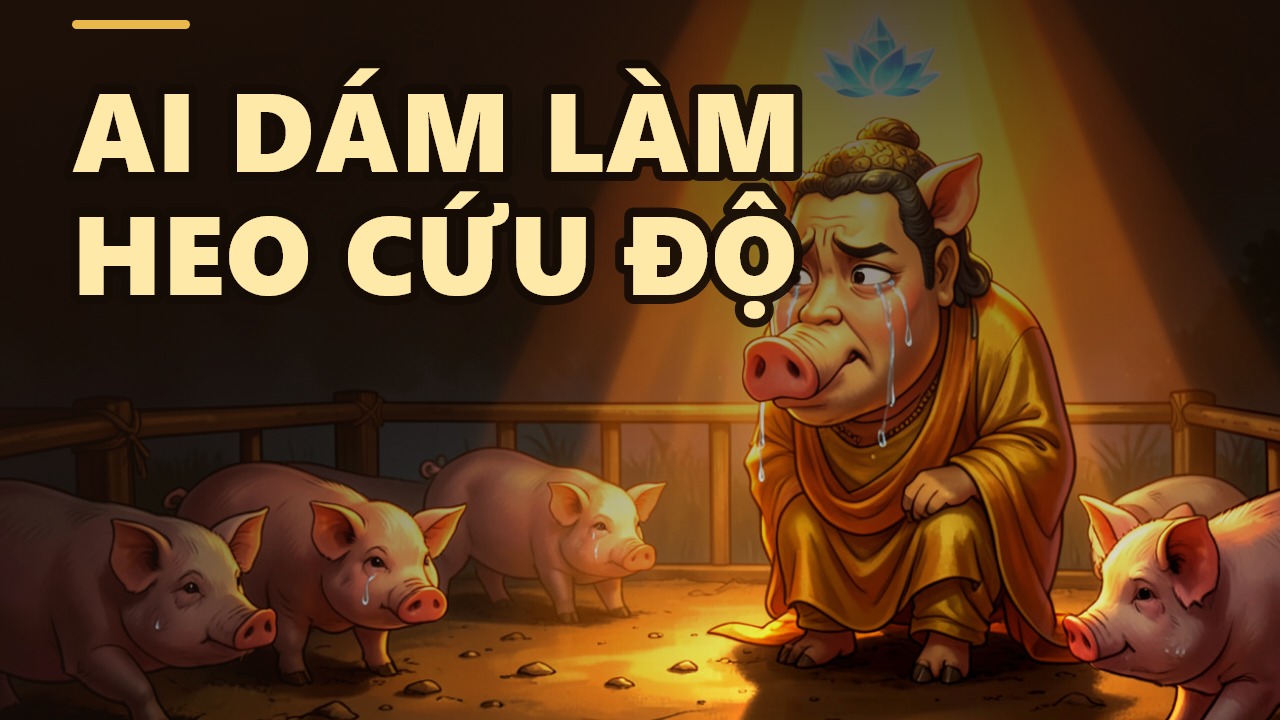
The Venerable offered a very vivid image: each of us looks at a herd of pigs and sees them as filthy, foul-smelling, living in squalor. Yet if we were to vow to be reborn as a pig in order to teach and save them — who would dare?
"I vow to be reborn as a pig, to live wallowing among pigs, in order to save them. Who dares do such a thing? Raise your hand!"
A bodhisattva, having transcended the human realm, looks back at humanity exactly as we look at a herd of pigs: foul, filthy, full of gossip and jealousy. Yet they still accept returning, living among such unwholesome hearts, solely to plant the conditions (dependent origination) for liberation. That is a magnificent sacrifice — the spirit of Ananda's vow to "be the first to enter this evil world of turbidity": not to attain Buddhahood until all sentient beings have become Buddhas.
Taking Credit: The Invisible Wall Between Ordinary Beings and Bodhisattvas
The greatest difference between us and the bodhisattvas lies not in ability, but in how we regard the merit we have created. The Venerable told a very down-to-earth story:
"All sentient beings suffer from this habit: doing a small good deed and remembering it forever, praising themselves endlessly — and thus they cannot attain sainthood."
Give up a seat to an elderly woman, and we praise ourselves for three months. Give a bowl of noodles to a beggar, and we go on praising ourselves for three years. The bodhisattva is the opposite: they perform countless acts of merit, even sacrificing their very lives for sentient beings, yet forget it all in an instant, never allowing a single thought of "I did this" to cling. This is the teaching of the Prajna Paramita Sutra: "Do everything, but take no credit."
Relying on the Buddha's Power: A Lesson in Humility
In the Great Prajna Paramita Sutra, Subhuti declared: "It is by the power of the World-Honored One that I speak this teaching of prajna." This teaches that all understanding, all eloquent words of Dharma, are not our own. The Venerable emphasized:
"Every word, every syllable of this — what is it truly? It is the grace of all the Buddhas, not the teacher's own."
When a dharma teacher still considers themselves talented and still enjoys being praised, that ego has already destroyed the path. Only by humbly seeing oneself as "grass and rubbish, dust beneath the Buddha's feet" can one teach the Dharma enduringly.
The Bodhisattva's Way of Being: Wandering Without End
A bodhisattva travels everywhere. Seeing a village about to be devastated by war, they arrive beforehand to prepare the people. When war breaks out, they appear again with medicine and rice to save sentient beings. When the work is done, they quietly depart, leaving no trace. Each time they accomplish such a deed, their merit ripens, and they are reborn into this world again, growing ever more extraordinary. They never stop walking, for as long as beings still suffer, there will still be hearts of compassion.
Try to practice living like a bodhisattva: do good deeds and then forget that you have done them, a little each day, a little with each thought. That is the most sacred path, and anyone can step onto it right now.
AI-assisted translation from the Vietnamese original.
Read in Vietnamese →