
The Secret of Great Wisdom: Starting from the Smallest Things
**Summary:** The key to unlocking wisdom is to begin with the smallest things. Master Thích Chân Quang teaches that when we attend to small matters, a greater vision naturally unfolds, and this is the path to happiness.
Have you ever thought that people with great wisdom always do grand things, while those with lesser wisdom only handle small tasks? In his lecture "The Small Things," Master Thích Chân Quang pointed out that this is not entirely true.
"We usually think that way, but in reality, it isn't so. A person with lesser wisdom has a narrow view of work, while a person with great wisdom has a broad horizon. This narrowness and breadth don't run horizontally, but along a vertical axis of high and low."
A person with lesser wisdom only sees problems at an average level—like giving rice to the hungry. A person with great wisdom looks deeply to the very foundation of the smallest needs, and also looks up to the most distant goals. They see that a poor person needs not just food, but also health to work, and a trade to sustain their family in the long term. From that small starting point, they open up a grand vision.
**The lesser wisdom looks narrowly; the great wisdom looks deeply.**
Master Thích Chân Quang used the example of helping those who suffer. A person with lesser wisdom sees what they lack and provides it—a packet of noodles, a set of clothes. A person with great wisdom pays attention to whether their health allows them to work, where they will sleep, if they have a mosquito net, and what trade they might learn in the future to support themselves.
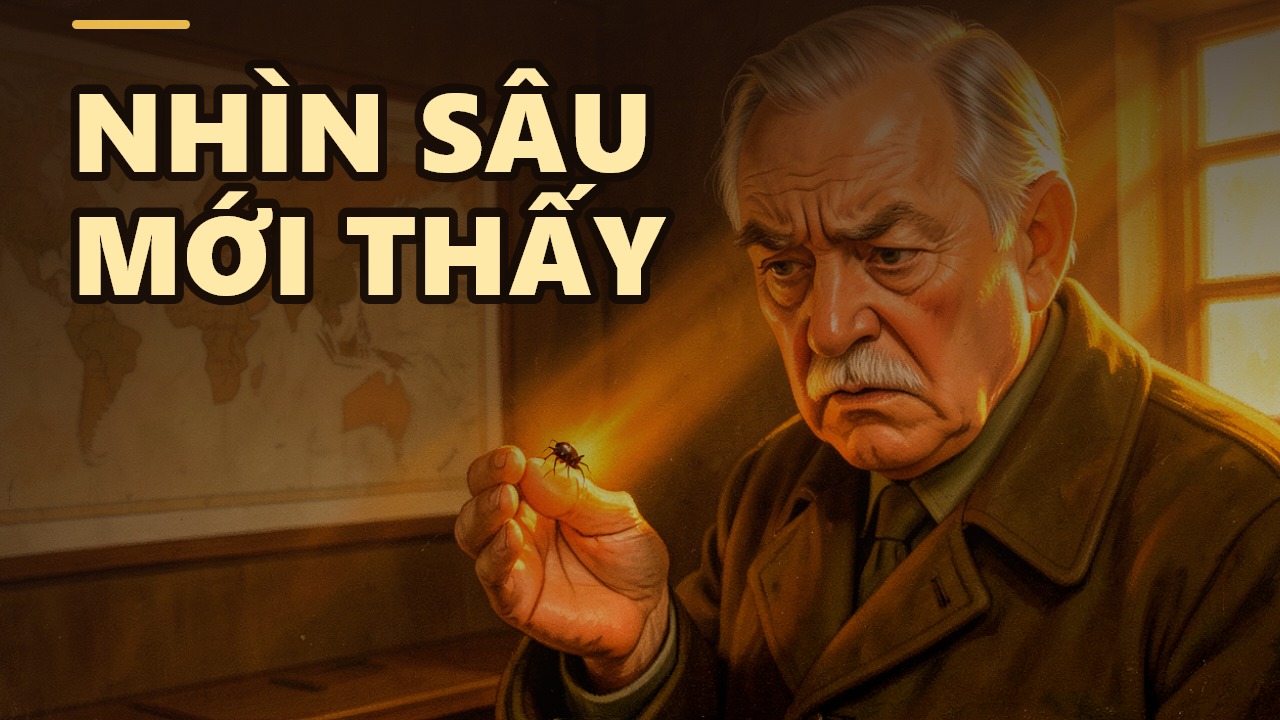
It is precisely these small matters that nurture great strength. The Master recounted the story of Prime Minister Winston Churchill during World War II. When given command of a front, he did not worry about guns or provisions, but discovered that soldiers were being bitten by bedbugs and could not sleep enough, weakening their combat effectiveness. He said, "We will win the battle against the bedbugs first, and then defeat Germany." Because of this, the British army grew stronger and achieved the final victory.
**The secret to expanding wisdom: Open the small door, and the great door opens by itself.**
The secret lies here: it is like when you pull one side of an automatic curtain, the other side opens as well. Wisdom is the same. When we practice focusing on small things, a broad vision naturally opens up.
"Just be attentive to the small things, just care for the smallest acts of goodness, just take on responsibility for the community from the tiniest deeds, and automatically the part of wisdom that looks at the big picture will also unfold accordingly."
This is why talented leaders always advise their staff: "If you cannot see the small details, you cannot accomplish great things."
**Perceiving danger in even the smallest fault.**
In Buddhism, there is a teaching: "A monk must see the danger in even the smallest fault." Master Chân Quang gave an example: when a driver throws a bottle onto the road, they think it's normal because someone will sweep it up in the evening. But that very mindset creates karmic retribution: one will become the street sweeper in a future life. The law of cause and effect is that subtle.
Similarly, when we stop our car in a narrow road to answer a phone or buy fruit, we think it's no big deal. But the stress of the people behind us, the obstruction we cause, will return to us on our own life's path as failures, frustrations, and blockages.
**Responsibility for small things is responsibility for life.**
In a meditation center, if we see a child running alone or an elderly person struggling to climb a step, we are not permitted to look away. That is a fault.
The Master taught: for those whose capacity for action is diminished and who fall within our field of vision, we must take responsibility. This is a rule of heaven and earth, not written in law, but inscribed in conscience and wisdom. Those who can do this will experience a strange happiness, independent of wealth or circumstances. It is precisely through this attentiveness and responsibility that they find peace and confidence.
**From small things, we see macroscopic problems.**
When we become accustomed to seeing and doing small things, we will naturally see big problems. For instance, if we are assigned to organize a dharma talk, we will list each small task: the sound, the speaker cables, whether chairs have backrests, the restroom... These seemingly small details determine the success of the entire event.
A person responsible for each small thing will have the ability to address macroscopic issues like traffic congestion, economics, and integration. They will see that for a country to develop, it needs refined, high-technology products—and from there, they find practical solutions.
Start today. Practice seeing the smallest things in your life—a grain of rice, a single chopstick, a passerby who needs help. Automatically, your wisdom will expand, and you will see the great things you previously never noticed.
That is the secret to a happy and wise life.
AI-assisted translation from the Vietnamese original.
Read in Vietnamese →