
Why Is Impermanence Suffering? Teachings to Help You Let Go of All Attachment
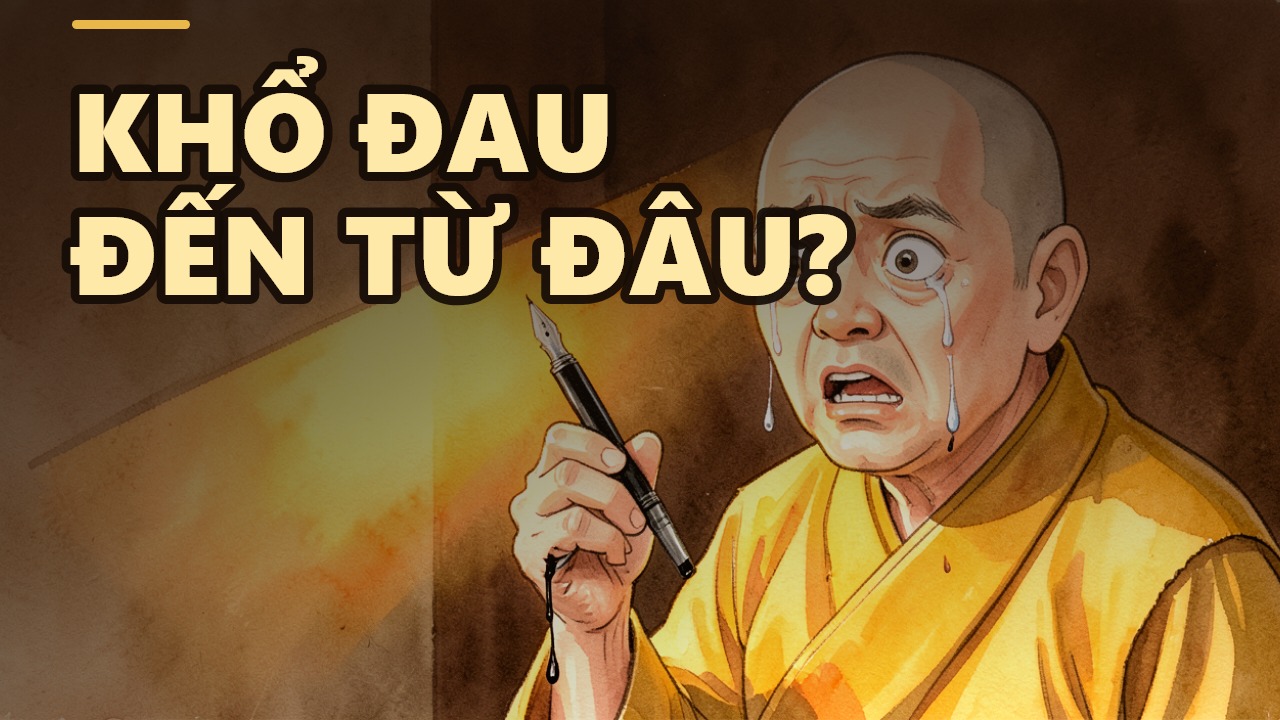
Have you ever loved something so deeply that when it was lost, your entire world seemed to collapse? It might be a beautiful pen, a close friend, or even your own health. All things are impermanent (anicca), and this very impermanence brings suffering (dukkha). Yet, there is a path to step out of this pain.
1. Impermanence Is Suffering: An Inevitable Law
The Buddha taught: "Whatever is impermanent is suffering. Impermanence is suffering." This may sound simple, but its meaning is profound. When you cherish a beautiful pen, you feel joy in possessing it. But when it rusts or is lost, sadness arises. Similarly, with a close friend, you find happiness, yet when they leave or fall ill, you endure hardship. Because all things are subject to impermanence and decay, whatever brings happiness inevitably becomes a source of pain when it is gone.
"Whatever is impermanent is suffering. Impermanence is suffering," says Venerable Thich Chan Quang.
This is not merely a logical argument, but a truth acknowledged by many Western philosophers: "What you consider happiness will cause you suffering when it is lost." Therefore, impermanence is not an abstract concept, but an obvious law of life.
2. The Five Aggregates: Form, Feeling, Perception, Mental Formations, and Consciousness Are Not "Self"
In the sutra, the Buddha clearly points out that human beings consist of five aggregates:
Form: the physical body and appearance. Feeling: sensations of pleasure, pain, or neutrality. Perception: thoughts, imaginations, and mental images. Mental formations: volitions, decisions, and deep emotions. Consciousness: passive awareness, vast and boundless.
All these are impermanent and subject to change. If we see them as impermanent, we should not regard them as "I," "mine," or "my self." Venerable Chan Quang emphasizes: "This is the essential point of the entire Buddhist path." However, because our attachment is so deep, especially to the physical body, letting go is difficult.
"Never regard them as 'I,' 'mine,' or anything related to 'self,'" advises Venerable Chan Quang.
He shares a story: A young woman received a heart transplant from a deceased male donor. After recovering, her personality changed; she began drinking beer, riding motorcycles recklessly, and eating fried chicken—things she had never liked before. These were the habits of the donor. Even though he had passed away, his heart carried an invisible attachment that bound the recipient. Likewise, after death, consciousness can linger around the corpse or ashes due to deep clinging. This shows how intense attachment to the body can be.
3. Disenchantment – The First Step of Letting Go
When one clearly sees impermanence, the practitioner develops disenchantment—a turning away, or more accurately, a lack of clinging. Venerable Chan Quang explains disenchantment as "turning away" and "leaving behind," a feeling of non-attachment to body and mind. From disenchantment comes detachment from greed, hatred and delusion, and from detachment comes liberation. This is an internal transformation, not just intellectual understanding.
"Because of disenchantment, there is detachment. Because of detachment, there is liberation," states Venerable Chan Quang.
Disenchantment is not negative disgust for life, but clear seeing that frees us from bondage. As we practice contemplation, we increasingly realize that the body, feelings, perceptions, and mental activities are changing every second. Consequently, we no longer cling to them. This is the beginning of liberation.
4. Learn to Practice, Not Just to Understand
Venerable Chan Quang warns that many monastics easily become "scholars"—learning only for understanding without practicing. But the purpose of learning is practice. Without application, the teachings become dry and bland. Then, when we pass them on to disciples, the instructions lose their vitality.
"We are monastics, practitioners of the Dharma. We learn to practice, not just to understand," reminds Venerable Chan Quang.
This is a reminder of our responsibility to future generations. If each generation passes down only knowledge without practice, the Buddha's teachings (Dharma) will gradually fade. Contemplate this body hour by hour, minute by minute, while eating, sleeping, walking, and standing. Cultivate disenchantment toward this form, bringing the power of practice into every word.
5. Let Go of Everything to Attain Liberation
In the process of cultivation, when meditative concentration deepens, what remains is a vast, passive awareness—the aggregate of consciousness. The Buddha teaches that we must not cling even to this aggregate, viewing it also as impermanent. Although we may not transcend it immediately, if we do not accept it as "self," we are on the right path. Gradually letting go of each aggregate leads to the state of Arhat.
"When you attain this level of concentration, remember today’s teaching: do not cling," advises Venerable Chan Quang.
Here lies the miracle: simply by not clinging, even if we have not yet crossed the deepest threshold, we are purifying ourselves step by step. When conditions are ripe, realization will occur.
Today, as you hear these teachings, please do not let them remain mere knowledge. Spend a few minutes daily contemplating body and mind, letting go of what is not truly "you." Peace lies in clearly seeing impermanence and refusing to cling. Through practice, the Buddha's teachings (Dharma) will continue to shine as a light for humanity.
AI-assisted translation from the Vietnamese original.
Read in Vietnamese →