
Why Did the Buddha Say the Twelve Links of Dependent Origination Span Only Two Lifetimes?
Understanding the twelve links of dependent origination as the Buddha taught: not three lifetimes, but only the causes of a past life and the results of a future life. This article opens a profound perspective that helps us escape suffering (dukkha).
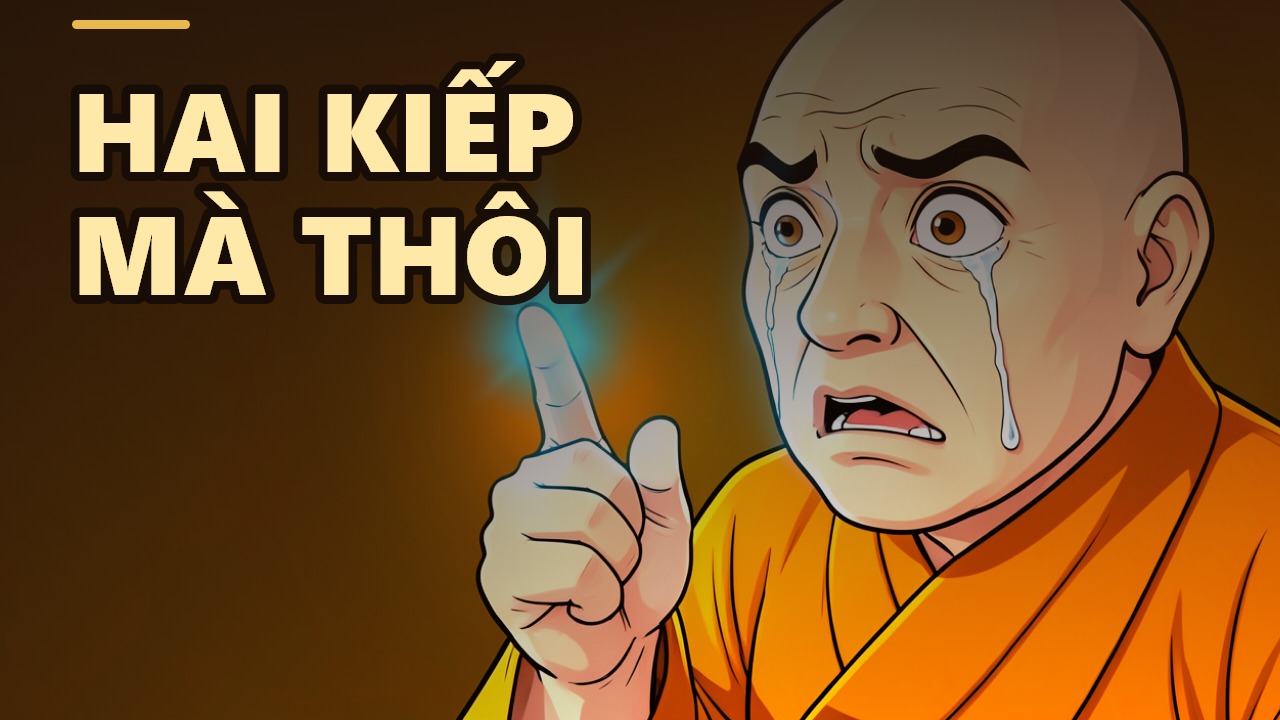
Have you ever wondered why we are born, then grow old, fall sick, and die? Why is one person intelligent while another is blind or deaf? Many people believe that an unchanging "soul" travels through samsara (cycle of rebirth) from one life to the next. But the Buddha taught something different. In the Discourse on Cutting Off Craving, he rebuked a monk who believed that consciousness does not change. It was from this that he revealed the twelve links of dependent origination, a profound spiritual roadmap for understanding and escaping suffering (dukkha).
The Twelve Links: Not a Map of Three Lifetimes
We often hear it taught that the twelve links of dependent origination span three lifetimes: past, present, and future. But in his dharma talk on the Discourse on Cutting Off Craving, Master Thích Chân Quang pointed out that this view is not accurate. The Buddha spoke only of two lifetimes: the causes of a past life and the results of a future life. The cause of rebirth lies right within the mental process of the past life, from ignorance all the way to clinging, which creates karma; then from becoming, birth, aging and death appear in the next life.
"In truth, the Buddha spoke of only two lifetimes. In these twelve links, the Buddha spoke only of the past life and the future life; he did not speak of past, present, and future."
This helps us look more closely at the present: every moment we live is the result of causes created in the past, and the present itself is creating causes for the near future. We do not need to search for some distant lifetime; right here, in every breath and every thought, we can observe this turning wheel.
The Word "Condition" — One Word, Three Meanings
In daily life, we often say we "have a connection with someone" to describe a good relationship. In the teaching of Prajna, a condition (dependent origination) is a factor, an element that comes together. But in the twelve links of dependent origination, "condition" is a verb: it causes the activity of what follows. Master Chân Quang explained this very clearly:
"The word 'condition' in the twelve links of dependent origination is a verb; it means to cause the activity of what comes after."
For example, "ignorance conditions formations" means that ignorance causes the activity of formations. Understanding this meaning, we see that each link is not a fixed thing, but an impulse, an energy flowing from the subtle to the coarse, from mind/heart to body. We realize that it is misunderstanding itself (ignorance) that drives our mental formations, and those mental formations create the Sense of Self (consciousness), and so on. We are not bound by an unchanging "soul," but by the continuous flow of cause and effect (karmic law).
Why Does Ignorance Activate Formations Before Consciousness?
In the twelve links, the order is ignorance, formations, consciousness. This seems strange: formations are placed before consciousness, even though the formation aggregate is coarser than the consciousness aggregate. Why did the Buddha not arrange consciousness first? Master Chân Quang used the image of a sprouting plant to illustrate:
"When we look at a plant, we see that wherever there is movement, this corner moves first, and only afterwards does it send roots down and begin to reach upward, becoming the perception aggregate."
When a seed sprouts, the junction between root and shoot (called the "stam") moves first; only then do the roots grow downward (the consciousness aggregate) and the shoot reach upward (the perception aggregate). Similarly, the "lair of the self" — the formation aggregate — activates first, and only then does it pull the consciousness aggregate down into depth. The Buddha taught us to see this process not as a mechanical procedure but as the natural law of the mind/heart. This very skillfulness shows that his wisdom far surpasses ordinary reasoning.
The Six Sense Bases: Whose Senses Does the World Appear Through?
Each sentient being has six different sense bases, and therefore the world they perceive is entirely different. Master Chân Quang recounted that people blind from birth know the world only through touch and hearing. They cannot imagine colors or light. Even those who become blind later through accident gradually forget the faces of their loved ones, a hidden sorrow. This reminds us that:
"These six sense bases are fascinating. Because each sentient being has different senses."
When we understand this, we become less confident that our world is the only one. It is like the story of aliens who communicate through scent — they would not understand our sounds or images. In that case, our very conceptions of the world, of people, of happiness and suffering (dukkha), are only one perspective among countless perspectives. Realizing this helps us open our hearts with compassion, understanding that each person's "self" is only a product of the senses and of karma.
The Buddha's Wisdom Beyond All Images
Master Chân Quang expressed his deep admiration for the Buddha: "The more I practice and study, the more I revere the Buddha." Because although everyone memorizes the twelve links of dependent origination when they first begin to practice, that psychological process cannot be seen without attaining realization. The Master quoted:
"Teachings like this, we learn them as soon as we enter the path, and we know right away what the twelve links of dependent origination are, what the Noble Eightfold Path is, what the Four Noble Truths are — we know within the very first days of entering the path. But the true process of the twelve links cannot be seen without attaining realization."
He also compared supernatural powers with wisdom: supernatural powers are insignificant; wisdom is what deserves reverence. The Buddha's teachings (Dharma) are a formula that never changes, like the formula for attaining meditative concentration. Therefore, studying the twelve links is not for the sake of knowing about samsara (cycle of rebirth), but for transforming the mind/heart right here. When we clearly see how the clinging that creates karma operates, we can practice letting go, stop, and no longer create new suffering (dukkha).
The Buddha taught: "Whoever sees the twelve links of dependent origination sees the Dharma." Today, try to begin observing yourself: when anger arises, can you see ignorance pulling along formations, then consciousness, then name and form, like a chain reaction? Each time we stop is a moment of freeing ourselves. This lesson is not dry; it is very much of this life, very close. We need not wait for a future life; we can be at peace in this very life, beginning with the very next breath.
AI-assisted translation from the Vietnamese original.
Read in Vietnamese →