
Why Is Keeping the Precepts Difficult? The Secret of the Three-Legged Stool: Precepts, Concentration, and Wisdom
Have you ever wondered why, despite having taken the precepts, we sometimes fail to keep them perfectly? Are the rules merely dry regulations? In truth, keeping the precepts is not just about using willpower to resist temptation. Like a three-legged stool, precepts, meditative concentration, and wisdom must exist together. If one leg is missing, the entire structure collapses. This is the profound secret of the three trainings in higher learning that Venerable Thich Chan Quang often reminded candidates about before they ascended the platform to take their vows.
The Three Legs of the Practitioner’s Path
In Buddhist teachings, the three trainings in higher learning are the supreme subjects: precepts, meditative concentration, and wisdom. They interact and support one another. Venerable Chan Quang emphasized, “Precepts give rise to meditative concentration, and meditative concentration gives rise to wisdom. But in reality, this is a cycle. Only with wisdom can one keep the precepts; only with meditative concentration can one keep the precepts. Just as keeping the precepts gives rise to meditative concentration, and keeping the precepts gives rise to wisdom.” Therefore, practitioners cannot neglect any of these studies.
Keeping the Precepts Through Willpower
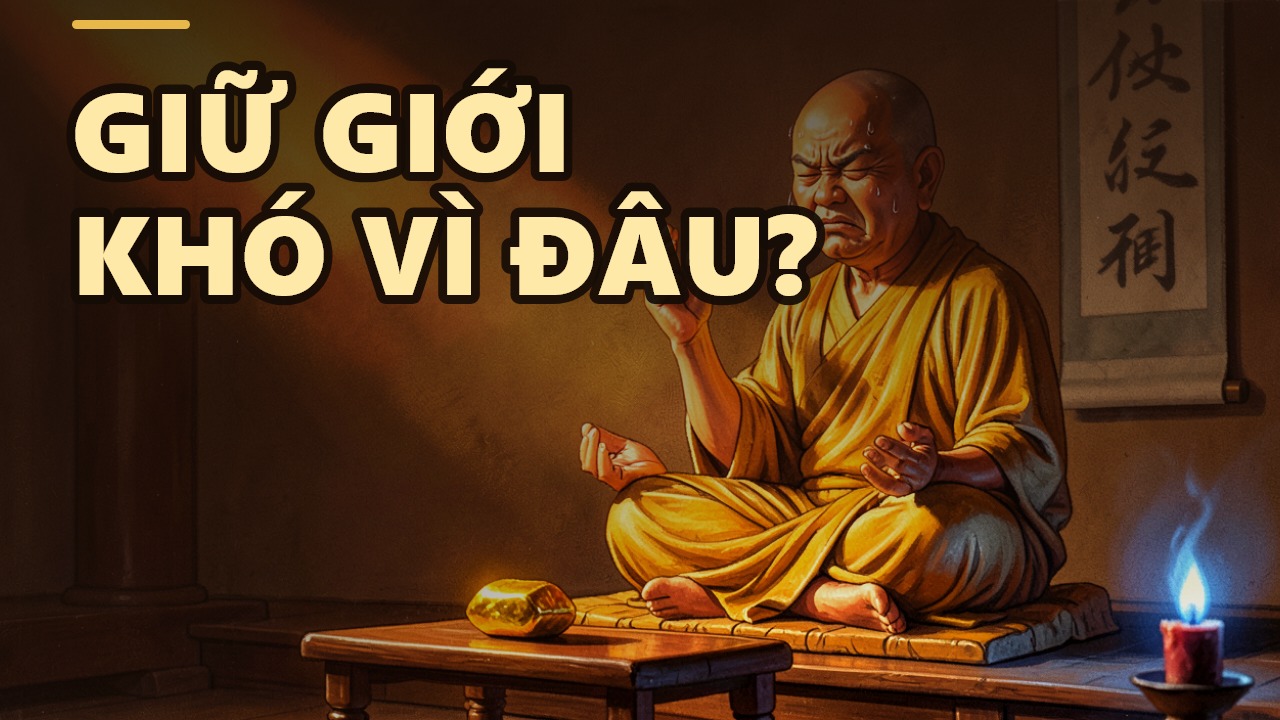
When we observe the rules solely because they are forbidden, we keep the precepts through willpower. Venerable Chan Quang offered an example: “If a tael of gold is placed on a table where no one is watching, it would be easy to slip it into your pocket. But because the precepts do not allow it, you firmly refuse to touch it. This is due to willpower and adherence to the rules.” This is the first level of keeping the precepts. However, relying only on willpower can become rigid and may break easily when faced with strong conditions.
Keeping the Precepts Through Meditative Concentration
When the mind is settled in meditative concentration, greed arises but is naturally extinguished. The teacher explained, “In the second case, because you do not allow greed to arise within your pure mind of meditative concentration, you do not take that tael of gold. This is called keeping the precepts through meditative concentration.” A person with meditative concentration often has a calm, gentle, and composed demeanor. Thanks to this stability, the precepts are not forced upon us but remain naturally pure.
Keeping the Precepts Through Wisdom
The highest level is keeping the precepts through wisdom. Wisdom is not just understanding scriptures; importantly, it is seeing clearly the nature of merit, demerit, and cause and effect (karmic law). When facing the tael of gold, one reflects: “If I take it, someone else loses it. That person suffers, and my karmic obstacles increase. At the same time, my own mind becomes stained.” This reflection on merit and demerit is what Venerable Chan Quang concluded as “keeping the precepts through wisdom.” A truly wise person always recognizes their own faults and examines the seeds within their inner self, rather than blaming others.
What Happens When One Leg Is Missing
Without wisdom and meditative concentration, the precepts can easily turn into attachment. The teacher shared a story: “If a monk focuses only on strict rule-keeping, he nitpicks everything. When you enter the main hall, he looks down at your feet and orders you to straighten your sandals. He sits there constantly correcting you. But if that monk possessed meditative concentration and wisdom, he would correct you with love, analyzing the fault so that you feel warmth and joy in making amends.” Thus, all three legs must be complete for the precepts not to become a burden.
Non-Self (Anatta) – The Ultimate Goal
Ultimately, keeping the precepts is not just for moral conduct, but to attain non-self (anatta). The teacher stressed, “Only Buddhism has the goal of non-self. We practice to lose the ego. Without meditative concentration, we cannot perceive non-self; without wisdom, we cannot see our own faults; without precepts, we remain attached to the ego.” Therefore, taking the precepts is a lifelong commitment to practice. Each day, we cultivate precepts, meditative concentration, and wisdom to keep our conduct pure and to serve as role models for future generations.
Keeping the precepts is not an easy task. It is a battle against greed, hatred and delusion. Yet, when the three-legged stool stands firm, we find that keeping the precepts becomes a source of joy and creates good conditions for ourselves and others. Begin today: each morning, settle your mind in a few minutes of meditative concentration; each evening, reflect on your own faults; in every moment, maintain your willpower. This is the path of the practitioner, the way for the precepts to become a magical staff protecting us on every step of the journey.
AI-assisted translation from the Vietnamese original.
Read in Vietnamese →