
For the Common Good: From the Family Meal to the Destiny of a Nation
In this dharma talk, Thầy Thích Chân Quang explores the profound meaning of the common good, from a family meal to great sacrifices made for one's country, reminding us to live each day with greater mindfulness and moral integrity.
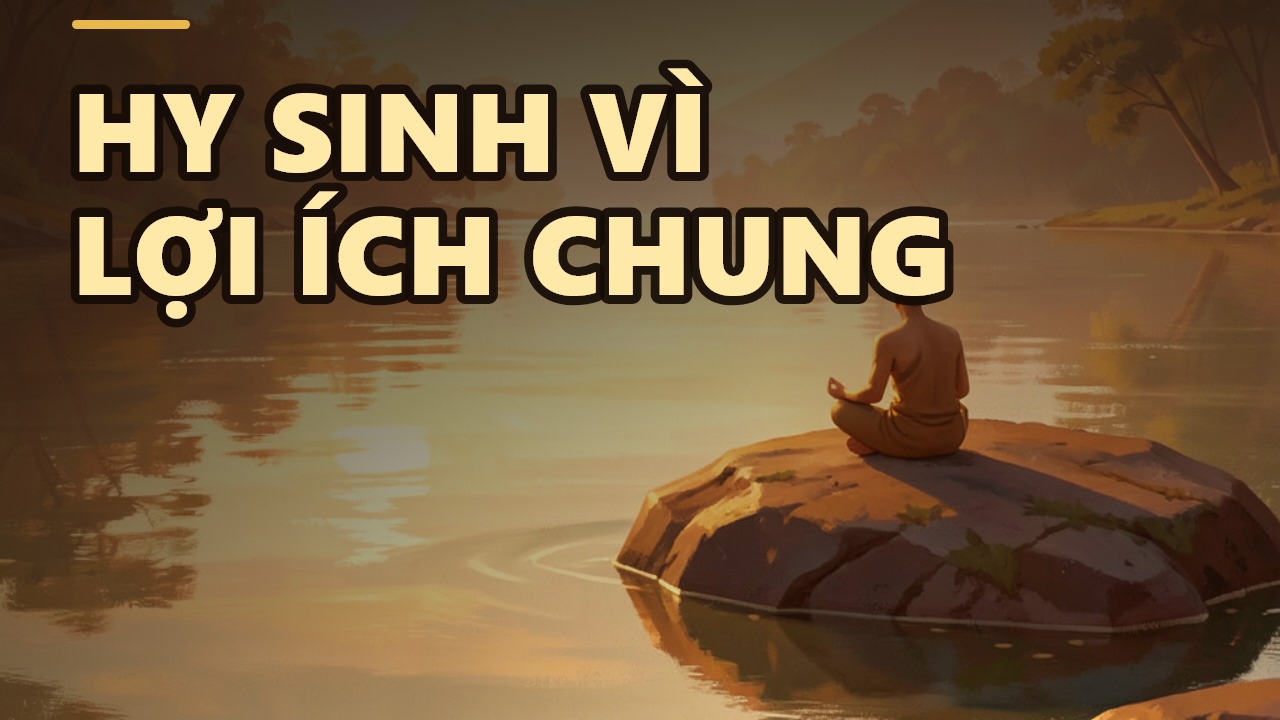
Have you ever wondered why some people are willing to accept personal loss in order to bring benefit to others? They lose nothing at all; on the contrary, they receive far more in return. Today, let us listen together to the dharma talk of Thầy Thích Chân Quang and discover the lesson of the "common good" — a concept that seems simple, yet holds great depth of morality and happiness.
The common good begins with a family meal
Thầy Chân Quang opens with a very ordinary image: the family dinner table. When we eat together, if someone is greedy and takes too much, others will have less to eat. This is the first lesson about the common good.
"The meal is the shared right of everyone in the family. If I am a little greedy and take a bit too much, then truly my family will have less to eat."
Thầy tells of many poor parents who give their portion of food to their children, and from that very meal, the child can learn the lesson of sacrifice. Living in a family, we cannot think only of ourselves. Every small action affects those we love.
Morality is higher than blood ties
From the family, we step out into society, where relationships are no longer bound by blood. Thầy emphasizes that the most solid foundation for a human being is not blood ties, but morality.
"The most solid foundation for a person is morality, not blood ties. Morality is higher than the bonds of blood."
In society, toward strangers, we have no obligatory duty to care for them. But if each person only looks after their own interests, the community will become cold and indifferent. It is morality that guides us to live for the common good.
Two directions: Grabbing or Contributing?
Thầy points out that in life, everyone seeks happiness. But there are two ways: one is to struggle fiercely to grab benefits for oneself; the other is to contribute to the community — still living one's life, but knowing how to yield benefits to others. As disciples of the Buddha, we must choose the second direction.
"Within the framework of everyone's shared interests, I think much about the common benefit of all people, of society, of the community."
This does not mean we deny our own right to live. Thầy reminds us that we still need benefits in order to live and support our family, but those benefits must be tied to the common development of all. In fact, working with dedication, going beyond one's duties, is itself making offerings to the temple — a form of spiritual practice.
Accepting loss to protect the common good
Thầy tells the story of Mr. Mộ — a guerrilla soldier who quietly gave up the woman he loved to a comrade, in order to preserve unity within his unit. He accepted the loss, and this did not diminish the respect he received; rather, it made him great in Thầy's eyes.
"He sat and thought... then he reported to his superiors, saying that in truth, he had not married for himself, but had married on behalf of that friend."
Thầy then recounts the historical story of Trần Hưng Đạo — the great general who was ready to execute his own son when the son dared to place a personal grudge above the great cause of the nation. The example of "forgetting family vendettas for the sake of the country's debt" stands as proof of placing the common good above all else.
Careful in every word and action
Thầy also warns that we can unintentionally harm the common good through small things, such as speaking badly of others, or throwing trash on the street. Such actions tarnish the image of Buddhism and of our people.
"Foreigners come to visit our country in great numbers, and they see a Vietnamese person... throwing trash right onto the street. They wonder what kind of people this nation is. In terms of education and culture, such a simple act can affect the honor of an entire nation."
Therefore, every word and every action must be carefully considered. We must always ask ourselves: does this benefit the community?
Begin today
Thầy Chân Quang emphasizes that "for the common good" is only four words, yet to practice it in every moment is extremely difficult. We cannot achieve it instantly, but each day we can try a little more. Begin with the family meal, with yielding to others, with kind words, with working wholeheartedly.
Remember, when you accept loss for the sake of the common good, you lose nothing at all. On the contrary, you are giving happiness to others, and that very happiness will return to you, like a river flowing back to the sea. So let us begin living for the common good today.
AI-assisted translation from the Vietnamese original.
Read in Vietnamese →