
The Little Dreams in a Child's Eyes and the Boundless Visions of the Wise
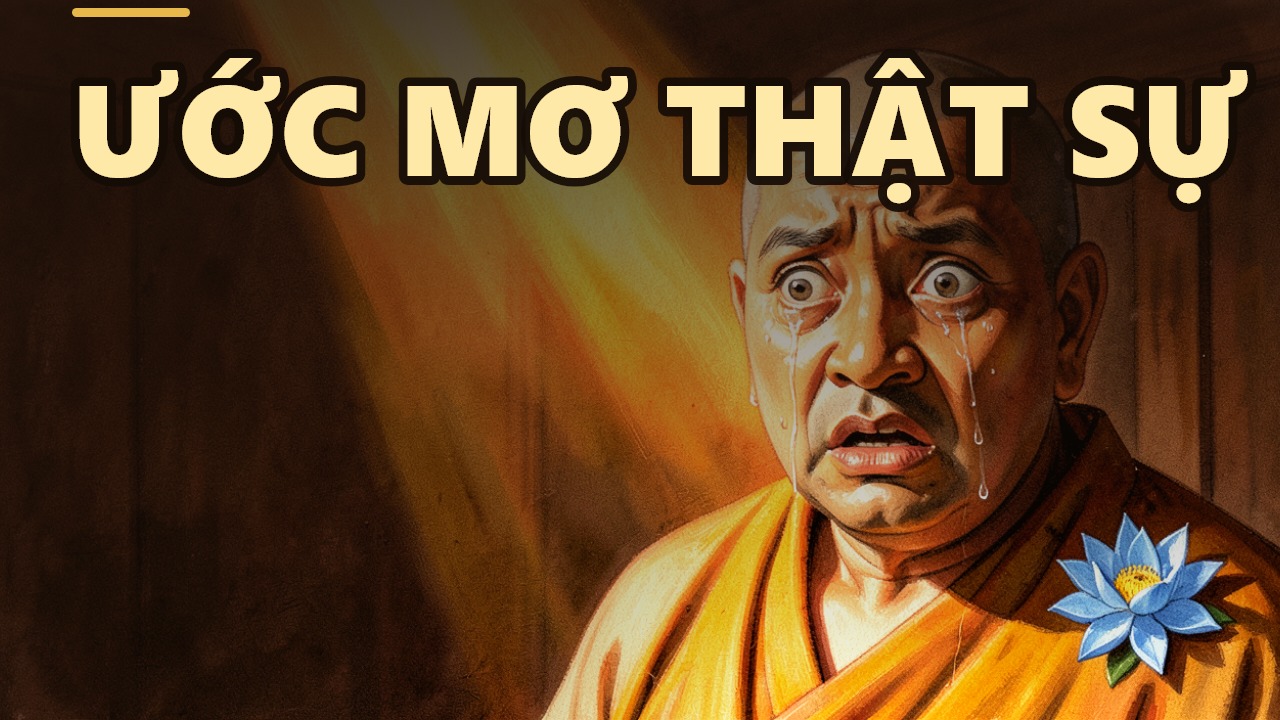
**Summary:** The dharma talk by Thầy Thích Chân Quang takes us back to our first dreams, but through the lens of the Buddha's teachings. Here, dreams are no longer about petty fame or gain, but become an endless, immortal aspiration that transcends the cycle of rebirth.
Have you ever asked yourself: What is my dream now? Is it the same as when I was a child – wishing to wear beautiful clothes, receive lucky money, or grow up to become a doctor or engineer? Or has life beaten it down and replaced it with "safer" dreams of a nice house, a car, and successful children? In his talk "The Boundless and Endless Dream," Thầy Thích Chân Quang offers a perspective that startles us: The true dream of a wise person does not lie in these trivial, finite things, but in an endless, undying aspiration.
**The Innocent Dream: Just a Small Door into Life**
Every one of us has had dreams. As children, we dreamed of the Lunar New Year for new clothes, lucky money, and joyful play. Then as we grew, we dreamed of a good education and a respectable career. But we must ask: do those dreams reflect a person's moral character and wisdom? Thầy Chân Quang says: "A person with poor morality and shallow wisdom will have dreams that are close, superficial, and selfishly pleasure-seeking. A person with great morality and great wisdom will have dreams that are lofty and beautiful." However, even a lofty dream is still confined within the limits of a single lifetime.
"If we could listen to the dream within another person's heart about their future life, we would understand the nature of that person – how much morality and wisdom they possess."
**When Life Pushes Us Along: Dreams Drifting with the Wind**
As we reach adulthood, we face responsibilities: providing for ourselves and our families, caring for aging parents and young children. These harsh challenges erode our youthful dreams. We dream of a nicer house, a new car, a place in society. Then, once we obtain what we desired, we find ourselves swept into a whirlpool of indulgence and pride. As the teacher points out: "When we succeed, when we enjoy fortune, when we experience glory, a side effect appears alongside it. What is it? It is the arrogant ego." It is this arrogance and indulgence that act as two weights, preventing us from soaring.
**Re-encountering the Dharma: Dreams Reborn from the Ashes**
The miraculous happens when we encounter the Buddha's teachings again. The Buddha's words make our spirits strong, warm our morality, and ignite our wisdom. We feel young again. But now, our dreams are no longer about achieving worldly positions or wealth in this life. The teacher instructs: "We dream for future lives. Our vision is no longer limited to this one existence; the Buddha has opened for us a vision of countless future lifetimes through the law of cause and effect and the phenomenon of rebirth in samsara." We begin to actively build our future through wholesome karmic causes: by showing love, being kind, making sacrifices, and practicing the teachings.
"How? By using the law of karma, we create a little blessing at a time. We love people more, treat them more kindly, shoulder more responsibilities, endure more hardship, sacrifice more, and practice more. And we believe the absolutely fair law of karma will bring us a beautiful, inevitable result."
**Transcending Limited Dreams: From the Trivial to the Boundless**
But this is not easy. Many people, even while practicing, still dream of being a prince or princess in a future life, rich and noble. This is a naive return to a dream as trivial as childhood. The teacher calls this "a narrow vision, meager wisdom, and mediocre morality." We may understand karma, yet we still dream small. But "it's alright, no problem," the teacher assures us. We just need to continue our practice: respecting the Buddha, loving all beings, and dissolving the ego. Gradually, our respect expands toward the infinite, and our compassion grows toward the boundless. When wisdom expands, we no longer dream for ourselves alone.
**Seeing Impermanence: The Dawn of Wisdom**
The greatest turning point comes when we realize that everything is impermanent. From beauty, wealth, and fame to health – all are subject to decay. A wise person understands this clearly and so cannot be satisfied with temporary glories. They begin to dream of something immortal and eternal. Thầy Chân Quang compares: "A person who sees the impermanence of all things will naturally, necessarily, dream of what in their heart? They must dream of something immortal and eternal. Therefore, whoever understands impermanence is compelled to have an endless, boundless dream." This is the difference between the wise and the ordinary.
"The moment we begin to see that everything will change, that everything is impermanent, is the beginning of wisdom. What we manage to gain, even as we foresee its eventual decay and dissolution, is the start of having wisdom."
**Conclusion: Opening the Heart to the Infinite**
Thầy Chân Quang concludes his talk with an invitation: "Today I give this talk so that people may shatter their own hearts, shatter their limitations, and go in search of the endless and the boundless." He wishes for each of us to elevate our wisdom to another level, not to confine ourselves within trivial matters. Let us begin by looking deeply at our own dreams. If those dreams are only for money, fame, or children – please open your heart wider. With absolute reverence for the Buddha, with limitless love, and with the noble aspiration for enlightenment, we will find the path leading to the immortal and the boundless. That is the true dream of a disciple of the Buddha.
AI-assisted translation from the Vietnamese original.
Read in Vietnamese →