
Honoring the Buddha: The Most Fundamental Merit That Many Unknowingly Overlook
Understanding and honoring the Buddha is not merely a daily ritual, but the foundation of all merit. Without reverence for the Buddha, it is difficult to cultivate compassion, patience, and to progress on the path of liberation.
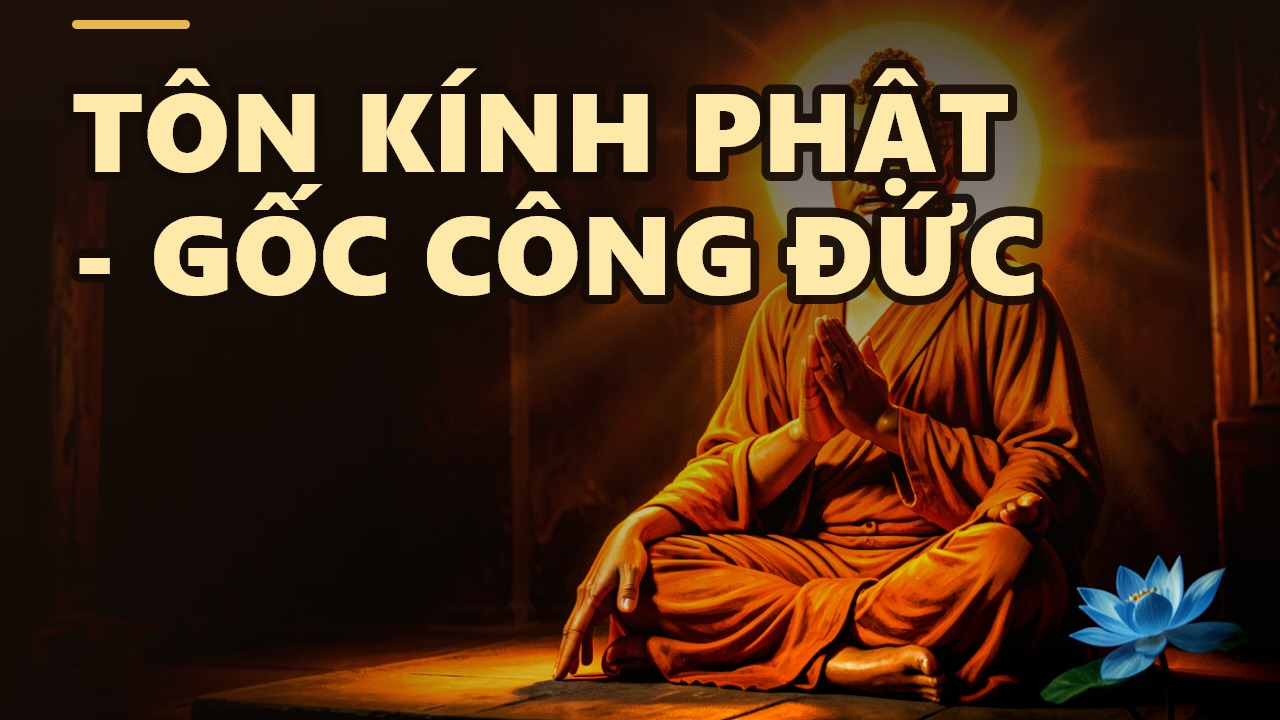
Have you ever felt that despite your efforts to cultivate compassion and patience, you still stumble? You want to love all sentient beings, yet when faced with someone who irritates you, anger still flares up in your heart. Do not rush to blame yourself. The problem may lie in a fundamental merit that we have unknowingly overlooked: honoring the Buddha.
Honoring the Buddha is the root of all merit
We often think that honoring the Buddha is simply a daily ritual: burning incense and bowing before the Buddha. But according to Thầy Thích Chân Quang, this is a great misunderstanding. He emphasized in his dharma talk:
"Honoring the Buddha is a very important quality of heart, the wholesome seed of all other merit. If we do not have enough reverence for the Buddha, we cannot build anything at all."
Consider this: when we wish to develop compassion, but our selfishness and self-grasping from countless lifetimes keep pulling us back. We want to love everyone, yet even with our own brothers and sisters around us, we still feel love and dislike. Why? Because we lack a foundational strength — reverence for the Buddha. When we have reverence for the Buddha, we place ourselves under the guidance of a Fully Awakened One, and from there we gain the strength to transform our other qualities of heart.
The lesson from the story of making offerings to an Arhat
To illustrate the wondrous power of reverence, Thầy told an ancient story: A poor couple met an Arhat whose appearance was dignified and radiant with majestic presence. They aspired to make offerings of a small piece of cloth. After the offering was made, the Arhat changed into new robes and stepped out, his face glowing with beauty. The wife spontaneously prayed:
"May I one day attain the fruit of realization that you have achieved."
That unintentional prayer landed on remarkably fertile ground — an Arhat. Many lifetimes later, when the Buddha appeared in the world, it was the husband who heard the Buddha recite a verse while watching a performance of climbing a tall tree, and he realized the truth right then and there. Eventually, both husband and wife ordained and attained liberation.
The story shows that a sincere heart of reverence and making offerings can create extraordinarily powerful conditions. Similarly, when we honor the Buddha today, the qualities of the Buddha will gradually take form within our own hearts.
Taking refuge in the Buddha: not merely "returning for shelter"
Thầy Thích Chân Quang offered a profound perspective on the meaning of "taking refuge in the Buddha." Many people translate it as "returning for shelter," but Thầy believed this understanding is far too light. He said:
"The word 'quy y' — the ancients used the words quy y... Now we must translate it as honoring, venerating... Venerating almost absolutely, and never betraying. The meaning is very weighty indeed."
Indeed, in ancient times, when people took refuge in the Buddha, they offered their entire heart, their whole life, to follow the Buddha. But if we understand "taking refuge" as merely seeking shelter, we can easily abandon the path. And Thầy also issued a serious warning:
"Never understand taking refuge in the Buddha as taking refuge in one's own true nature. Because none of us truly knows what that true nature is. That ego is very deeply hidden, yet it governs all of our thoughts and actions. Taking refuge in one's true nature can cause us to unknowingly worship our own ego."
This is an extremely relevant wake-up call for modern practitioners. When we have not yet attained enlightenment and do not clearly understand our true nature, turning our heart toward the "self" within can become a subtle form of nurturing self-grasping. Instead, we should venerate an absolutely holy being — the Buddha — whose virtues are flawless, without a single gap.
Honoring the Buddha helps you "take flight" on the path of practice
When you accumulate reverence for the Buddha along with a selfless heart, you are building spiritual momentum. Thầy used the image of an airplane: when the plane gains enough speed, it takes off and cannot turn back. Similarly, when selflessness and reverence for the Buddha grow strong enough, you will enter the stream of the noble ones — the fruit of Stream-Entry — no longer fearing falling into lower realms. Thầy explained:
"When we honor the Buddha and live a life of selflessness... at first it is only a little, gradually bit by bit, until it becomes momentum, so strong that it takes off and flies up, never able to fall back again. The moment we take flight through selflessness and reverence for the Buddha, that is the moment we are said to attain the fruit of Stream-Entry."
Therefore, do not regard bowing to and honoring the Buddha as mere formality. It is precisely how you build spiritual momentum to advance without retreat on the path of liberation.
Begin with small things each day: each morning upon waking, place your palms together before the Buddha's altar with a sincere and reverent heart; when facing difficulties, remember the Buddha and seek to follow his teachings; before every word and action, ask yourself: "What would the Buddha do in this situation?"
As long as you keep reverence for the Buddha alive in every moment, your character will gradually become calm and steady. You will gain a wondrous willpower — overcoming adversity with ease yet strength, no longer struggling or thrashing about. Why? Because you are no longer fighting with your ego, but with the boundless power of the Buddha's compassion flowing into your heart.
Begin today. Let reverence for the Buddha become the solid foundation for everything you do. Then nirvana will no longer be distant — in every breath, every step, you will see that you are walking in the right direction. Homage to our teacher, Shakyamuni Buddha.
AI-assisted translation from the Vietnamese original.
Read in Vietnamese →