
The Consciousness Aggregates: When You Think You Are Already Liberated – The Trap on the Path of Practice
A dharma talk by Venerable Thích Chân Quang on the Consciousness Aggregates – the final layer of the Five Aggregates, where many practitioners mistakenly believe they have attained realization. Understanding its three components: knowing, wanting, and karma, and the trap of reasoning that pulls us away from pristine purity.
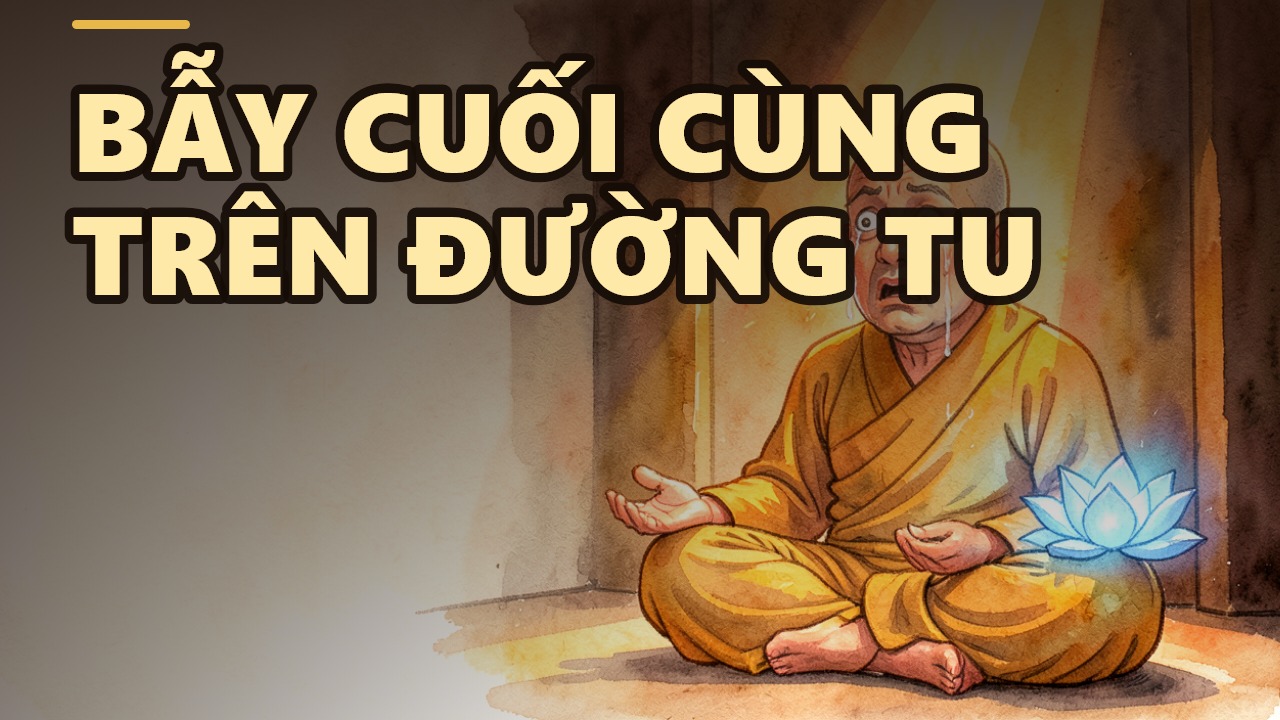
Have you ever heard the story of an ancient meditation master who, after attaining a lofty spiritual state, suddenly believed he was completely liberated, only to fall into a spiral of arrogance and suffering for countless lifetimes?
That is precisely the subtle trap that Venerable Thích Chân Quang calls the Consciousness Aggregates – the final layer of the Five Aggregates, and at the same time the most difficult to understand and the easiest to mistake. In his dharma talk on the Consciousness Aggregates, the teacher shares that many practitioners who reach this stage declare themselves enlightened, when in truth they are merely circling within the very layer of the consciousness aggregates itself.
What Are the Consciousness Aggregates? What Is the Mind?
Venerable Thích Chân Quang affirms: the mind is a collection of three things: knowing, wanting, and karma. Of these, "knowing" is the capacity to recognize and understand an object other than oneself. But if there is only knowing without "wanting" – that is, feeling and desire – then it cannot be called a sentient being. As for "karma," it is the law of cause and effect (karmic law) that governs the degree of our intelligence and the rightness or wrongness within our mind. When our mind carries karma, we misunderstand matters, seeing good people as bad and bad people as good.
"What is the mind? The mind is what we define as a collection of three things: knowing, wanting, and karma. Without knowing, it cannot be called a mind. But the mind is not merely knowing, because knowing without wanting also cannot be called sentient."
The Layers of Knowing: Knowing Through the Senses and Through Intuition
Knowing is not as simple as we imagine. When we are young, children can understand the minds of adults through intuition, but as language develops, we gradually cling to words and lose this capacity. Women often retain a portion of this keen intuition, while men usually lose it entirely. Moreover, plants and animals also have their own form of mind. We have seen dolphins swimming alongside boats, whales pushing fishermen's boats to shore, or the ancient turtle of Hoan Kiem Lake – all of which show that knowing does not reside only in the human brain.
"Knowing is the capacity to recognize and understand an object other than ourselves, usually an object outside of us. Only consciousness can understand our own inner mind. Many animals also possess a knowing that transcends space, like the whale that can hear the prayers of fishermen amid the storm."
The Mechanism of Perception: Sense Faculty, Sense Object, Consciousness
When we look with our eyes, the mechanism consists of three parts: the sense faculty is the organ of sense, the sense object is the external scene, and the consciousness is the neural network of the brain. This is pure knowing. But the problem lies in a fourth part: after seeing, the brain connects with a "busybody" region – the place where reasoning, imagination, liking and disliking arise. It is precisely this fourth part that makes our lives turbulent. Without it, we would be like a meditation master: seeing only to see, hearing only to hear, without gossip or speculation.
"The visual nerves pass the signal on to that busybody nerve region. And so the mind begins chattering away inside. Interpreting this, dreaming of that, fantasizing and speculating, then liking and disliking all sorts of things. All of it makes the self churn and our lives restless."
The Consciousness Aggregates – The Trap of Arrogance and Delusion
Because the consciousness aggregates operate so quickly, many people mistake a fleeting state of stillness for the true mind, the Buddha nature. Arrogance arises, and they believe they have attained realization. History is not lacking in meditation masters who fell into such delusion, only to later descend into suffering and pay the price for many lifetimes. The teachers of some of these people simply remained silent, telling them to continue practicing and contributing as if nothing had happened, in order to prevent their downfall.
"Many meditation masters, upon attaining realization, recognized these consciousness aggregates and then imagined they had attained the way – that this was the lofty true mind, the Buddha nature. Then hidden arrogance led them to fall back down, struggling for thousands of years. All forgotten, because of this loss of merit."
Freedom Like the Stone Maiden Dancing – Living Without Adding Commentary to Life
The meditation master Ban Long Uan once compared the realized practitioner to "a wooden person viewing a painting of a bird, a stone maiden dancing." This means: seeing is just seeing, hearing is just hearing, yet no thought or emotion arises in the mind. When we reach that state, we are no longer bound by the senses, by language, or by the judgments of the perception and formation aggregates.
"The wooden person viewing the painting of a bird – what does that mean? Does a wooden person reason and speculate? No. At that moment, we are like the wooden person: we look and see this is a flower, this is a person, but there is nothing at all in the mind. One is at ease – knowing is just knowing, seeing is just seeing, without adding all that extra busyness."
Conclusion: Live More Awake Each Day
The Consciousness Aggregates are not something distant. They are present right within our own scattered thoughts each day. Contemplate carefully, and do not rush to trust any spiritual state that has not yet been verified through practice and moral discipline. Have knowing so as not to be mistaken; have understanding so as not to fall. Starting today, train yourself in the knowing "of the wooden person": seeing without the mind being moved, hearing without giving rise to thoughts. Just that, and peace will come.
AI-assisted translation from the Vietnamese original.
Read in Vietnamese →