
The Consciousness Aggregate: The Most Subtle Trap on the Path of Practice
Why do so many practitioners fall into the trap of the consciousness aggregate, mistaking it for true attainment? Learn about the mind, knowing, and the right way to practice so you do not fall back.
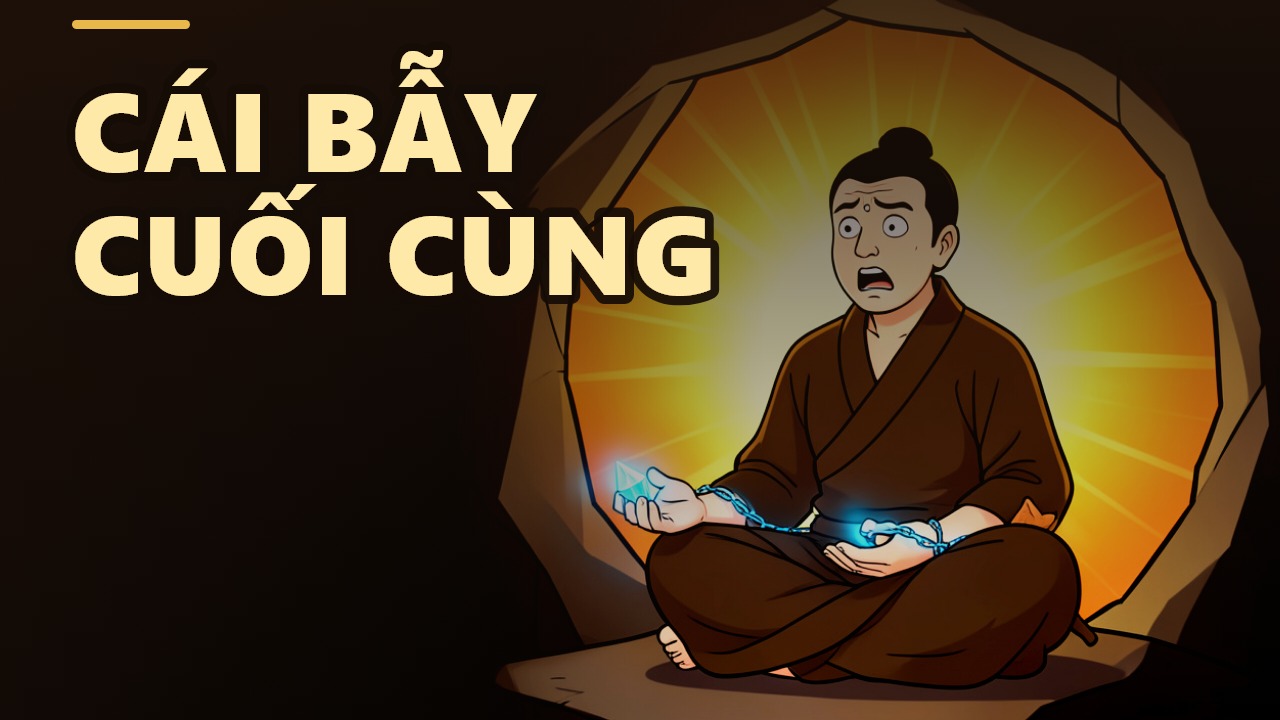
Have you ever believed you had touched the gate of liberation, only to be startled into realizing you had deceived yourself? This happens more often than you might think, especially on the path of meditative concentration. Among the five aggregates, there is one that comes last, is the hardest to understand, and is the place where many practitioners stumble in a way that feels sweet yet painful. That is the consciousness aggregate.
The Consciousness Aggregate: The Last Aggregate and the Subtle Trap
The consciousness aggregate is the last of the five aggregates, the most difficult to understand and the most abstract. Many practitioners reach this point and believe they have been liberated, believing they have attained some lofty realization, when in fact they have only been circling within the consciousness aggregate. Thầy Thích Chân Quang once warned:
"Many practitioners reach this point and mistakenly believe they have been liberated, believing they have attained some lofty realization, when in truth they have only been circling within the consciousness aggregate, over and over."
Why is this trap so subtle? Because the consciousness aggregate moves so quickly, as fast as tranquility itself. When a practitioner goes deep into meditative concentration and sees the mind grow still and luminous, it is easy to mistake that for Buddha-nature, for the true mind. But it is only the shadow of the consciousness aggregate. That hidden arrogance is what causes one to fall back later, struggling for a thousand years.
What Is the Mind? Three Components of a 'Mind'
So what is the mind? Thầy Thích Chân Quang defines it in a remarkably simple way:
"We define the mind as the coming together of three things: knowing, wanting, and karma."
These three intertwine to form our mind. Knowing is the capacity to perceive and understand. Wanting is feeling, love and aversion, desire. Karma is the law of cause and effect (karmic law) that governs our mind, causing us to understand rightly or wrongly, to be clear or clouded. From this, we see that the mind is never separate from cause and effect (karmic law). Even plants have a mind, because they possess knowing. A newborn baby can sense another person's mind through intuition, but as we grow up, we cling to language and gradually lose the ability to know another's mind directly, understanding only through words.
How Many Levels Does Knowing Have?
Thầy says: "Knowing is when we perceive an object that is other than ourselves." From this simple definition, we can see that knowing has many levels. The shallowest level is knowing through the five senses: the eye seeing, the ear hearing, the nose smelling, the tongue tasting, the body touching. Buddhism calls this sense faculty, sense object, and consciousness: the sense organ, the external world, and the receiving nervous system. If any one of the three is missing, knowing disappears. For example, a person is blind because the optic nerve is damaged, not because the eye itself is ruined. The story of the blind flower seller whose sight returned after eye surgery is a vivid illustration.
But there is another level of knowing, deeper still: intuition, or the ability to know another's mind directly. A fisherman prays to the whales, and the whales rise up to save his boat amid roaring waves. The old turtle of Hoan Kiem Lake understands human hearts and avoids the wicked. A newborn recognizes its parents through intuition, without needing words. Thầy emphasizes that this is "knowing from mind to mind," a form of knowing that science has not yet fully explained.
The Trap of the 'Chatty Nerves'
When the eyes see and the ears hear, signals are sent into the brain. We should simply recognize and stop there, but within the brain there is a region Thầy calls the "chatty nerves." It constantly speculates, interprets, imagines, loves and hates. Thầy says:
"If we could know without being so chatty, we would be meditation masters. We would see that person fully, and that would be all."
It is precisely these chatty nerves that sell us false stories, entangling our lives. We see a beautiful person and begin to daydream. We hear a compliment and drift into fantasy. We constantly mistake the speculation that follows knowing for knowing itself. And so life fills with war, suffering (dukkha), and failure, because we live in delusion rather than in reality.
The Meditation Master and Knowing Without Stirring
So how do we escape this trap? Thầy teaches: meditation masters rest at the third level of knowing and do not chase after the fourth. Their mind is like a mirror: when a good person comes, it reflects a good person; when a bad person comes, it reflects a bad person, but it adds no speculation, no stirring of thought. Thầy cites the meditation master Ban Long Uẩn:
"Like a wooden person viewing a painting of a bird, like a stone maiden dancing."
A wooden person viewing a painting sees the bird but gives rise to no thought. A stone maiden dancing moves, yet holds no emotion. That is the state of a meditation master: knowing without clinging, seeing without being stained. When you reach this state, you are truly at ease, no longer dragged about by the chatty nerves.
Perhaps you have had moments when your mind was still as a mirror. Do not rush to call it attainment! Remember Thầy's teaching: "Just keep practicing quietly, as if nothing had happened. Keep offering and serving, practicing as usual, and you will be less likely to fall back." Practice meditation every day, observe your own knowing, and do not let the chatty nerves deceive you. For the path of liberation lies not in mystical experiences, but in returning to live each quiet, wakeful moment. May you practice with diligence!
AI-assisted translation from the Vietnamese original.
Read in Vietnamese →