
Escaping the Swamp of Ignorance: Lessons from the War Elephant and a Wise Friend
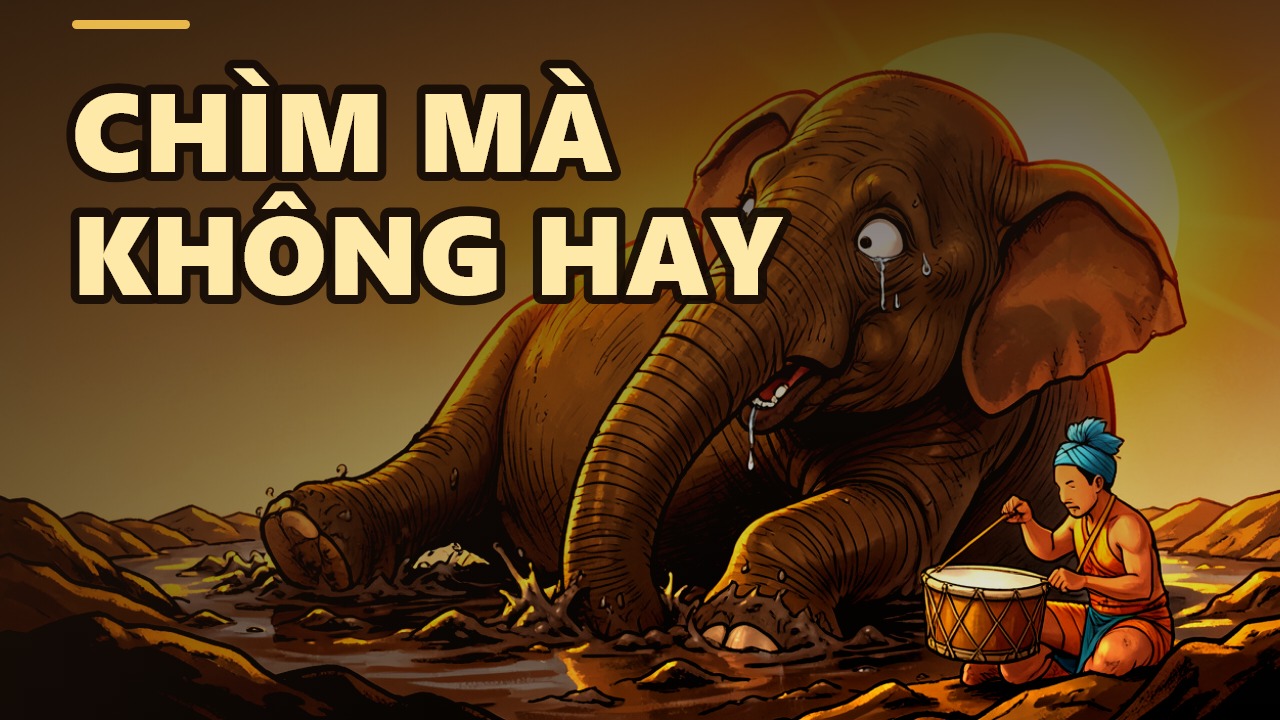
Have you ever heard the story of King Prasenajit’s war elephant? In its old age, it slipped and sank deep into a swamp. The mahout beat drums and shouted as if in the midst of battle to awaken its heroic spirit. Thanks to this, the elephant pulled each leg out of the mud and escaped danger.
The Buddha taught this story in the Dhammapada. But He was not merely telling a tale about an animal; He was speaking about us. We are sinking in the invisible swamp of ignorance, greed, hatred and delusion, and ego-clinging. Because this swamp is unseen, we do not realize we are trapped. And it is precisely this "not seeing" that is so dangerous.
### The Invisible Swamp: Why Are We Sinking Without Knowing It?
Venerable Thich Chan Quang asked a very direct question: "Are we good or bad?" Most of us know we are imperfect, but how many truly admit they are deeply immersed in mud? The elephant was old and accidentally fell in, but for us, it is not that we "fell down"; rather, we have been lying there for a long time. We simply do not see it.
The verse the Buddha taught says:
*Bind yourself to diligence, guard your mind.* *Free yourself from the evil paths, as the elephant frees itself from the swamp.*
But how can we escape when we do not even know we are sinking? This is the difficulty for practitioners. Venerable Chan Quang said that those who refuse to see the mud are still "far away." Conversely, anyone who believes they are sinking in ignorance possesses the "first right view."
### Seeing Your Own Faults Is the Beginning of Enlightenment
One statement from this teaching remains vividly in my memory:
*When we know the truth about our own weaknesses, a state naturally arises that the Buddha calls mindfulness and clear comprehension.*
He explained: When you are angry and someone says, "You are angry," if you deny it, your anger grows stronger. But if you pause, look back, and acknowledge, "Yes, I am indeed angry," the anger subsides. That is clear comprehension. Similarly, when you notice your wandering thoughts, that is mindfulness.
He emphasized:
*In this world, no one wants to see their own faults. People constantly try to find their virtues just to praise themselves.*
But those walking the Buddhist path are those who see their own errors. This is the first step of practice. Only by passing through this door do we truly enter the Buddha's teachings (Dharma).
### The Strength to Escape Mud: Wisdom and Merit
To escape the swamp, the elephant needed strength. For us, that strength is wisdom, blessings from merit, and willpower. Venerable Chan Quang taught that escaping the mud cannot happen overnight. It requires a long time to accumulate merit. On this path, while seeing our faults, we also create countless wholesome karma.
Consider a daily example: You strongly desire two bowls of pho, but then you encounter a poor person. A struggle arises within. Recognizing your selfishness is already a step toward awakening. When you set aside money to help them, you create merit. Thus, every time we see a fault and transform it, we are pulling another foot out of the swamp.
He also shared:
*If your mind is honest with itself, everything opens up naturally. Progress emerges on its own.*
Do not mistake this for passivity. When clarity arises, action follows spontaneously, and we sow countless seeds of goodness.
### What Is a Wise Friend?
The second verse in the teaching speaks of good friends. The Buddha taught:
*If you find a wise friend to live with, practicing wholesome deeds together,* *You will feel secure in trust, and mindfulness will easily grow.* *If you cannot find such a friend, better to live alone,* *Like a king in exile, or a forest elephant roaming free.*
Living with good people brings many benefits: safety, trust, and learning from their virtue. Venerable Chan Quang told of a friend who finished every grain of rice, wasting nothing, because he understood that each bite represented the labor of many and the life of a being. Another entered a house quietly, like a thief, so as not to disturb the wholesome thoughts of others. Such lessons are not found in schools; they are learned only by living near good people.
However, we are not always lucky enough to meet wise friends. When our merit is insufficient, we may have to live among bad people, requiring vigilance and defense. In such times, the Buddha advises living alone. It is better to dwell in solitude to keep the mind peaceful and focused on practice than to live amidst conflict and anxiety.
### When There Are No Wise Friends: Living Alone Like a Forest Elephant
Living alone is not asceticism. It is a wise choice when conditions are unfavorable. Like an exiled king or a solitary forest elephant, we can remain stable and free. Venerable Chan Quang said that without good companions, we need not worry about schemes, fear, or suspicion. This allows us to practice diligently and pull ourselves out of the mud.
Ultimately, each of us can pull our feet out of our own swamps. The most important thing is to see that we are sinking. Begin by looking inward. When you see your faults, do not despair, for that is the first light of enlightenment. Bind yourself to diligence, guard your mind, and seek a peaceful environment to nurture your soul. Remember: the elephant pulled itself out, and so can you. You only need to truly want to escape.
AI-assisted translation from the Vietnamese original.
Read in Vietnamese →