
Changing Rituals: The Medicine for Sustainable Buddhist Growth
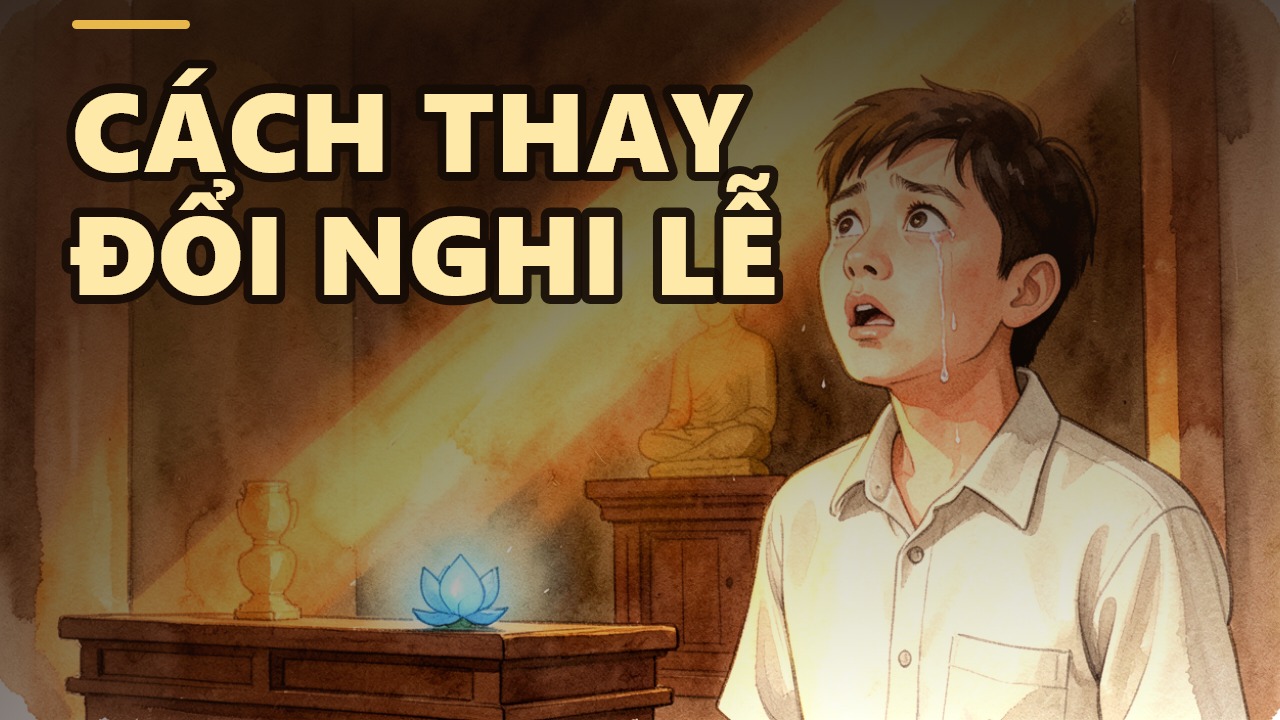
Have you ever wondered why some religions grow rapidly like a storm, while Buddhism seems to move slowly? According to Venerable Thich Chan Quang, one of the most important reasons lies in our rituals. However, it is not that rituals are bad. Rather, the way we currently use them is no longer suitable, causing Buddhists to gradually drift away.
### Other Religions Lead, Buddhism Follows
In his teachings, Venerable Thich Chan Quang once shared that other faiths set fierce goals to spread their message, seeking out every region and individual believer. They go door to door, ready to meet every need so people can understand and believe. In contrast, Buddhism tends to be passive, waiting for people to come. Sometimes, there is even an attitude of aloofness, similar to Bodhidharma.
He said, "We act aloof like Bodhidharma. If no one comes, we turn our backs and say nothing. We wait until someone cuts off their own arm before we agree to guide them."
The Venerable emphasized that this attitude harms the Buddha's teachings (Dharma), causing many people who visit temples to leave again. If we do not change, one day there may be no Buddhists left on the streets.
### Current Rituals Unintentionally Push Followers Away
Venerable Thich Chan Quang pointed out that many sutras we chant, such as the Heart Sutra or the Universal Gate Chapter, are intended for advanced practitioners. These texts are profound, but they are difficult for ordinary people to understand or practice. After chanting, they often do not know how to cultivate themselves or how to eliminate greed, hatred and delusion.
He asked, "After chanting those sutras, does anyone know how to practice well? How do we eliminate anger? How do we remove selfishness, jealousy, and sensual desire from our hearts?"
Because of this, many people feel confused after chanting services. Their devotion to the Dharma does not grow. When their spiritual heart does not deepen, they gradually distance themselves from the path.
### Six True Purposes of Rituals
Venerable Thich Chan Quang outlined six purposes that every ceremony should aim to achieve. This perspective is both practical and deep. First, we offer vows to the Buddha. Second, we let the Dharma penetrate our souls. Third, the community shares a unified understanding of practice. Fourth, outsiders can hear and understand the teachings. Fifth, invisible spirits can listen and benefit. Sixth, celestial beings observe and respond with protection.
He stated, "What is the purpose of this ceremony? If everyone’s devotion increases after the service, then we have succeeded."
### Modern Music: A Catalyst for Youth
The Venerable shared his experience at Phat Quang Temple, where modern music was introduced into ceremonies. As a result, thousands of young people and intellectuals flocked to the temple. Songs with simple, emotional lyrics, such as "The One Who Has Come," moved many to tears while singing.
He noted, "With each ceremony like this, love for the Dharma grows. We fully integrated modern music into the ritual format."
He also observed that other religions, such as Protestantism, have strongly incorporated modern music into their churches. Buddhism must learn from this to avoid falling behind.
### Four Requirements for New Rituals
To make rituals a true bridge connecting people to the Dharma, Venerable Thich Chan Quang proposed four requirements. Ceremonies must provide specific methods of practice, increase devotion, use language that is easy to understand yet dignified, and be pleasant to chant so the community enjoys them.
He explained, "Rituals must offer practical methods for cultivation. How do we eliminate anger? How do we reduce greed? How do we gather the mind? It cannot just be about chanting and closing the book."
These criteria are highly practical. They transform rituals from mere recitations into meaningful journeys of spiritual growth.
### Changing Together for Buddhism to Flourish
Finally, the Venerable reminded us that this is a sacred duty for monastics. However, it is not only for monks and nuns. Every Buddhist can contribute by praying, supporting, and most importantly, living the Dharma with wisdom and practice to spread love for the teachings.
Ask yourself: At your next temple visit, will you feel your devotion increase? If yes, the ritual is succeeding. If not, perhaps it is time for us to boldly embrace change. Each of us is responsible for bringing the Dharma into daily life. Let rituals become catalysts that purify our minds, deepen our love for the teachings, and enhance our compassion for others.
AI-assisted translation from the Vietnamese original.
Read in Vietnamese →