
It Is Better to Live Alone Than to Keep Company with the Foolish
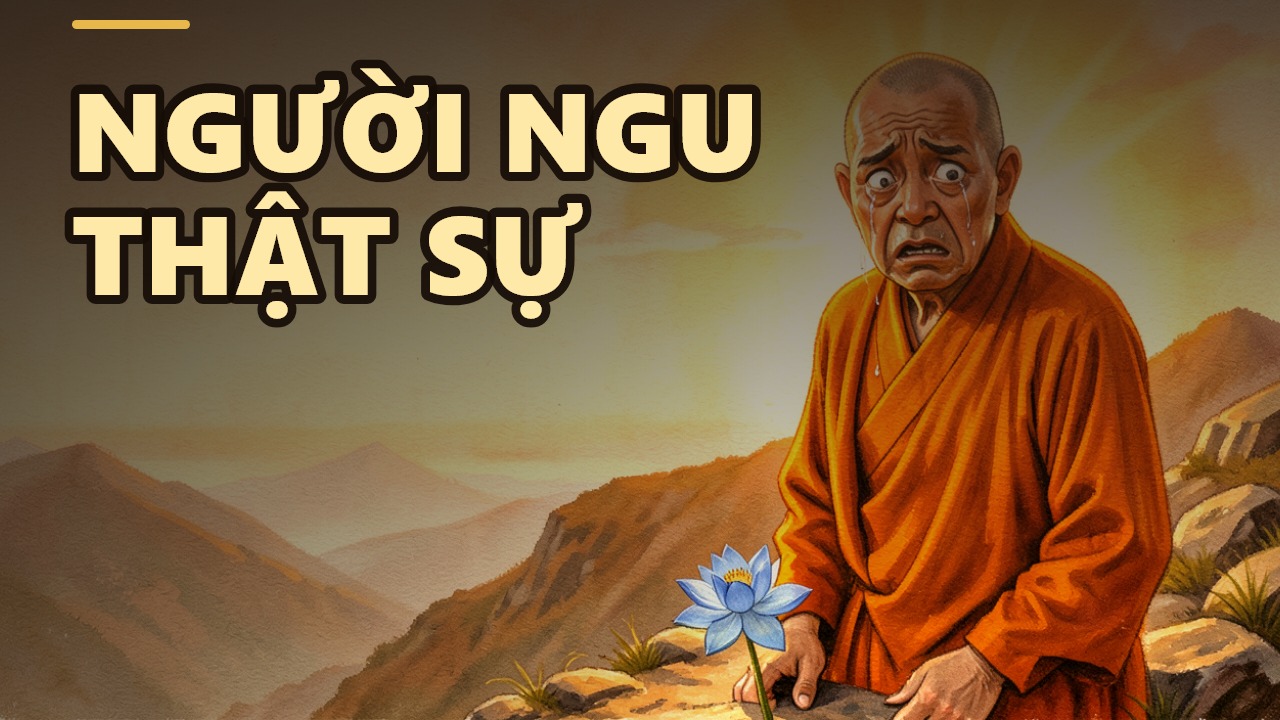
**Summary:** A Dharma talk by Venerable Thích Chân Quang offers a profound definition of the ‘foolish one’ in Buddhism and outlines five types of people, helping us reflect upon ourselves so we may choose our companions and our path of practice wisely.
Have you ever wondered why a great Arahant like Kassapa would accept such a corrupted and immoral disciple? And what did the Buddha teach about choosing our companions in that very moment? The story in the Dhammapada today reveals a profound teaching for anyone pondering friendship and their own path of practice.
**The Foolish One in Buddhism Is Not the Uneducated One**
In a famous verse, the Buddha taught: “If one cannot find a companion better or equal to oneself, it is better to live alone, for there is no fellowship with the foolish.” But the “foolish one” here does not refer to someone with little knowledge or a low level of education. Venerable Thích Chân Quang clarifies:
“The foolish one here is a person without moral virtue, not ‘foolish’ as in stupid, nor foolish as in a low educational level. In Buddhism, this word ‘foolish’ means lacking moral virtue.”
Foolishness in Buddhism means being unable to see one’s own faults. A person might win first prize in an international math competition or hold a doctoral degree, but if they cannot recognize their own shortcomings, they are still called foolish. Worldly wisdom and spiritual morality are two different paths, and the root of morality lies in the ability to reflect upon oneself.
**The Five Types of People: Which Type Are You?**
Venerable Chân Quang categorizes people into five types based on whether they can see their own faults. Place yourself in each category to understand where you stand on the path of practice.
**The first type** sees a fault before it has even arisen. This is the highest level of wisdom, able to perceive greed or arrogance about to arise and stop it beforehand. This person “is very likely to attain enlightenment.”
“Seeing one’s own faults when the fault has not yet arisen. This kind of person is very likely to attain enlightenment.”
**The second type** knows immediately when a fault arises, repents on their own, and eradicates it. For example, when cut off while driving, one becomes irritated but instantly recognizes this, recites the Buddha’s name, and repents. The fault is pacified before it can even grow.
**The third type** does not see their own faults but, when reminded by others, happily recognizes and corrects them. A spiritual friend points out, “Let us take the joy of others as our own joy,” and we are immediately awakened.
**The fourth type** has faults but, when reminded, not only fails to see them but also tries to prove they are right. For example, while distributing charity gifts, one acts arrogantly and without compassion, and when given feedback, dismisses it.
**The fifth type** has faults but does not see them, does not see them when others point them out, and even feels hatred towards the person offering feedback. This is a person of extremely poor morality, heading towards the lower realms, and is a cause of suffering for others.
“A person who does not know their own faults immediately becomes a person without moral virtue.”
**What is a Spiritual Companion? How to Choose Companions for the Journey**
In Buddhism, a “spiritual companion” is not just someone we study, practice, work, or enjoy leisure with. The purest friendships are often those formed during student years, as there is no competition for gain then. Friends who are only joyful when there is money or entertainment are very fragile. Venerable Chân Quang warns:
Those who “only keep company with you when you have money” will turn their backs when you face hardship. Try “borrowing without repaying” to see how many of those so-called friends reveal their true nature. That is a practical lesson to distinguish true friends from false ones.
When choosing companions, we should choose those with moral virtue, those who are able to see their own faults. Such a friend not only supports us on life’s journey but also helps us advance on the path of practice. Like the Venerable Kassapa, who, knowing the disciple’s faults, still accepted him with a heart of “who knows?” hoping for transformation. However, we must ourselves safeguard our faith and resolve to practice, not going astray just because others are wrong.
“People can make mistakes, but the Buddha’s teachings (Dharma) cannot be wrong. Let each person guard themselves rightly.”
**Conclusion: Reflect Upon Yourself**
The most profound lesson from the Dhammapada today is not merely about avoiding the foolish, but also about not becoming the foolish one in the eyes of others and in our own eyes. Practice seeing your own faults each day, starting with the smallest matters. If we ourselves cannot yet see our own faults, then all joys and all friends are ultimately fleeting. Only when we know ourselves can we choose a true companion on the journey back to our original, pure mind.
Namo the Original Teacher Shakyamuni Buddha!
AI-assisted translation from the Vietnamese original.
Read in Vietnamese →