
The Three Karmas: Mastering Speech is Easy, but Taming the Mind is Hard – Why is 'Mental Karma' the Root of Liberation?
**Summary:** Purifying the three karmas is the foundation for a Buddhist practitioner. This article analyzes why cultivating speech is easier but taming the mind is the greatest challenge, and the role of meditative concentration in purifying both body and mind.
Have you ever wondered: among body, speech, and mind—the three doors through which we create karma—which is the easiest to cultivate? And which presents the greatest challenge?
Recall a time you stopped at a red light late at night. If no one were watching, would you wait for the green light? The answer you give yourself reveals something about the degree of "freedom" within your heart.
**Body, Speech, and Mind – The Three Karmas That Shape Us**
According to the teachings of Thầy Thích Chân Quang, the three karmas are the three gateways through which all beings act: karma of the body—actions; karma of speech—words; and karma of mind—thoughts. Mastering these three is to master one’s life and the path of cultivation.
He emphasizes: "These are the complete three karmas of a sentient being. If for any being these three karmas are purified, made holy... then that person gradually ascends to higher realms to realize the noble stages of supreme holiness."
**Speech is the Easiest to Cultivate, Yet Also the Easiest to Create Sin**
Of the three, karma of speech is the easiest to cultivate. One need only imitate the words of the Buddha and the sages—chanting sutras, reciting mantras—to create merit. But Thầy Chân Quang reminds us: the mouth is also the easiest tool for creating sin, requiring not a single drop of sweat.
"Idle words can send you to hell instantly. Idle words can cause rebirth in the animal realm immediately. Therefore, the mouth easily creates karma, but also easily creates blessings, and it is the most effortless."
However, although easy to cultivate, karma of speech cannot stand alone. For words to have power, they must be supported by the body and mind. The teacher recounts a story of a venerable monk of great virtue: every word he spoke commanded the spirits. The story of an autistic child healed through the monk's devoted blessing is a testament to this.
"A word spoken like thunder, full of authority, shaking heaven and earth, making spirits and gods obey."
**Karma of the Body: The Most Laborious, Yet the Most Diligent**
Karma of the body involves deeds, conduct, and practical sacrifices. Unlike speech, the body must sweat and endure constraints. The teacher teaches: some people love freedom, running red lights when no one is watching; but a person of morality finds joy in discipline and in following the rules. The image of a car stopping at a red light even in an empty street is a manifestation of a purified body and mind karma.
Among the Buddhist schools, the Vinaya school focuses on cultivating body karma. These masters of discipline not only observe the precepts but also pay meticulous attention to the smallest gestures in eating, speaking, walking, and working. This is a thorough form of training, making one's life a model of integrity.
**Karma of the Mind – The Hardest Because It is Unseen**
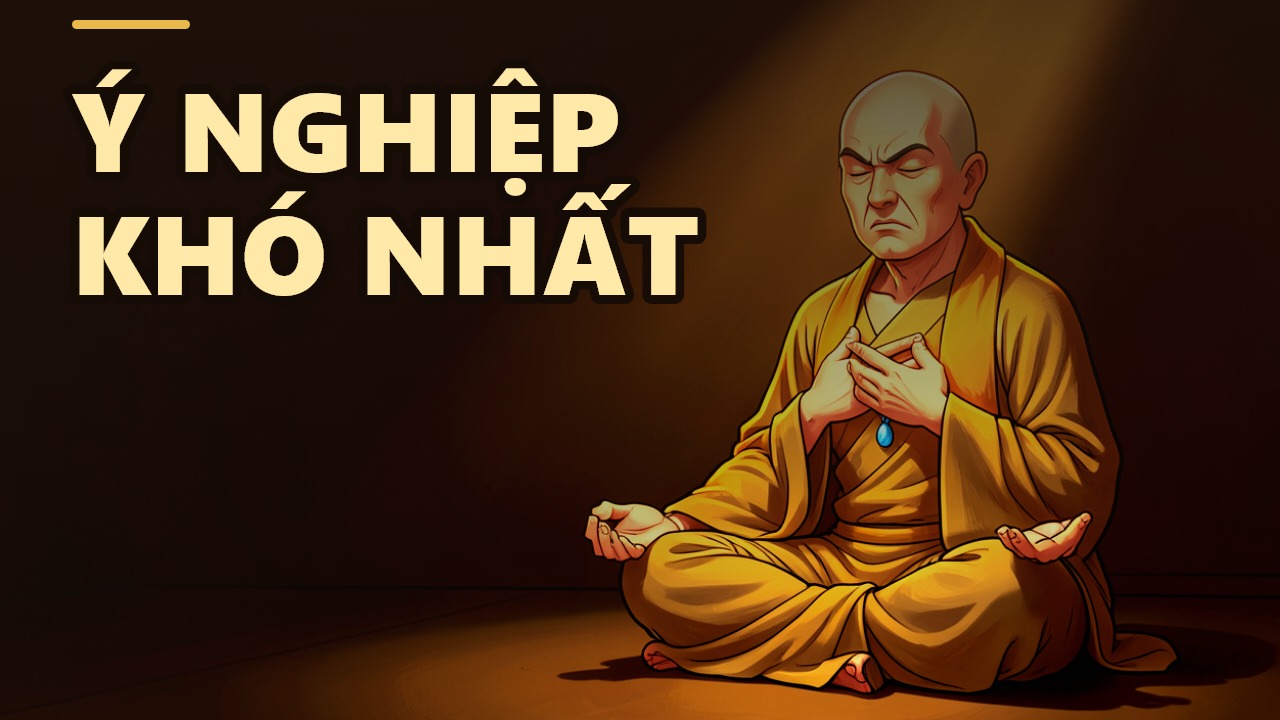
If karma of speech is the easiest and karma of the body is the most laborious, then karma of the mind is the "inner victory"—the most difficult. Why? Because no one sees it and no one controls it, we easily let it run wild. Therefore, the ability to discipline one's own mind is the true measure of a sage.
"People like to escape control to act out. Only sages, when no one controls them, control themselves seriously—those are the sages."
Thus, when we fear being controlled, eagerly seeking a "secret door" to do as we please, it is a sign of a still-weak spiritual mind. Conversely, someone who finds peace in the precepts and in the rules of practice possesses true spiritual strength.
**Meditative Concentration – The Core of All Practice**
At the end of his dharma talk, Thầy Thích Chân Quang recounted the teaching of a respected elder monk: "If a practitioner does not know how to practice meditative concentration, they cannot be called a practitioner." Meditation is not a separate school, but the essential substance of a practitioner, like the saltiness of the sea.
"Just as the essence of the sea is salt, the essence of a practitioner must be meditation."
He also conveyed a third teaching: "When practice is correct, the realization is the same." This means that regardless of the school—Pure Land, Zen, or Tantric—if the practice is correct, the result is the same jewel. Therefore, let each person take time to sit with their own mind, to practice meditative concentration, and to contemplate body, speech, and mind with each breath.
Purifying the three karmas is not a dry formula, but a journey of returning to oneself. Each morning upon waking, ask yourself: "What will I say, do, and think today?" If you recite the Buddha's name, let the words travel from your mouth into your heart; if you work, let each action flow from a heart of compassion. And begin with a few minutes of meditative concentration each day—it is the medicine that heals the very three karmas within you.
Please begin practicing today, starting with small steps, so that your body, speech, and mind may gradually become purified. When the mind is still and serene, you will see that the destination is not far.
AI-assisted translation from the Vietnamese original.
Read in Vietnamese →