
The Most Precious Asset Is Not Money, Nor Love – So What Is It?
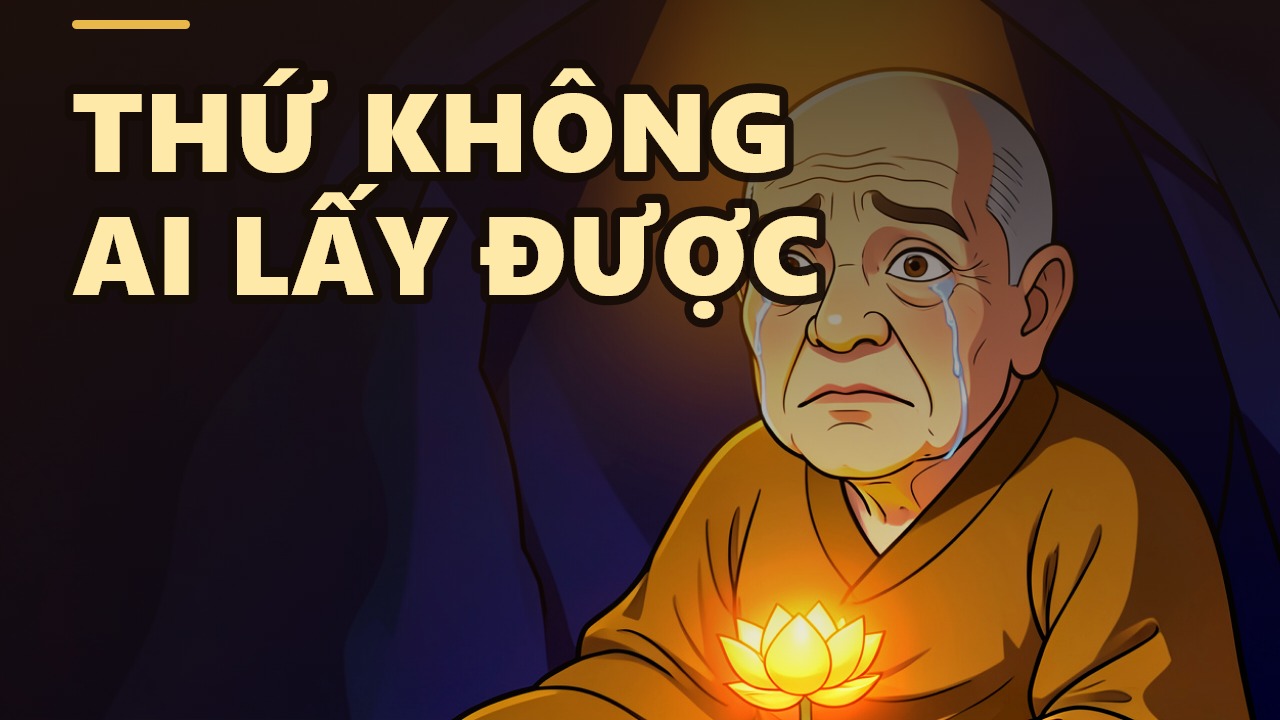
Discover the most precious asset in human life through the Buddha’s teachings: it is not money, affection, or fame, but rather our own mind and heart, along with our perspective on life. Have you ever asked yourself what truly holds the greatest value in this existence? Is it wealth, houses, or vehicles? Or perhaps love, family, and friends? Everyone craves these things and wishes to preserve them. But will they follow us until the very end? Today, based on the teachings of Venerable Thich Chan Quang, we seek together the most profound answer.
Money and material possessions are merely external objects. When Venerable Thich Chan Quang asks, “Is money the most precious asset?” most people shake their heads. Yet, if someone were to stand up and say, “Then please bring all your money here so I can help the poor,” surely few would dare to comply. Why? Because although we know money is not everything, we still cling to it as a material refuge. The Venerable clarifies that money, assets, the house we worked so hard to build, and the car we dreamed of for years are ultimately just external things. They belong to us for a time, then to others. Indeed, no matter how carefully we guard them, when we close our eyes for the last time, we must practice letting go of everything. Assets can change hands or be lost, so they cannot be the most valuable thing.
Love and fame are also fleeting illusions. Many believe love is paramount. However, the Venerable reminds us that romantic love, however intense, is as fragile as a spider’s thread. In modern society, people easily divorce over minor disagreements. As for fame and status, they are equally vain and quickly forgotten. The Venerable recounts the story of Zen Master Dongshan, an enlightened being who, upon approaching his passing, told his disciples, “I have great renown in the world; who can erase it for me?” He viewed reputation as merely a name, unrelated to his true self. An enlightened one remains unmoved by praise or blame. When we still hold onto non-self (anatta) incorrectly, we rejoice at praise and anger at criticism. But understanding that the name is not us brings lightness and freedom.
So, what is truly the most precious? The Venerable affirms: “Our mind/heart is the most precious asset. What resides within it is what matters.” The mind/heart has no form, yet it follows us from one life to another across samsara (cycle of rebirth). At death, the body dissolves, and money, loved ones, and fame remain behind. Only the mind/heart, with its thoughts, feelings, and perspectives, travels with us. The Venerable uses a parable: A dying man asks his wives if they will follow him. The first refuses due to her wealth, the second due to her business, the third due to her fame, and the fourth due to her power. Only the fifth wife, representing the mind/heart, agrees to accompany him. This simple story teaches that everything we cling to leaves us, except the mind/heart, our sole companion.
However, the mind/heart is complex, comprising thoughts, memory, emotions, and will. According to the Venerable, the most crucial element is our perspective on life. “Perspective is the root of all else. One with an arrogant view gradually destroys their own memory, intelligence, emotions, and character.” Conversely, holding a correct view—such as recognizing life’s impermanence (anicca) and choosing to live kindly—makes our actions gentle and compassionate, accumulating merit. Perspective acts as a compass, guiding our entire existence.
Beware of thieves stealing your mind/heart. If the mind/heart is our treasure, we must protect it. The Venerable warns of invisible thieves who steal our perspective. They do not enter through the front door, but through the windows of our eyes and the back doors of our ears. “One who gazes into your eyes with obsession is a thief. They enter your mind/heart and steal your innocence. Now, thieves may dress well, smile politely, and speak sweetly to lure you away from good values.” These could be those urging you to abandon ancestral altars or teaching wrong views. Therefore, maintain mindfulness, stay firm, and let no one corrupt your mind/heart.
Finally, recognize the true value of life. Do not chase money or fame endlessly. Instead, listen to your mind/heart, cultivate good qualities, and build a positive perspective. As the Venerable advises, “Your mind/heart is your most precious asset. Guard it like an invaluable treasure.” Each day, practice kindness, compassion, gratitude, and direct your energy toward wholesome deeds. This is how we protect the most precious asset of our lives.
AI-assisted translation from the Vietnamese original.
Read in Vietnamese →