
The Strength of a Nation Lies in Something Few Would Expect
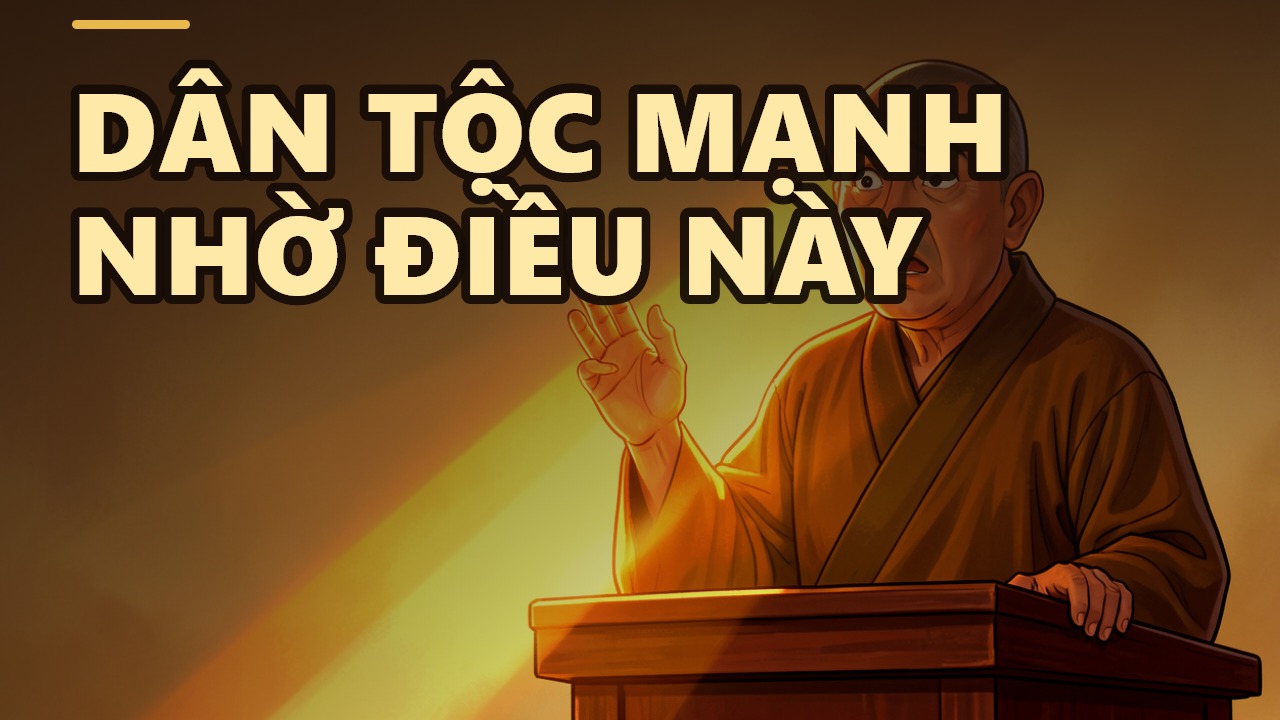
A dharma talk by Master Thích Chân Quang reveals three spiritual elements that form the strength of a nation: morality, authentic faith, and divine quality — things that money or weapons can never replace.
If asked, "Where does the strength of a nation come from?", many people would list: wealth, a powerful army, talented leaders, good diplomacy, an efficient economic system, excellent education. But Master Thích Chân Quang opens a different door: that strength also lies at a deeper level — in the spirituality of an entire people.
The factors usually mentioned when speaking of national strength
The Master points out that for a country to be strong, it first needs financial capacity, a strong military, leaders of talent and virtue, open diplomacy, a prosperous economy, and effective education. He especially emphasizes:
"To destroy the future of a nation, to make a nation perish, one need only make its education system fail. When teachers teach poorly and students learn poorly, then ten or twenty years later, the country will collapse."
Yet that is only the surface. There is another extremely important factor that few people notice: the spirituality of a nation.
The spiritual element consists of three things
The Master shares that the spirituality of a nation is not something vague, but is composed of three concrete elements:
The morality of the entire people — when everyone lives morally, the nation has inner strength.
An authentic faith — free of superstition, able to explain the mysteries, leading people toward truth, goodness, and beauty.
Divine quality — the ability to accomplish extraordinary things that ordinary people consider impossible.
Morality — the foundation of a nation's spirituality
The Master tells of the Trần dynasty era, when the Mongol army — a force that had never known defeat — was beaten three times by tiny Vietnam. According to Trương Hán Siêu, that strength came from the virtue of the kings, who were enlightened Zen masters. King Trần Nhân Tông, with his bamboo staff and brown robe, used virtue to transform the entire southern region.
"Our morality defeated the enemy. Our morality expanded our borders."
Morality is not an abstract concept. It is expressed in every thought, word, and action of each citizen. When an entire people live with kindness, that strength is unmatched.
Authentic faith — choosing a religion is a responsibility to the nation
The Master affirms that authentic faith contributes to a nation's spirituality. And we are fortunate to have Buddhism — a religion that explains cause and effect (karmic law), delivers both the living and the departed, and is free of superstition. But the Master warns:
"Choosing which religion to follow is our responsibility toward the spirituality of our nation. Therefore, it is not merely a personal matter."
The Master gives the example of someone who was "lent five million dong and then invited to join a religion" — a shallow, irresponsible way of practicing. A Buddhist must choose a religion that walks alongside the nation, builds morality among the people, and contributes to the spiritual strength of the homeland.
Divine quality — gratitude and the heroic spirit
Why do we call our two wars of resistance "divine"? Because a poor, deprived country defeated powerful enemies. That is divine quality. The Master points out three manifestations:
There are talented heroes who are revered: from Father Lạc Long Quân and Mother Âu Cơ to generals and revolutionaries.
The people are full of gratitude: never forgetting the fallen soldiers, regularly visiting cemeteries, burning incense in tribute.
A heroic spirit in peacetime: heroes of labor and production, technical innovators, and those who cultivate themselves sincerely.
The Master shares his own habit: every time he passes the martyrs' cemetery in Cần Thơ – Hậu Giang, he stops his vehicle, buys offerings of fruit and cakes, and goes in to burn incense at each grave. This is not merely a ritual, but a spiritual bond connecting the living and the departed.
The final secret: the way of being a child
The Master tells an old story of a child beaten by his parents, crying loudly, but who must not be angry and must still love and respect them. At school, scolded by teachers, the child must likewise not be angry, and must still love and respect them. He recalls a memory from his student days: having forgotten his English textbook, he was slapped three times by his teacher and thrown out of class. Yet afterward, "the next time I met him, he looked at me with such loving eyes, and I cherished him for the rest of my life."
"The secret lies in the way of being a child. The child within the family — even when parents scold or strike, one must not be angry, but must still love and respect one's parents."
Why is this a source of strength? Because in the military, discipline is strength, and discipline is absolute obedience. A soldier sets aside the ego, sets aside personal opinions, and simply obeys. And the Vietnamese people have had that quality from within the family — from the way of being a child.
Preserve and carry it forward
Today, war has receded into the past, but "divine quality" still needs to be carried on. Let each of us live morally, hold firm to authentic faith, be grateful for the past, and become "heroes" in our work, our creativity, and our practice. Do not let the nation's spirituality fade. As the Master reminds us:
"We have ancestors watching over this nation, and some secret spiritual elements that come together to form the strength of a people."
Let faith and morality shine in each of our small actions — for the strength of a nation begins in every heart.
AI-assisted translation from the Vietnamese original.
Read in Vietnamese →