
Bright as a Snow Mountain: Lessons from Anathapindika's Daughter and the Danger of Strange Doctrines
The story of a young bride who held firm to her faith amid a strange doctrine, together with the Buddha's teaching on the value of a kind heart and wisdom in all reasoning.
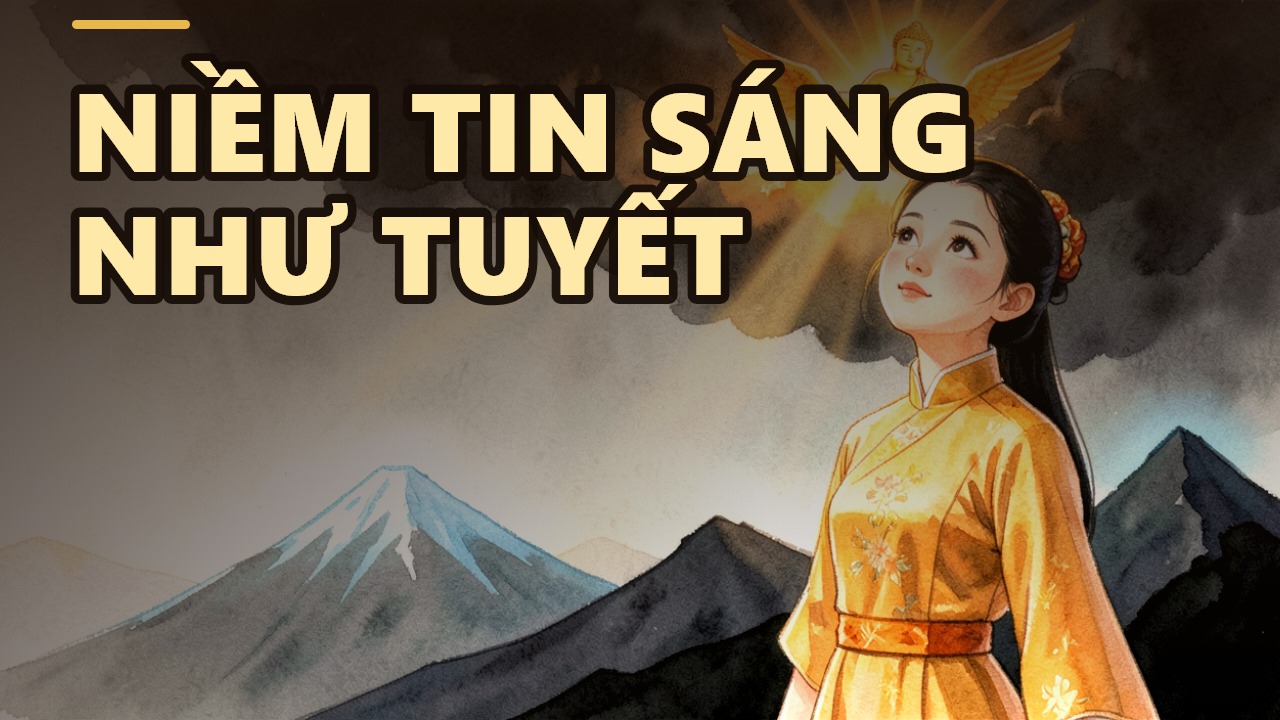
There is a story in the Dhammapada that I wish each of us could hear at least once in our lives. It is the story of a young bride, a faith, and a snow mountain reflecting light in the dark of night. It is the dharma talk that Venerable Thich Chan Quang opened with the title "The Plot to Harm the Buddha – Dhammapada (70)". Let us step into that story together.
The good person, like a snow mountain in the dark of night
Long ago, in the city of Savatthi, there lived a lay devotee named Anathapindika, who had attained the fruit of stream-entry. His daughter married a man who belonged to the naked ascetic sect of the Niganthas. She went to her husband's home, fulfilled her duties, yet kept her faith unshaken. When her in-laws invited the naked ascetics to their home for making offerings, she could not bear the sight and sought to avoid it. Scolded by her husband's family, she skillfully explained that those who followed her path bore a dignified, graceful bearing and measured speech. She invited the Buddha to come receive a meal, and said serenely: "I trust that with the Buddha's miraculous powers, he will hear my words."
Indeed, the next day the Buddha flew through the sky and descended before the door of that house. When asked, the Buddha did not praise himself, but praised the girl for her kind and wholesome heart. He spoke this verse:
"The good person, though far away, shines bright as a snow mountain. The wicked person, though near, is like an arrow shot in the dark of night, seen by no one."
Venerable Thich Chan Quang explained that a snow mountain reflects light so that it sparkles even in the night. The kind heart of a person, even from afar, radiates into the minds of everyone. But the wicked person, though near, is like an arrow shot in the dark of night, seen by no one.
The temptation of arguments that "sound so reasonable"
But hidden behind this story, the Venerable led us deeper: the danger of false doctrines that wear the name of "liberation." He gave the example of the naked ascetic sect of ancient times. They held that to be truly free, one must let go of everything, including clothing. The argument sounds quite reasonable: no dependence on houses, no dependence on family, no dependence on clothing... Just discard things bit by bit, peeling away layer after layer, to attain the utmost freedom of mind.
Yet the Venerable offered this warning:
"In this world, we fear no one more than those who speak cleverly. When they speak skillfully, they can change an entire era, change an entire culture, and lead whole multitudes of people to follow them."
He told of a practitioner in the western regions who went to the river to bathe and lost his clothes. He climbed ashore, stood like a moving statue, and walked home wearing not a stitch to cover his body. His face was calm and at ease. People looked at him and called him a "saint." But was that true freedom? Or was it merely extremism in disguise?
The naked ascetic sect believed that human shame is an animal instinct, and that practicing until one no longer feels shame is the highest attainment. The Venerable turned the question around: what if, through practicing this way, they simply forgot they were human? He called it "practicing until one becomes no better than a beast."
Every action is karma – a look at modern life
Not only stories of the past, the Venerable drew us back to the present. He spoke of droughts and heat waves reaching forty-two degrees. He said that a heedless way of living, in which we enjoy ourselves without thinking of others, is precisely creating karma:
"When I use something for myself, and I do not compare, do not pay attention to the needs of others, but simply care only that I can enjoy myself — then those things are a calamity; that is bad karma."
When we bathe, what do we think? There are people in desert regions without water to survive. When we eat, what do we think? There are people without rice. When we turn on the air conditioner, do we consider that we are pushing heat outside for others to endure? The Venerable reminded us not to insist on using air conditioning to "defeat" the heat, because air conditioning only moves heat from one place to another. Let us learn to "bear it patiently," for this is our collective karma. If we do so, next year the weather will be less hot.
Do not let any argument sweep us into extremism
Returning to the naked ascetic sect, the Venerable analyzed: any doctrine, taken to an extreme, becomes an error. He gave the example of compassion. Compassion means forgiveness, but if we forgive a robber who has just stabbed someone, without any punishment, society will fall into chaos. Compassion must go together with wisdom. And if, out of love for others, we give away all the family's money, our family will resent us and come to hate Buddhism as well.
The Venerable told of people who "cure illness" with brown rice and sesame salt. They believe brown rice and sesame salt are miracle drugs. But illnesses come in countless forms, and nutrition is endlessly varied. Eating only one thing forever is extremism; it is superstition. He emphasized:
"Any doctrine at all is the same — taken to an excessive extreme, it becomes wrong."
We must know how to stay sober and alert. A clever phrase, an empty argument, may sound very "lofty," very "free," but if it leads us to cast off every bond, including the things that preserve our humanity, then that is precisely the trap. The ancients had a saying: "Tonics taken in overdose become poison." Do not let yourself become a pawn on the chessboard of those who borrow the banner of truth in order to destroy.
Keeping a kind heart and clear awareness amid the currents of life
The story of Anathapindika's daughter ends with her guiding her whole family to take refuge in the Buddha. But there is a deeper meaning for each of us: let us keep a heart as bright as a snow mountain, unshaken by extreme arguments. Let us learn to weigh every action, every word, every drop of water we use. For a kind heart is shown not only in generosity, but also in understanding and protecting the true values of life.
When night falls, we need not shine like the sun. A little goodness, a sincere faith, is enough for us to keep the flavor of peace amid the world. And most important of all: deep in our hearts, let us not allow any ideology — however "sublime" it may sound — to turn us into the blind amid this world.
AI-assisted translation from the Vietnamese original.
Read in Vietnamese →