
A Small Deviation, a Great Detour: Guiding Faith in Buddhism
This article warns about the consequences of holding slightly incorrect beliefs from the start, which can lead to a lifetime of spiritual misdirection.
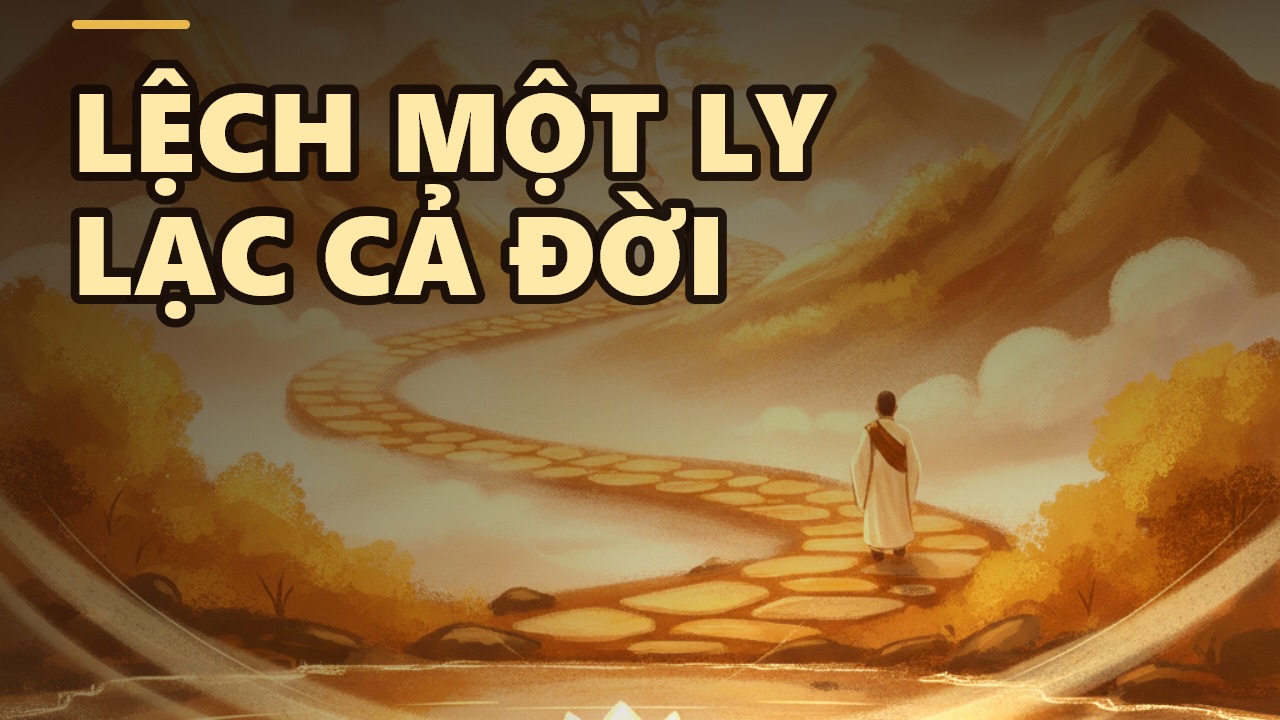
A Small Story, A Big Lesson
Have you ever considered how a tiny initial error can lead to unforeseen consequences? Like a ship that deviates by just one-tenth of a degree at departure, after thousands of nautical miles, it arrives at a completely unfamiliar place. In spiritual life, this effect is even more profound. Venerable Thich Chan Quang once emphasized: “If we have a small wrong starting point from the beginning, we may not see it as important. But we might lose our entire life near its end.”
So, how do we set the right direction from the very start?
Faith: A Double-Edged Sword
Every religion relies on faith. However, faith belongs to the realm of emotion and is easily exploited. Many people hastily believe in unverified claims, such as “the Buddha’s mother gave birth to Shakyamuni Buddha” or “holy well water cures all diseases.” They do not ask questions or engage in critical thinking, simply because many others believe them. The Venerable warned: “The most frightening thing is when errors are accepted as truth by the majority.”
Do not let the crowd sweep you away; use reason to examine everything.
The Equation Two Plus Two Equals Four: Objective Truth or Divine Command?
A Catholic believer once asked: “The universe operates under strict laws; must there be a Creator?” The Venerable responded with a counter-question: “Is two plus two equals four forced by God, or is it an objective truth?” If two plus two equals four is objective, then all universal laws are likewise objective. While awaiting answers, continue to love one another, help reduce suffering, and build peace. That is the core essence.
Science Also Has Extreme Beliefs
Not only religions but also science can fall into the trap of blind belief. After continuous successes, people often assume they have grasped the ultimate truth. Yet, as Newton said: “What we know is but a drop; what we do not know is the ocean.” Scientists once resisted religion because they demanded verification. But if they become extreme, believing that “only science holds truth,” they suffer from the same blindness as dogmatic religion.
The Courage of a Buddhist: Alertness and Critical Inquiry
The Buddha taught: “Do not believe anything merely because someone says it, even if it comes from me. Test it, practice it, and realize it for yourself.” Therefore, when someone introduces a dharma method, look at the results in their life: Do they possess peace, morality, and holiness? Do not rush to believe just because they speak eloquently or have many followers. The Venerable stressed: “Buddhists must have courage: listen to what anyone says, compare it with real life, and never accept it immediately.”
Ask questions and engage in critical inquiry. This is not disrespect; it is alertness.
Lost in the Deep Forest: Every Choice is a Gamble
Life is like a deep forest with many paths before us. Each person points out a different way. If we choose wrongly, we may hit a dead end or face danger. We have only one life, not enough time to try every path. Thus, use wisdom to choose correctly from the start. Do not let “a small deviation lead to a great detour,” costing your whole life to correct.
Always remain alert, practice mindfulness, and experience things for yourself. This is the only way for your faith to become a guiding light, rather than a blindfold covering your eyes.
AI-assisted translation from the Vietnamese original.
Read in Vietnamese →