
Merit and Wisdom: Why Do Many Plan Yet Few Succeed?
**Summary:** Explore the connection between merit and wisdom in success. Do not let future goals entice you; instead, look into past karma and cultivate present wisdom.
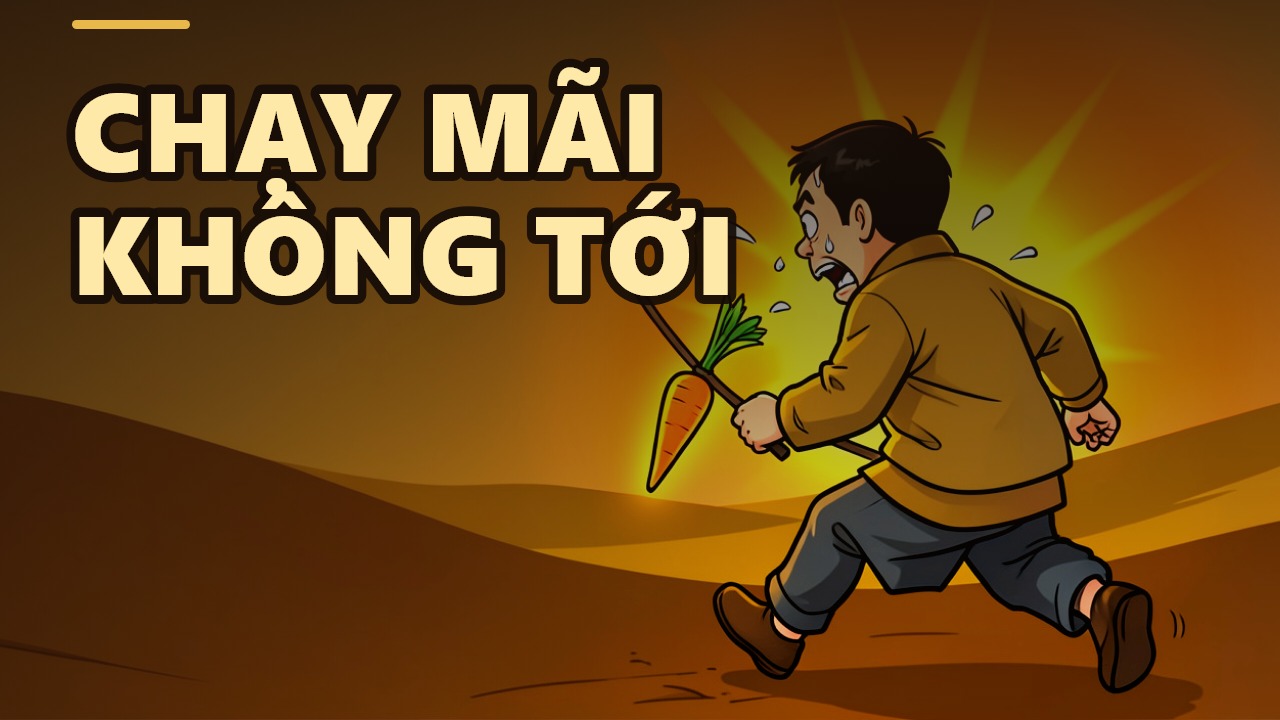
Imagine you are running forward with a carrot dangling before your nose. Each step you take pulls the carrot a little further away. You keep running and running like this forever... This is the life of many people who chase after future goals. But there is a truth few realize: success depends not only on what you do in the present, but also on what you have sown in the past. In the New Year's Dharma talk "Merit and Wisdom," Venerable Thích Chân Quang offered a profound perspective on these two factors.
**The Goal Ahead: What Gives You Life, But Can Also Deceive**
Each of us has goals. The young wish to marry a loved one, then buy a house, a car, have children, and raise them to be successful. For those who have left the world, the goal is to uphold the precepts, achieve meditative concentration, and attain the wisdom of non-self. It is these goals that carry us through life. Venerable Chân Quang shared:
"The reason we still live is because we still plan to do something tomorrow. If tomorrow we have nothing to plan for, next month nothing to plan for, next year nothing to plan for, then there is no reason to live."
But once we achieve one goal, another immediately appears. Thus, we run forever without ever stopping. He compared us to a donkey tied to a carrot, stepping forward endlessly yet never able to eat. Is life perhaps just a series of illusions?
**Success Is Not Only Wisdom: What Is Behind Your Back?**
In life, some are brilliant scholars and excellent planners, yet they fail when they enter the world. Others perform poorly in school, yet become very wealthy. If we only look at present wisdom, this cannot be explained. A Buddhist understands that success also depends on the blessings from merit accumulated in past lives. The Venerable teaches:
"To step forward, one must know what is behind. To seek success ahead, but have deep faith in the law of cause and effect behind."
Thus, wisdom is the condition of the present, while merit is the cause from the past. Success requires both. If one is lacking, the result will not meet expectations.
**More Wisdom than Merit: Many Plans, Little Success**
Venerable Chân Quang observed: people with more wisdom than merit often dream a great deal, plan extensively, and arrange many things, yet achieve very little. Despite their knowledge, plans, and efforts, because their past karma lacks sufficient blessings from merit, they stumble repeatedly. This is the reality for many. He said:
"The person with more wisdom than merit is the one who plans a lot but achieves very little."
Therefore, do not just focus on cultivating knowledge and skills while neglecting to make merit. Every careful, thorough, and dedicated action is itself planting blessings.
**More Merit than Wisdom: A Flash of Success That Easily Crumbles**
Conversely, people with more merit than wisdom may achieve success without much planning. They are born into wealthy families, opening their eyes as princes. But success that comes quickly is also easily lost. When holding money and power in their hands but lacking wisdom, they use it wrongly, waste it, and their merit depletes very quickly. The Venerable warns:
"Success arrives very quickly, but it cannot be held onto."
So, even with merit, we must constantly learn and cultivate wisdom to manage and preserve our achievements.
**Balancing Merit and Wisdom: A Lesson from the Temple Festival**
The Venerable gave an example of Phat Quang Pagoda organizing a large festival that attracted tens of thousands of Buddhists. Some think it is because the Venerable has great merit and conditions. But he affirmed it was thanks to the carefulness, thoroughness, planning, and arrangement of the entire community—that is wisdom in the present. However, without the good conditions from the past, no matter how well organized it was, it would be hard to attract so many people. Therefore, both merit and wisdom are important.
It is like a director successful in one company who may fail when moving to another (in a different field). Thus, one must never be complacent. One must always humbly learn.
**Strategy and Scheming: The Boundary of Wisdom**
The Venerable distinguished two types of wisdom: strategy and scheming. Both are wisdom, but their purposes differ. If wisdom is used to protect one's comrades and countrymen from enemies, it is strategy. If wisdom is used to harm one's comrades and countrymen, it is scheming. The boundary is very fine; lacking morality can cause one to fall into scheming. He emphasized:
"Scheming means we use our wisdom but mistakenly strike our own ranks. Yet that same wisdom, used to fight the enemy to protect our comrades and countrymen, is called strategy."
Therefore, those with wisdom must always have ideals and morals in life, so as not to become evil.
**Merit Can Give Rise to Wisdom, Wisdom Can Give Rise to Merit**
Finally, the relationship between merit and wisdom is interactive. When we have merit, suddenly we get an idea. That is wisdom. And when we use wisdom to work thoroughly and wholeheartedly, we are creating merit. As the Venerable told of an engineer who, worried, couldn't sleep and returned to inspect the worksite, discovering a problem. This was because his merit had given him such sensitivity. He said:
"Merit has the function to create wisdom, and wisdom has the function to create merit."
Therefore, we should collect every bit of merit in each action, word, and thought. And at the same time, continuously cultivate wisdom, being careful and learning. When the two blend together, success will come in a way that is lasting and peaceful.
**The Greatest Lesson:** Do not let the goals ahead lead you to forget the origins behind. Live with a mind of compassion, make merit every day, and keep your wisdom clear. That is the foundation for a fulfilled life.
AI-assisted translation from the Vietnamese original.
Read in Vietnamese →