
Developing the Dharma in Depth: Do Not Stop at Numbers
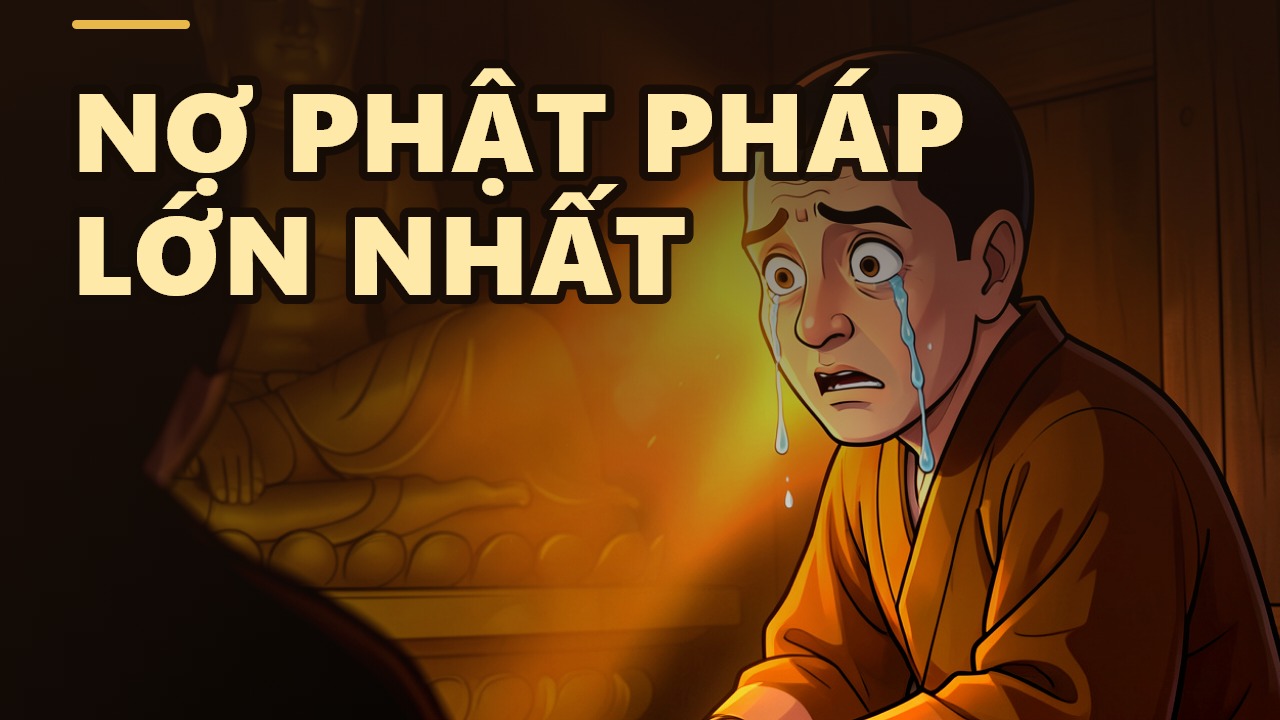
The dharma talk by Most Venerable Thích Chân Quang opens a path of practice that does not stop merely at the number of Buddhists. Instead, it calls for going deeper into understanding cause and effect (karmic law), keeping precepts, and taking refuge completely. Did you know that for every person around us who has not yet encountered the Buddha's teachings (Dharma), we carry an invisible debt? This is the profound message shared by Most Venerable Thích Chân Quang during his dharma talk at Ba Da Pagoda. Let us reflect together on the journey of developing the Dharma in depth, where each Buddhist is not just a statistic, but a soul undergoing transformation.
### Breadth Alone Is Not Enough
When speaking of developing the Buddha's teachings (Dharma), we often think of attracting more Buddhists or building more temples. However, Master Thích Chân Quang reminds us that expanding the Dharma horizontally means gaining many followers. Yet, if there are still people who do not know the Dharma, whose responsibility is it? He states that this responsibility lies first with the monks and nuns, and second with the lay Buddhists. If we still see someone who does not know the Dharma, we ourselves bear some fault. We must accept this responsibility without blaming others.
This is truly worth contemplating. When we see a neighbor living in ignorance, unaware of the Buddha’s teachings, we might choose to quietly turn away. But for a sincere Buddhist, this is a sacred duty. As the master said, if one goes to the temple alone without inviting anyone, one may face karmic consequences such as blindness, deafness, or muteness in future lives. This is because we have a mouth but do not speak, and eyes but do not see those who need light.
### Taking Refuge Is a Solid Beginning
In his teaching, the master emphasized that following the Buddha is not just about casually visiting the temple. A true Buddhist must take refuge in the Three Jewels—kneeling before the Buddha and vowing to be a disciple for life. The ceremony of taking refuge is not merely a ritual; it is a deep promise made to oneself and to all Buddhas. Once you kneel before the Buddha, you commit to following Him through countless lifetimes. You never change your path again. Your heart becomes like gold, silver, or diamond, loyal and unwavering.
This is not blind faith, but a choice born of wisdom. When we understand that the Buddha is the supreme teacher, doubt disappears. Taking refuge allows us to step through the gate of the right Dharma, marking the first step on a long journey spanning eons.
### Five Precepts and Seven Vows: A Delicate Balance
Many people fear they cannot keep the five precepts perfectly, so they hesitate to take refuge. Master Thích Chân Quang reassures them that the Buddha is not overly strict. If we fall short in one area, we can compensate in another. Lay Buddhists keep the five precepts against killing, stealing, sexual misconduct, lying, and intoxication. However, if we struggle, we can rely on seven vows—vowing to do good deeds, eat vegetarian food, spread the Dharma, and so forth. These acts generate merit that can offset our shortcomings. Thus, the Buddha's teachings (Dharma) are not a burden, but a flexible path encouraging progress within our capabilities. Before taking refuge, do not let detailed rules discourage you. Start now, and grow through compensation and learning.
### Cause and Effect: Fundamental Yet Complex
The foundational teaching every Buddhist must understand is the law of cause and effect (karmic law). The master recounted that the Buddha often told stories about karma to new acquaintances, and he himself has written many books on the subject. However, cause and effect (karmic law) is not as simple as planting seeds and harvesting crops. Consider this example: when you give money, you do not always know where it will go or whether it creates blessings from merit or negative karma. For instance, if you give money to someone who uses it to buy weapons for fighting, you share in the blame.
Has anyone paused to reflect on this? Giving alms does not automatically create blessings from merit. If the recipient uses your gift for harmful purposes, you contribute to shared karma. Therefore, understanding cause and effect (karmic law) requires mindfulness and careful consideration. The master also taught that a fleeting thought of arrogance, such as feeling superior to others, can wipe out accumulated merit. Karma is extremely precise. Because of this, those who deeply understand cause and effect (karmic law) live carefully in every word, action, and thought.
### Living Carefully in Every Word and Thought
Once we grasp the depth of cause and effect (karmic law), we cannot carelessly criticize others. As the saying goes, "Before criticizing someone, swallow your tongue seven times." One wrong word can lead to suffering (dukkha) across many lifetimes. Instead, practice praising truthfully, for honest praise also generates merit. The master advised: "Be extremely careful." Living cautiously is not done out of fear of retribution, but to keep the mind/heart pure, avoiding new stains in the realm of karma.
### Conclusion: Starting from the Mind/Heart
Developing the Buddha's teachings (Dharma) in depth is not something distant. It begins when we pause and ask ourselves: "Does the person next to me know the Dharma? Have I taken refuge with a sincere vow? Am I living mindfully regarding cause and effect (karmic law)?" Each day, let us be a small flower contributing beauty to the garden of Buddhism. Share the joy of practice with others, and let the compassion of each Buddhist become a bright mirror for the world. As the master said: "When the mind/heart is peaceful, the world is peaceful."
AI-assisted translation from the Vietnamese original.
Read in Vietnamese →