
The Hidden Fear: Why We Need Both Love and Fear
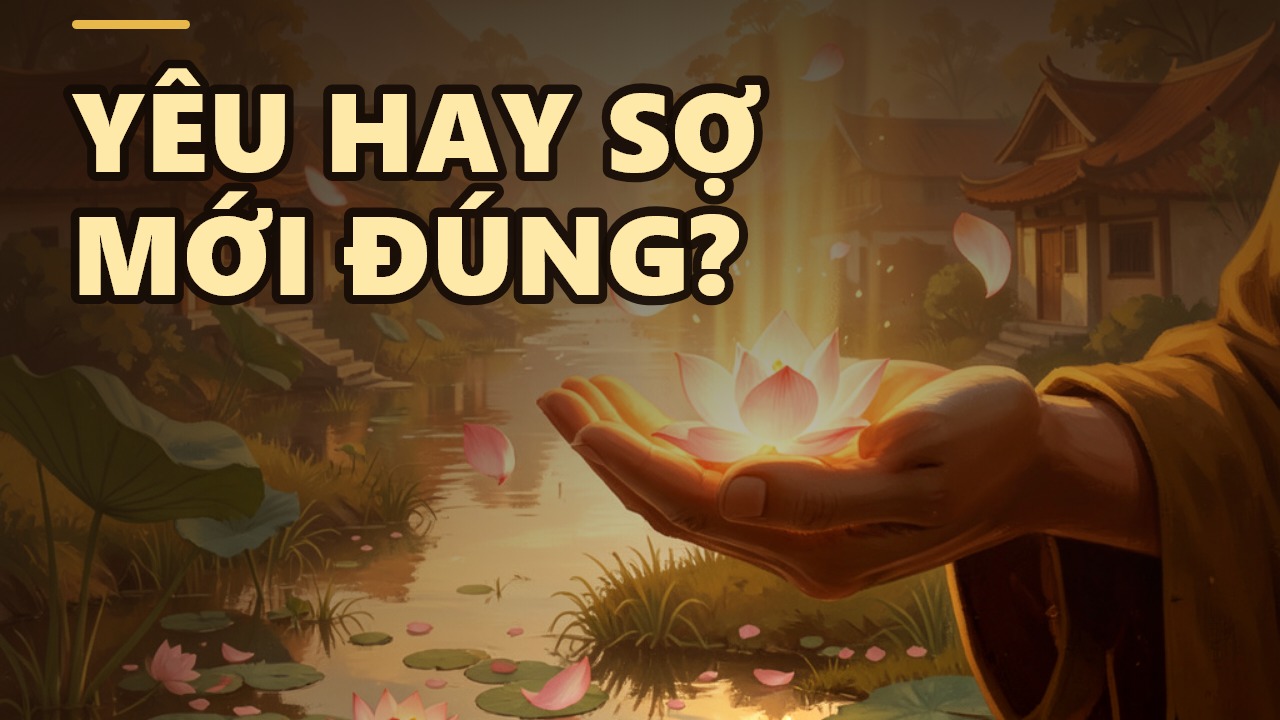
Have you ever wondered what makes you choose one dish over another when sitting before a meal? Or why a mother might confront a cobra to protect her child? All these actions are governed by emotions, among which fear is particularly powerful. Today, let us listen to the teachings of Venerable Thich Chan Quang to better understand the psychology of fear and its role in our lives.
## Craving Leads to Clinging: Every Action Begins with Emotion
In the chain of twelve links of dependent origination, the Buddha pointed out a crucial link: craving leads to clinging. Here, "craving" refers to emotion, while "clinging" refers to action. It is emotion that gives rise to action, and action creates karma. Venerable Chan Quang explains this clearly. He reminds us that within the twelve links of dependent origination, which form the cycle of samsara, there is a specific connection where feeling leads to grasping. Because we have an emotional attachment, we perform an action, and that action generates karma.
This may sound strange at first, but look closely at your own life. When eating, you do not randomly pick up food; you choose it because you find it appealing. You run away because you are afraid. You start a conversation with a stranger because you feel interested. You care for a dog because you love it. From studying and boasting to even committing crimes, every action is subtly driven by an underlying emotion.
## Fear as an Invisible Motivation
Fear is not always negative. It can be a powerful motivation that drives us to act in order to protect what we cherish. Consider a soldier going into battle. Everyone fears death, yet their love for their country and their people makes them fear losing their nation even more. Venerable Chan Quang notes that soldiers are influenced by a complex mix of emotions. While they genuinely fear death, that fear is outweighed by the fear of losing their homeland. And why do they fear losing their country? Because they love it deeply.
It is precisely because they love their fellow citizens that they fear their suffering. It is because they love their country that they fear its loss. These two emotions walk hand in hand. Conversely, if there is love without any element of fear or caution, that love may be superficial or lacking in responsibility.
## Education Requires Both Love and Fear
In raising children, fear is also essential. Venerable Chan Quang observes that modern Western education often eliminates punishment, relying solely on encouragement. However, this approach can disrupt a child's psychological balance. He states that the psychology of fear is very necessary. When we discipline a child, it is not out of hatred. Rather, we impose consequences to cultivate a healthy sense of fear regarding wrong actions.
Children need both affection and boundaries. When they behave correctly, we praise and encourage them. When they make mistakes, we apply discipline so they learn to respect rules and avoid repeating errors. Therefore, parents should ensure their children feel the family’s love, helping them value goodness. They must also set clear disciplines and consequences so children learn to fear wrongdoing. Praise good behavior to nurture confidence and a love for learning. Finally, teach children to dislike bad actions, not to hate people, thereby establishing a strong moral compass. When fear is placed appropriately, it helps children mature, become respectful, diligent, and grow into good human beings.
## From Emotion to Wisdom: The Path of the Noble Ones
Of course, as we mature and practice the Dharma, we should not allow emotions to blindly control us. Yet, this does not mean we suppress feelings or become indifferent. The teacher emphasizes that noble beings still give to beggars, but not out of weak sentimentality or a desire for karmic reward. They act because it is right, fulfilling their responsibility toward the conditions (dependent origination) present before them. The compassion of a noble being is vast, clear, and free from attachment. This level of understanding may not be immediately accessible to us, but it is the path we strive toward.
## Use Fear Wisely
Returning to daily life, reflect on yourself. What do you love? What do you fear? Does your fear guide you to do the right thing? Transform fear into motivation to live virtuously and protect what is precious. Do not extinguish fear, nor let it overwhelm love. Allow both to guide you on the spiritual path, moving steadily toward wisdom.
Respectfully bowing to Venerable Chan Quang, I confess my shortcomings and vow to practice according to his teachings.
AI-assisted translation from the Vietnamese original.
Read in Vietnamese →