
The Karmic Law of Truthfulness: A Small Lie with Not-So-Small Consequences
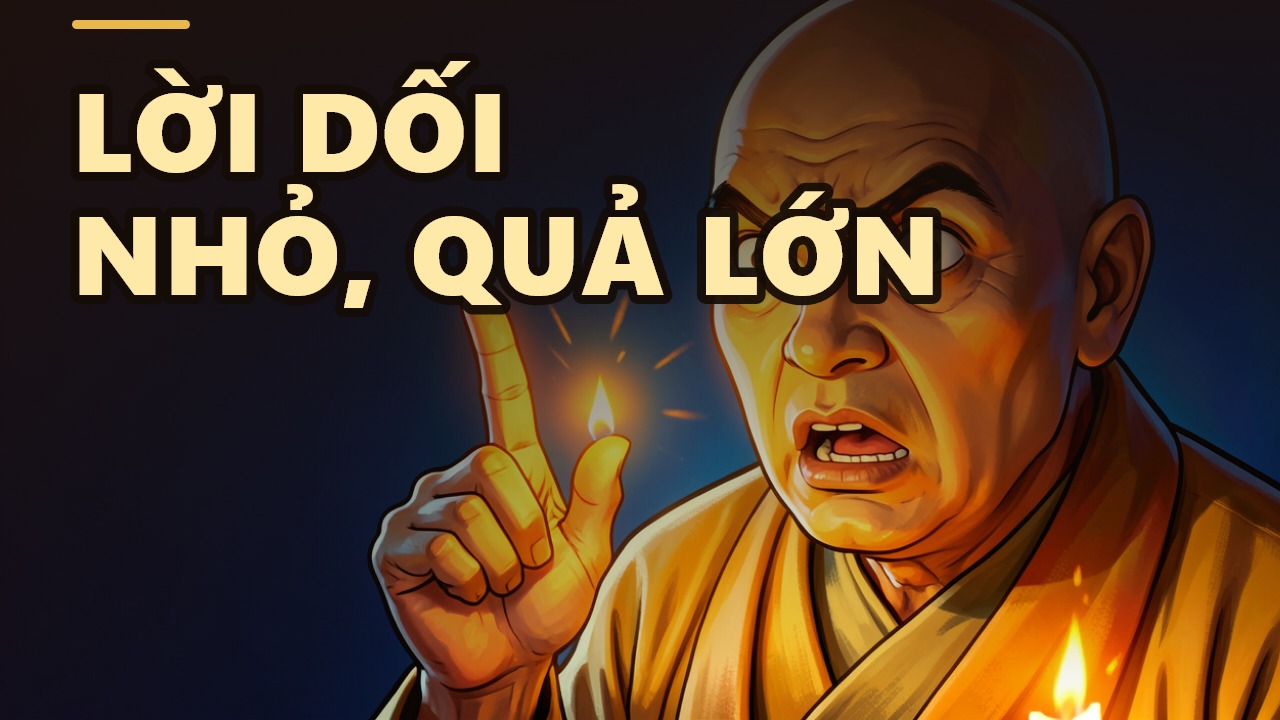
During the first full moon of the lunar year, our ancestors often say that visiting a temple brings the most blessings. Yet, even if it is most auspicious, we may not truly know. What we do know is a simple question everyone has faced: “To tell the truth or to lie?” From childhood, we are taught to be honest. Yet as we grow, who among us can claim to have never lied? Venerable Thich Chan Quang offers a profoundly deep perspective on the karmic law of truthfulness—a topic that seems familiar yet holds much to contemplate.
**Why Do We Lie?**
Every path teaches us not to lie. But can anyone live completely without deceit? Venerable Chan Quang straightforwardly identifies the root cause: “We lie primarily to avoid blame when we do wrong. We enjoy doing wrong, but we do not wish to be criticized. That is the reason for every lie in this world.” To conceal our faults, we bend the rules and evade responsibility. A child steals money and lies to avoid their mother’s scolding; a student skips school and invents an excuse about a parent’s accident; a soldier abandons their post claiming a stomach ache… These small lies make it impossible for families, schools, and organizations to guide and educate us. Consequently, social discipline becomes lax, and people live without mutual trust.
**The Most Serious Lie: Falsely Claiming Enlightenment**
In Buddhism, there is an extremely serious type of lie that can lead one to the hells: falsely claiming to have attained enlightenment. Venerable Chan Quang warns: “Anyone who violates this precept will fall into the hells. In this very life, one might even reap the karmic retribution of insanity, as they will be despised by all.” This is not only an intentional act but also a dangerous trap for practitioners. Many who achieve some meditative results or begin to develop psychic abilities mistakenly believe they are enlightened. They may say, with false modesty, “I am no longer an ordinary person.” In truth, this is merely the initial stage of mindfulness, nothing more. Without meeting a wise teacher to point this out, they risk losing their merit and suffering for ten or twenty lifetimes.
Venerable Chan Quang shares: “I am speaking ahead for thirty lifetimes. Do not be impatient; do not think you can complete the path of mindfulness in one lifetime. Do not even mention meditative concentration; it is far deeper.” Therefore, do not hastily declare you have attained the path. Do not elevate yourself. Be calm and practice correctly according to the journey of the Buddhas.
**Lying for Gain: False Testimony and Profit**
Another type of lie is intentional deception, such as giving false testimony for personal gain. In ancient times, when forensic science was undeveloped, many made a business of false witness to harm others. Venerable Chan Quang recounts: “That profession killed countless people; they would testify falsely to have someone hanged or thrown into prison.” Today, although forensic methods have advanced, the mentality of deceit remains. Some falsify claims to win advantages. The Venerable emphasizes: “When one intentionally knows they are lying and does so to gain more, the karmic retribution begins. This sin is very close to leading one to be reborn as an animal or in hell upon death.”
**When Should We Not Tell the Absolute Truth?**
The Buddha does not demand we speak the absolute truth in every situation. There are times when we must remain silent or speak evasively to save lives or protect beings. For example, if a hunter asks a monk about a deer, telling the truth would make the monk complicit in killing. The monk might answer: “Something ran by here earlier, but I was so startled I didn’t see which way it went.” Or, when enemies ask where guerrillas are hiding, one must remain silent. Venerable Chan Quang teaches: “Not lying does not mean we must blurt out every truth. Why? Because there are situations like this: first, to save people and living beings.”
Furthermore, there are national secrets and the private confidences of others. Knowing a secret that could bring harm to the country or destroy another’s happiness means it should not be disclosed. Venerable Chan Quang tells of a woman who had past romantic relationships, but when her husband asked, a neighbor who knew the story skillfully said: “She is gentle and respectable.” This helped preserve the family’s happiness, and the other person later felt remorse for their past poor treatment. The Venerable teaches: “Only those with virtue and wisdom can keep secrets for others.”
**How Can We Stop Lying?**
The only way to stop lying is to stop doing wrong. Venerable Chan Quang says: “There is only one way not to lie: do not err.” When our mind and heart are pure, we need no cover, no deceit. And when we stand before an assembly, whether of kings or celestial beings, a truthful person feels no fear. The Venerable affirms: “A person who can truly say they do not lie has, in their life, already reached a position close to that of a saint.”
Let us live truthfully, starting from the smallest words. Let us stay far from the temptations of deceit. Let us uphold our precepts and live purely, so our mind and heart are at peace, so we are worthy children of the Buddha. This is how we gradually walk the path to liberation, bringing peace and happiness to ourselves and to all.
AI-assisted translation from the Vietnamese original.
Read in Vietnamese →