
A Fool Who Knows He Is a Fool: The Key of the Wise
Knowing one's own foolishness is the first step toward wisdom. A fool who believes himself clever only grows more foolish. Through the story of two thieves, Venerable Thích Chân Quang teaches us a lesson about ethics and spiritual practice.
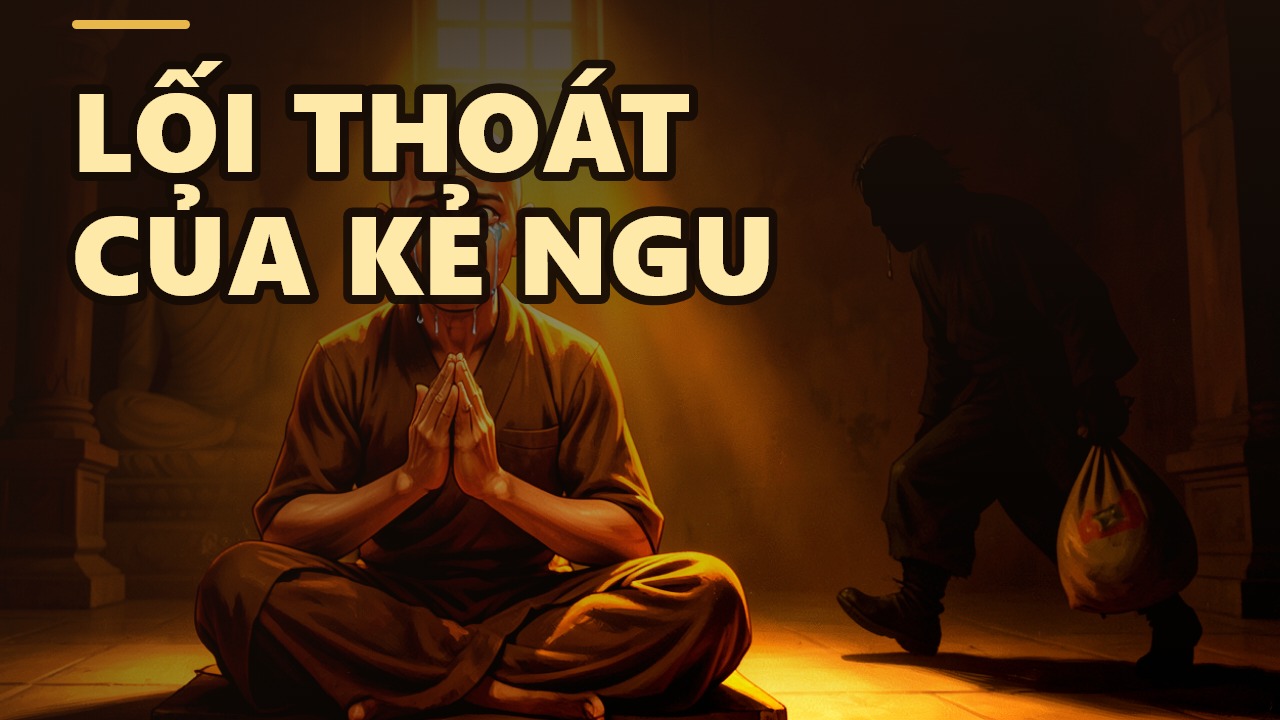
Long ago, two thieves slipped into an assembly to listen to the Buddha preach the Dharma. One of them listened so attentively that he forgot his original purpose. Suddenly he awakened and saw that his life was full of deceit, greed, and restlessness. The other thief quietly picked many pockets, then went home and gleefully boasted to his wife, even mocking his friend as a fool for having the opportunity and not taking it. His friend only shook his head, knowing that speaking would be useless, for the other man simply could not understand.
The Buddha taught: "A fool who knows he is a fool thereby becomes a wise person. A fool who believes himself wise is all the more foolish." That is the lesson hidden behind this story, and it is the subject of today's dharma talk by Venerable Thích Chân Quang.
Foolishness and wisdom from an ethical perspective
Venerable Chân Quang began: "Foolishness and wisdom here refer to what the Buddha means by ethics. A person with ethics is a wise person; a person without ethics is a fool." A wise person is not someone with vast learning, but someone who recognizes their own faults. It is this self-awareness, this examining of oneself, that creates ethics. Conversely, a person who cannot see their own faults lives in ever deeper error.
The foolish criticize the good
In life, we often encounter people criticizing one another. But there are two kinds of criticism: the capable criticize the incapable because they see clearly, and the incapable criticize the capable because they do not understand. Venerable Chân Quang gave an example: "When a person skilled in mathematics criticizes a student who solves problems poorly, that is correct. But when a student poor at mathematics criticizes the teacher for solving a problem wrongly, that is absurd." Likewise, in the Dharma, a person who understands the Noble Eightfold Path deeply will recognize when another can only speak of it superficially. The other person, however, seeing someone more capable than himself, believes that he alone is right. This is the sickness of all sentient beings.
"When a person of lesser ability criticizes someone more capable than himself, then later, as the Buddha said, he will become all the more foolish."
Standing firm against criticism and isolation
Once we have left behind our bad habits, we can easily be criticized and isolated by old friends. The Venerable told the story of a man who gave up gambling and heavy drinking to live soberly, and was mocked by his friends as a "woman." But that man understood that only a peaceful mind is true happiness, while worldly pleasures merely burn up the soul.
The Venerable advised: "We must stand firm against criticism, against public opinion, against gossip, and even against being isolated by others. Do not collapse out of fear of isolation and step onto the wrong path."
"Each of us must be a warrior protecting the light, protecting goodness for this world."
When growing wealthy, do not forget the true meaning
There is the story of two friends who both became rich. One realized that life is short, that old age had arrived, and that death might be near. He stopped, devoted time to spiritual practice and doing good, and ran his business to create jobs for others. The other remained greedy, chasing after fame, unable to understand his friend, and even mocked him, asking why he did not strive to become a tycoon.
"In the past, one became rich out of selfishness. Today, I become rich for the sake of goodness in society. These are two different ways of living, and the soul immediately rises above."
Knowing one's own foolishness is the first step of practice
The Venerable emphasized: those who come to study and practice do not need to be brilliant, eloquent, or polished in appearance. What matters most is "being a fool who knows he is a fool, being wrong and knowing one is wrong." When we look back at the past and see that we were once foolish, once mistaken, that is a good sign. On the contrary, the person who believes himself good enough and sees no need to practice is the one steeped in lasting foolishness, for greed, hatred and delusion still remain intact within the mind.
"To be wrong and to know one is wrong. That is, entering the Buddha's teachings, we need precisely such people first."
At the end of the talk, the Venerable taught us not to fear loss, not to fear being poorer than others, because we are holding a value that others cannot understand. Have the courage to stand firm, protect what is good, and never forget: knowing our own foolishness is the very path that opens onto wisdom.
AI-assisted translation from the Vietnamese original.
Read in Vietnamese →