
Hearing the Dharma Without Practicing – Like a Flower with Color but No Fragrance
Understanding the teachings without practicing them, merely repeating them to others, is no different from a beautiful flower without fragrance. Bow to the Buddha, make a vow, and begin with small deeds to gain merit.
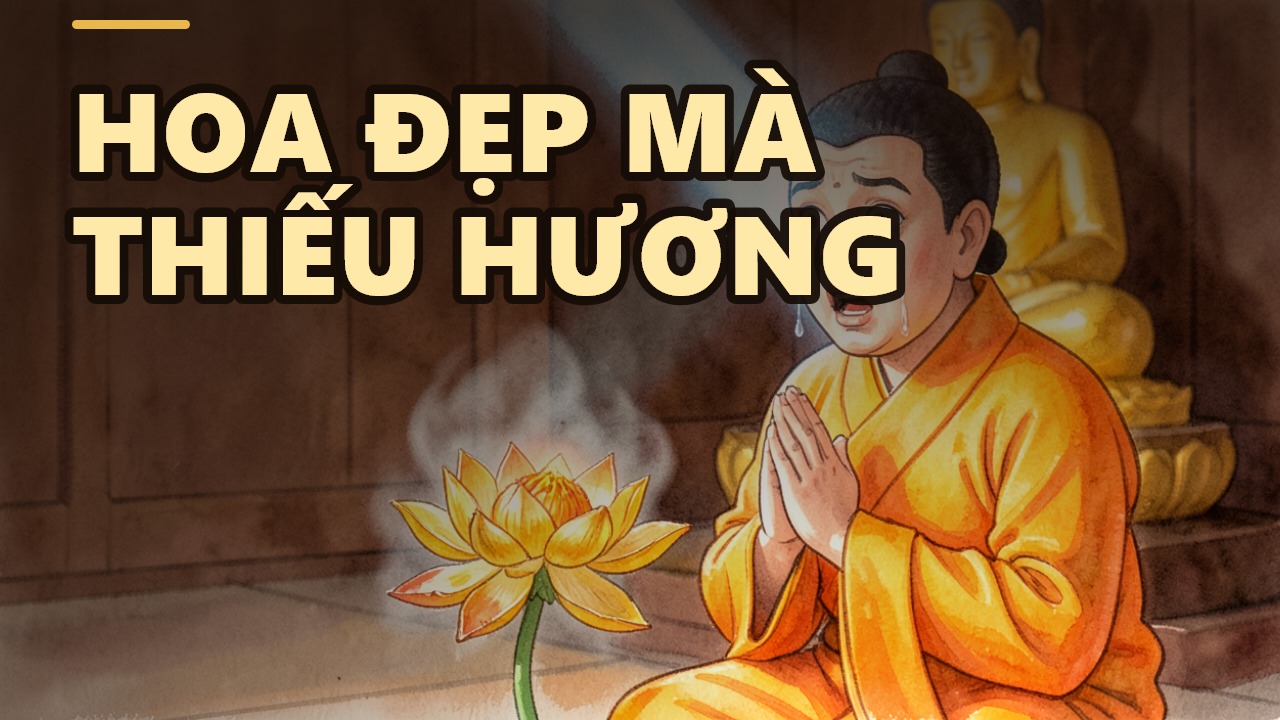
Have you ever wondered why you have heard the Dharma so many times, understood so much, and retold it beautifully to others, yet your life still has not changed? Perhaps the answer lies in the Dhammapada verse that Thay Thich Chan Quang explained through the image of a flower that has color but no fragrance. Today, let us explore the deep meaning of this verse, so that we do not become a flower that is only beautiful on the outside while lacking fragrance.
A Flower with Color but No Fragrance – The Buddha's Teaching
The Buddha spoke this verse on a special occasion. When King Pasenadi invited the Buddha to the palace to teach his royal consorts, there were two among them: Queen Malika studied the Dharma diligently and applied it to her life, while the consort Vasapa only studied superficially to please the king, without practicing. For this reason, the Buddha taught:
"Like a beautiful flower that has color but no fragrance, so too are well-spoken words that are not put into practice. Like a beautiful flower that has both color and fragrance, so too are well-spoken words that are practiced and bring peace and joy."
Thay Thich Chan Quang explained: "Those who followed Queen Malika studied properly, attentively, and reported back on how they applied the teachings. Those who followed the other consort did the opposite. They spoke the teachings to please the king, but because they did not practice, it brought no benefit at all." This is precisely the illness of many Buddhists today.
A Common Illness: Hearing the Dharma, Speaking the Dharma, but Not Practicing
Thay Chan Quang pointed out: "When we hear a beautiful teaching, we understand it, we enjoy it, we feel excited, and we immediately go and repeat it to others. And the way we speak makes it sound as if we were the ones who created that teaching." He called this "borrowing the Buddha's copyright without paying the author's fee." Then he warned:
"If we speak without having practiced, we will never be able to practice at all."
That is the most terrible consequence. He gave an example: we hear the Buddha teach us to remain unmoved by praise and blame, and then we invite others to practice. But the moment we step out the door and a dog bites us, we immediately burn with anger for seven days. When our words contradict our actions, we can no longer practice at all.
Playing the Teacher of the World – The Trap of Pride
Not only do some people speak without acting, but many also "play the teacher of the world" – using a condescending tone to teach others. Thay reminded us: "When someone is making a mistake, going through hardship, and we take advantage of that moment to lord over them, that is playing the teacher of the world." The result is that the listener becomes angry, and later we feel ashamed of ourselves because we cannot live up to our own words.
So when we have not yet practiced much but need to advise someone, we should speak in the "WTO spirit" – with proper copyright. That means mentioning the Buddha rather than playing the author: "The Buddha taught in the sutras..." or "The Buddha's words say..." In this way, the listener receives it gently, and we avoid the fault of falsely claiming credit.
The Secret of Transformation: Bow to the Buddha, Make a Vow, Then Begin with Small Deeds
Thay taught a concrete process of practice. First, once we understand the teaching, we must bow to the Buddha and make a vow. For example, if we see that we are still selfish and indifferent to the suffering of others, then each day we bow to the Buddha and confide: "May the Buddha bless me to know how to love everyone and to share what I have." Though the vow is small, it plants wholesome inclinations in our mind/heart.
After that, begin doing small deeds. Thay told a story: "When the storm came and an acquaintance's house collapsed, even if I could not help with all fifteen million, I could help with three or five million. That is a step forward." Over time, as merit grows, we can take on more difficult tasks. But always remember to do so discreetly, without boasting. Thay shared the story of a Buddhist laywoman who emptied her savings and even borrowed money to pay for heart surgery for a child she had never met. Afterwards, she encountered much good fortune. The blessings from merit returned to her clearly.
Conclusion: From Learning to Practice, From a Flower with Color to a Flower with Fragrance
Perhaps every one of us can be a beautiful flower. But to have fragrance, we must transform the Buddha's teachings into concrete actions in this life. Do not stop at merely hearing and understanding, and do not merely carry the Dharma to others while never having practiced it yourself. Begin by bowing to the Buddha, making a vow, and then doing one small, decent deed each day. Little by little, the flower of your heart will radiate its sweet fragrance.
Homage to Our Original Teacher, Shakyamuni Buddha.
AI-assisted translation from the Vietnamese original.
Read in Vietnamese →