
The Way of Beauty: When Aesthetics Become a Life Philosophy
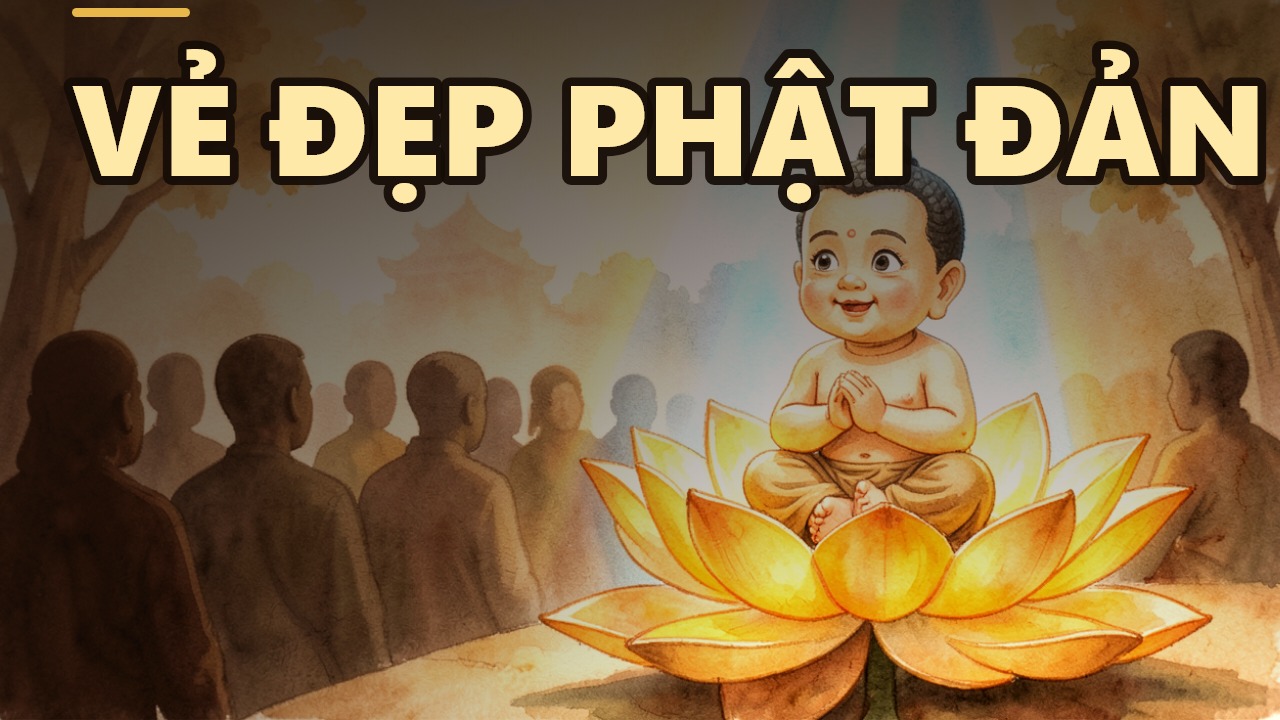
**Summary:** Explore the meaning of beauty in Buddhism through the story of the Buddha's birth, and lessons on beautifying our inner spirit and the world around us.
Have you ever wondered why, with every Vesak season, we solemnly commemorate an event that took place over two thousand five hundred years ago? It is not only to remember an extraordinary person, but also so that each time, our mind and heart may gain a little more of the spiritual spirit, making life more beautiful. Today, let us revisit the moment of the Buddha’s coming into the world through the lens of beauty—the Way of Beauty. It is a philosophy of beauty that one might not expect to find deeply rooted in the Buddha’s teachings.
**The First Beauty: The Dignity of Human Beings**
When Queen Maya was about to give birth, the king arranged an entire procession of ox-drawn carriages adorned with golden palanquins and radiant banners. This is the beauty created by humans: the beauty of sincere devotion, of reverence for a life about to begin. That image reminds us of the solemn processions at temple gates, or the moments of gathering during a Vesak ceremony. Beauty is not merely ornamentation; it is the way people express their soul through outward form.
This is the beauty of moral principles. It radiates in our demeanor, permeates our lives, and shines forth in how we interact, bringing happiness and joy to many around us.
**The Second Beauty: The Udumbara Flower in Full Bloom**
Amidst a long road, an unprecedented fragrance appeared. It turned out to be an Udumbara tree in bloom—a flower said to blossom only when a sage is born. From roots to tips, the blossoms were dense, releasing a rich, sweet scent. This is the beauty of nature, of heaven and earth seeming to celebrate a momentous event. This beauty is not of human making, but a sign of a miracle.
The tree trunk was so wide it would take several people to encircle it. The buds emerged from the base roots, pushing up along the trunk, gradually reaching the branches and leaves, stretching all the way to the tips, casting a broad shadow. The flowers, unaware of when they had fallen, remained fresh, thickly carpeting the entire ground.
**The Third Beauty: The Radiance of Heaven and Earth**
The moment the Buddha was born, the earth and sky blazed with light, a radiant aura shone brilliantly, celestial music played, and the heavenly beings flew with banners waving. The earth trembled in six ways, as if in celebration. This was a spiritual beauty, a mysterious wonder that left everyone stunned. It was a beauty transcending the mundane world, awakening the human spirit.
Everyone was stunned at that moment. It was too sudden. No one could have prepared for that instant, because no one expected the queen to give birth right then.
**The Fourth Beauty: The Thirty-Two Marks of the Buddha**
And finally, there is the beauty of that person himself: the Buddha, possessing the thirty-two major marks and eighty minor marks of excellence. From feet like those of a deer, to a neck with three folds, a slender waist, or webbed fingers like a sign of nobility. Master Chân Quang shares an interesting reflection on those webbed fingers: they are not a deformity, but a symbol of nobility. When such a hand is extended, it is one that will always hold gold.
This is the beauty of a human being, the beauty of karmic retribution, the beauty of merit.
**Truth, Goodness, and Beauty: The Three Elements of a Perfect Soul**
In moral philosophy, a beautiful soul requires three things: truth, goodness, and beauty. Truth is reality, is wisdom. Goodness is kindness, living for others. And beauty—this is what many people unconsciously neglect. The Master recounts that in his youth, he thought spiritual practice meant dressing in rags and looking slovenly to prove one had attained realization. Later, he came to understand that beauty is an expression of wisdom. A person with a noble soul will naturally create beauty around them.
A person who lacks awareness of beauty, of aesthetics, of what is good and excellent, is a person whose soul exists at a lower level. When a person’s soul is at a higher level, they naturally must understand beauty, be conscious of beauty, and create beauty for life.
**Living Beautifully: From the Soul to the Surroundings**
The Master offers four examples of neighborhoods: a poor, filthy area indicates little merit and a lowly soul; a poor but clean, orderly, and neat area proves its people have high souls and will produce virtuous and talented descendants; a wealthy but slovenly, trash-filled area where residents speak coarsely shows they have merit but lack wisdom; and a wealthy, beautiful, and polite area indicates a place with both merit and a worthy soul. He tells a story of a teacher famously known for her beauty, yet whose home was messy; she only adorned herself. True beauty originates from the soul, radiating into our gestures, our clothing, and the scenery around us.
A person who possesses wisdom and morality—who is, in short, a person of true stature—will create cleanliness and beauty for themselves and their surroundings.
The Way of Beauty is not a distant concept. It is how we face ourselves, those around us, and every small corner of life. Every time Vesak season returns, we recall His beauty and ask ourselves: Am I making life beautiful? Let us begin with the smallest things: maintaining cleanliness, balance, and dignity in daily activities. And most precious is the beauty of the soul—sincerity, compassion, and a wisdom that knows how to love. With just a little of this each day, our soul will become more beautiful, and life will become more beautiful too.
AI-assisted translation from the Vietnamese original.
Read in Vietnamese →